Judges Lesson 2 - Chapters 1:19-2 & 3
In last week’s lesson, we left off at Judges 1:19. Remember that in the first 2 chapters of Judges, we are simply reviewing the book of Joshua. Upon their arrival in the Promised Land (under the leadership of Joshua), the tribe of Judah was successful in capturing Gaza, Ashkelon, and Ekron, but they could not drive out the inhabitants of the valley because the enemy had chariots. Hummm, is it that they could not or they would not? I tend to think the latter.
1.Read Judges 1:20-36. What would you say is the theme of these verses?
If I had to sum up the majority of these verses, it would be “they could have had it, but they didn’t take it.” Caleb was the lone man out again. Do you ever wonder if you’ve settled for less than God’s best? I remember an elderly woman I worked with years ago. She had married a hateful man, ornery man who never tended to her needs in any way. By the time I worked with her, both she and her husband were up into their 80’s.
She once told me that when she was younger, she feared she would not find someone else to marry her and she just decided to go ahead and marry this fella. She settled. She was sweet and precious and had once been beautiful in her younger years, and she knew the Lord. Her husband, to my knowledge, never came to know Jesus as his personal Savior. Do I think God had someone better for her, someone who would have treasured her, who would have worshipped the Lord together with her? Yes I do. She settled and for the rest of her natural life, she suffered in quiet torment.
Friends, this is what happens when we settle for less than God’s best for us. You see, God had promised to deliver all the Canaanites into their hands and He had commanded them to destroy all the inhabitants and/or drive them out of the land. For the most part, this did not happen and now, thousands of years later, the Jewish people are still paying the price for settling for less than God’s best for them.
2.In Judges 1:34-36, what happened to the tribe of Dan and to their territory?
3.Did they take any of the territory the Lord had laid out for them?
The original plot of land for the Danites was along the central coast of Israel. There were powerful groups like the Philistines and the Amorites who threatened their existence. They gave up their original inheritance. They sent out spies to look for another plot of land and ended up in the northern part of Israel. They attacked the peaceful city of Laish in northern Israel and destroyed it. They eventually rebuilt it and renamed it “Dan”. That is why you will see the tribe of Dan listed in 2 different areas on many ancient maps. The area where they ended up settling was close to Lebanon. We will read more about this migration to the north when we get to Judges 18.
So, who was Dan anyway? He was the 5th son of Jacob, right behind Judah.
If you go back to lesson 1 and look at the map, you will find that the allotment of land given to Dan was quite small in comparison to some of the other allotments. But this piece of land was fertile and it was on the coast of the Mediterranean Sea. Any piece of land that borders on a water source has the potential for extra commerce. Joshua 19:40-48 gives the details of the original allotment of land to Dan.
If you recall, Dan’s father, Jacob (later renamed Israel), had 2 wives who were sisters, Rachel, and Leah. Leah had born Jacob 4 sons and Rachel had been barren. Rachel sent her maidservant, Bilhah, into Jacob and she conceived Dan. The culture in those days considered the children of the maidservant to be their own. Therefore, Dan was legally Rachel’s although he was biologically Bilhah’s.
4.Now, here’s the part you need to remember; what blessing did Jacob give to Dan on his deathbed in Gen. 49:16?
The tribe of Dan became associated with idolatry and many Bible teachers believe that it was the tribe of Dan that initiated the idolatrous worship that occurred after the settlement into the Promised Land. We’ll be examining this deeper as we move into the latter chapters of the book of Judges.
5.In the following verses, list what each tribe took and what they failed to take (if indeed they failed to take any):
Tribe of Judah (Judges 1:16-20) Tribe of Benjamin (Judges 1:21)
Tribes of Ephriam and Manasseh (Judges 1:22-29) *Note, the name “House of Joseph” is synonymous with the tribes of Ephriam and Manasseh.
Tribe of Zebulun (Judges 1:30) Tribe of Asher (Judges 1:31-32) Tribe of Naphtali (Judges 1:33)
Tribe of Dan (Judges 1:34-36)
I think it is clear after reading the very first chapter of the book of Judges that there’s already trouble a brewing. This brings us to Judges 2.
6.Read Judges 2:1-4. What did God say about His covenant with the people?
Replacement theology (the belief that the Church has replaced Israel) is abundant within many evangelical churches today. One of the arguments for this belief system is that when God made/cut a covenant with Abrahm that it was only for Abrahm and not for all of his future descendants. Judges 2:1 should be a proof-text that God’s covenant was with all of Abraham’s future descendants. Abraham had long gone when we get to Judges 2:1 and yet the “you” doesn’t simply refer to Abraham, but to all of his offspring. There are many other verses that also point to this fact.
7.In Judges 2:2, what were the people specifically warned NOT to do?
As I’m writing this lesson, the U.S. is brokering a “deal”, a “covenant”, a “memorandum of understanding (MOU)”, a “treaty”, with an evil regime, Iran. I cannot help but think about what we’re reading here in Judges 2 regarding making covenants with enemies. The Old Testament has a lot to say about this.
8.Read the following verses and note what God says: Exodus 23:32
Exodus 34:12-15
Deut. 7:2
Joshua 9:15
Isaiah 28:15
That last one is the one that really gets me. The prophet Isaiah in addressing the 10 northern tribes, is rebuking the leaders of Jerusalem for their false sense of security. They assumed that by relying on their political alliances that involved lies and deception, they could bypass God’s judgement. They were horribly wrong in that assumption and they paid the price for it.
Has America made a covenant with death? Have we allowed our “peace” to rely on our political alliances with Middle Eastern nations who worship other gods instead of the God we should be serving? I’m afraid that we are falling into the same trap as ancient Israel. We know how they ended up. God will not stand for these kinds of alliances regardless of how many times the word “peace” might appear in the wording of these international treaties.
9.Because the people of Israel did not do as God had instructed them to do, what did He say would be the result in Judges 2:3?
10.Friends, actions have consequences. What was the response of the people in Judges 2:4?
11.Who do you think the angel of the Lord is in these verses?
There are some who think this might be a pre-incarnate Christ. There are others who think this angel was indeed an angel who spoke on behalf of God and with the authority of God. I’m not sure it matters either way for our personnel understanding. What matters is that this message was from God.
12.After the people lifted up their voices and wept, what did they do in Judges 2:5?
Bochim means weepers or place of weeping. It is believed that this altar was erected in the hill country west of the Jordan River, near Gilgal or Bethel.
Remorse should always lead to repentance. Repentance is a good thing and it should be lasting, but all too often, it is not. This is going to be the situation we look at in the book of Judges with the people of God. Their remorse and repentance seem to be short-lived. Isn’t that the way we are? I could not count the number of times when my boys were growing up that this very scenario was played out. I’d catch them being disobedient and discipline them and they’d say “Sorry!”, only to return and repeat the behavior. I’d always remind them that “sorry” doesn’t apply when they repeat the offense. They weren’t really sorry the first time or they wouldn’t have done it again and again.
Were the children of God truly sorry? Only God knows for sure, but the pattern of repeating their offenses would lead us to believe that they were never truly sorry.
13.Read Judges 2:6-10. During the time that Joshua was alive, how did the people respond to God?
14.In Judges 2:7, what had the people who were living at that time been privy to?
15.Does it make a difference whether you are witness to something in regards to how you relate to that thing?
When I worked at the VA, it was rare to have a WWII veteran in the hospital because most of them had already passed on. Today, in 2026, there’s an estimated .2% who are still alive and the youngest of those are in their 90s with most of the living ones being over 100 years old. My grandfather was a WWII vet. Of those still living, about 40 die every day. Soon, we will not have any who are still living. As Tom Brokaw so famously said of that generation, they were the greatest American generation who ever lived. I would agree with that.
My grandfather actually lied about his age to get into the Army because he wanted so badly to defend his country. He knew what was on the line, the existence of Western society and he knew that he was not going to allow this to slip away without a fight. He wasn’t alone. Many men (and some women) flooded to recruitment offices to sign up. Those veterans knew what could have been lost and they also knew the tremendous toll of fighting an evil like Nazi Germany.
The war was over on Sept. 2, 1945. Just 10 years later, when the Vietnam War began, men were moving to other countries in order to avoid the draft and keep from fighting. I’m not sure we should have ever been in the Vietnam War and it came at a tremendous loss of life to our American troops with over 20 years of boots on the ground fighting. However, somewhere between 1945 and 1955 something happened to the mindset of Americans.
Resentment began to grow over the continued forcing of having all young men sign up for the Selective Service. Many didn’t understand what was going on with the geopolitics on the other side of the world and didn’t see how it made any sense for them to risk their lives for an existential cause that never seemed to touch them at home. Gone were the days of knowing who the enemy was and understanding the evil that lurked across the waters. Those days are still gone. But for those WWII veterans who were still alive at the beginning of the Vietnam War, they knew (or at least they thought they did) the cost of freedom. As those WWII vets began to die, so too did the original fervor to defend the country. Oh, there are still heroes today, but once upon a time, we had a country full of them.
Once a generation dies out, the things they witnessed and fought for are relegated to the history books and to the oral stories passed down through the generations. Those who crossed the Jordan River with Joshua into the Promised Land and who fought for possession of the land that God had given them remembered the parting of the Jordan River. Some might even have remembered the parting of the Red Sea and how God provided manna from heaven for them and led them with a pillar of cloud by day and a pillar of fire by night. Those people remembered that they were completely reliant upon God for their very daily sustenance. Once those people all died, these miracles were just stories that were passed down.
16.In Judges 2:10, what happened after Joshua’s generation all died?
That didn’t take long did it?!!! Human beings have a short memory, especially when they are doing well physically or monetarily or when something might not directly affect them.
Hear me when I say this because it is crucial, we are always, always, always only 1 generation away from forgetting God and the things of God. Judges 2:10 stands as a solemn reminder of this fact. The children of Israel should have fought for and claimed their full inheritance from God. But unfortunately, they only claimed part of it. And that part is what killed them in the end. Those nations who were not killed and driven out of the land were not neutral. They didn’t just sit on the sidelines and do nothing. They brought their gods, their altars, and their religious practices and the people of Israel absorbed some of these practices and intermarried with people that God considered an abomination.
The Hebrew word for know in Judges 2:10 is yada. Yada doesn’t mean ignorance of information. It means the absence of experienced relational knowledge. Yada means to have an intimate, relational connection with someone. They knew about God in their head, but they did not know Him in their heart and they did not walk with Him because they had not learned His precepts and His voice. The distance between knowing about God and actually knowing God is the distance between the book of Joshua and the book of Judges.
17.Judges 2:10 and Judges 2:19 connect with each other. What does Judges 2:19 lead us to believe about the behavior of a generation following a corrupt generation? Is the generation who follows about as bad or are they worse than their fathers?
I know a woman who was and is rotten to the core. When she had children and raised them, I feared for how they would turn out. One of them turned out even rottener (I just made that word up) than the mother. This child was more deceptive, more manipulative, and more materialistic than the mother. The other child found the Lord. While this child had some negative things occur in life, finding God presented a turn-around that changed the direction of his life.
But when you are looking at an entire generation of a large group of people and they forget God and their succeeding generations forget God, then you have an entire nation in trouble. This was the situation here in the book of Judges.
18.Read Judges 2:11-13. What did the sons of Israel do after Joshua died?
These are some of the saddest verses in the Bible in my opinion. Think about this from God’s perspective. He called Abraham out of the Ur of the Chaldees and made of him a nation unto God, a nation that would make the name of God known across the face of the earth. He led them out of a 400 year captivity in Egypt and parted the Red Sea and the Jordan River to get them into the place He had specifically prepared for them. He had gone before them into war to secure the land. And now, their leader is dead and the people go immediately into idolatry.
This is not a fun book to contemplate. It is the story of failure, not on God’s part, but on the people that God had set aside to be a witness to His glory on the earth. Ever heard this saying, “Those who fail to learn from history are doomed to repeat it”? George Santayana, a writer and philosopher, in his book The Life of Reason, coined this concept in 1905 and Winston Churchill in 1948 tweaked it a bit in his address to the UK House of Commons. Truer words were never spoken!
19.There are 2 foreign gods mentioned in Judges 2:11-13. Who are they?
Baal - the supreme god worshipped in ancient Canaan and Phoenicia. This god who was a fertility god would not only grant an abundance of children to those who worshiped him, but grant fertility to the crops that were planted and grown and as such was the sun god and the storm god. The worship of this god got so much worse as time went on and kind of crescendoed during the reign of King Ahab and Queen Jezebel. Baal means lord and the plural of this word is baalim. Serving Baal often meant that one would have to sacrifice a firstborn child. The priests of Baal would often worship him with crazy gestures and loud proclamations and self-inflicted injury. We see this played out in Elijah’s day on Mt. Carmel.
Asherah - (also known as Astarte) a prominent Canaanite fertility goddess. Asherah poles were wooden poles that would be planted in “high places” where pagan worship took place.
So what in the world was the big attraction for the Israelites to follow foreign gods? I’ll tell you in 1 word, SEX! There was a huge sexual allure because the pagans who surrounded them combined all kinds of sensual and sexual pleasures with worship.
20.What do you discover from Numbers 25:1?
You see, even when the people were still wandering in the wilderness, these foreign women were luring the Israelite men. I think you can guess how they were luring them. There is a hilarious scene in the movie, Oh Brother, Where Art Thou, where these 3 sexy women (called sirens) were singing a song (“Go to sleepy little baby”) to the 3 main characters (all men) and they became completely entranced as the sirens sang, “You and me and the devil makes 3” were the words. In my mind, I kinda wonder if the Israelite men were completely entranced like that by these Canaanite women. They were seduced sexually and then they were seduced religiously. And the words to that song were absolutely correct, the men, the pagan women, and the Devil were definitely a trio!
When we get over to Judges 6, we’ll find the judge, Gideon, as he fights to rut out the Asherah poles that had been erected throughout the land of Israel. One of the most evil kings in Israel’s history, Manasseh, actually erected an Asherah pole in the temple of God. Can you imagine the bravado of this man to risk such a thing?!!!
21.Read Judges 2:15-16. What did the Lord do to the nation of Israel as a result of their worship of other gods?
When my boys were growing up, my Dad frequently said to me, “If you tell them you’re going to get them a puppy, then get them a puppy. If you tell them you’re going to give them a spanking, then give them a spanking.” God had told them He would give them a spanking if they went after other gods, and indeed He did. He is always true to His word.
22.What did God do to them in Judges 2:16 that was meant to help them? 23.In Judges 2:17, what was the people’s response?
There is an adverb used here in v. 17 “quickly”. In other words, when their forefathers died, it didn’t take them long to fall headfirst into trouble. I heard a preacher once say that “Revival rarely makes it into the next generation.” If you look back through human history, that statement bears true. Revival is a generational thing. If it occurs during your generation, then you are the benefactor of it and while your children might reap those benefits as well while they are young, once they become adults, they will have to make their own decisions as to whether they will follow the Lord or not.
What we are witnessing in our current generation is that those who grow up in church grow up and go off to that cesspool of liberal thought (we call it college) all too often they come out as agnostics or atheists or they do something called "deconstructing" their faith. There are many people out there who call themselves evangelical Christians who believe that what they’ve been taught about hell or patriarchy or submission doesn’t align with their concept of unconditional love.
This is where the whole term “my truth” came about. As we’ve spoken of many, many times in the past, there can only ever be 1 truth and that is God’s truth. It doesn’t matter if you don’t like it. God’s Holy Word never depends on whether you like it or not. It is dependent on what He says is right and wrong, good and evil, etc. There’s an active “support group” (I use this term loosely) in Johnson City that operates out of a counseling office. The group exists to “help” (also used loosely) people deconstruct their faith. This kind of deconstruction is aimed at helping people to question their religious beliefs so that they can decide what no longer serves them. OH SO DANGEROUS!
24.Read Judges 2:20-23. Because Israel did not adhere to the covenant of God, what did He do to them?
25.What was one of the reasons that God left some of these nations to linger within the boundaries of Israel after the death of Joshua?
When we take tests in school, it is to see if we know the material. If we don't study to learn the material, then we fail the test. We get a big, fat F! God laid out His covenant with the people in Gen. 15 and Deut. 28 and repeatedly as they wandered in the wilderness for 40 years. They apparently didn’t study a whole lot, because they failed the test and made an F.
When God laid out the parameters of the land for Abraham in Gen. 15, He laid out roughly 300,000 square miles. The most land that Israel ever occupied and controlled was during King David’s reign and that was 30,000 square miles. One tenth of their inheritance was the most they ever got because they did not study for the test. Today, the nation of Israel only covers 8,522 square miles, literally 2.84 % of what God meant for them to have. Oh, they’ll get it all back in the millennial reign of Christ, but what a tragedy when you look at it this way!
Do you think you are taking hold of everything God has promised you in Christ Jesus? None of us are. We can point a finger at the ancient Jews, but that same finger will be pointing right back at us.
I’m praying that as we read and study this book that we do so in a way that helps us to profit from the history of the Jews by reminding us about their failures. We do not want history to repeat itself, but it has over and over and over again over the past 4000 years.
In a question and answer session at one of Dr. John MacArthur’s conferences, a woman came to the microphone and asked this question: “I understand that God has willed evil to exist, but I lost you when you started talking about the wrath of God. Who is He mad at? Why would He be mad?”. Dr. MacArthur answered her: “God is not mad in the sense that we think of...some days you’re happy and some days you’re mad. God is angry all the time. He is angry all the time at sin. All of God’s attributes are always fully operational at all times. He’s also loving all the time, merciful all the time, gracious all the time, etc. So you don’t want to think of God as getting ticked off on a certain day and drowning a whole country.” When he said this, the whole audience erupted in laughter.
26.I want you to think about God’s anger with sin as we move into Judges 3. Read Judges 3:1-8. Why did God leave some of the nations in the land?
Seven times in the book of Judges, we will see something called, The Sin Cycle. Let’s examine it below:
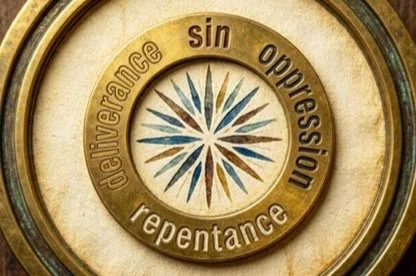
One thing I have learned over the years as a counselor is that if any kind of behavior is cyclical, it is not good. This basically means that you get caught in a ferris wheel of behavior that continues to go around and around.
Sin or rebellion
Oppression or enslavement
Repentance or crying out
Deliveranceorrescue
Every time a judge dies, the cycle starts all over again and it gets worse each and every time. This book highlights the flaws of humanity and our deep need for a Savior. This cycle repeats 7 times in the book of Judges.
Othniel (Judges 3:7-11)
Ehud and Shamgar (Judges 3:12-31)
Barak and Deborah (Judges 4:1-5:31)
Gideon(Judges6:1-8:32)
*Abnimelech (not a judge, but a son of Gideon from a concubine, Judges 8:33-10:5)
Jephthah, Ibzan, Elon, and Abdon (Judges 10:6-12:15)
Samson(Judges13:1-16:31)
General breakdown (Judges 17-21)
As we go through these 13 judges, you may ask yourself where in the world did God find these people. Did He go to the brothels? Did He search out the most immoral people? God’s choices are probably not what our choices would be, and yet, God chose them for a time and for a purpose. Over and over again, we will read that “the Spirit of the Lord came upon him.”
27.Do you believe that God tests all His children?
28.What is the purpose of a test if God already knows what we will or won’t do?
Over the years in counseling kids, I’ve seen them grow into adolescents who sometimes question the faith of their parents. At times, some parents kind of freak out because they think their child is going to abandon the faith. But I always tell them that there comes a point in all of our lives where we have to decide if our faith is real. We all have to come to some kind of crisis of faith. God’s people are getting ready to experience one crisis after another.
29.Who were the people groups mentioned in Judges 3:1-8 and where were they located?
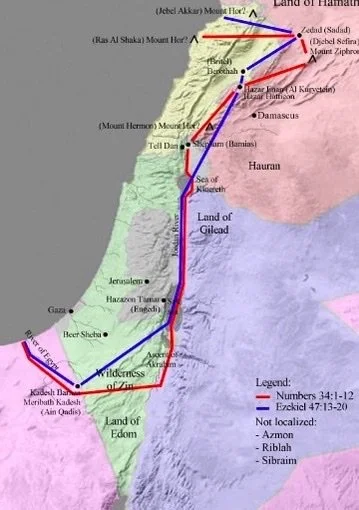
You can see how far north these people groups were at this time in the book of Judges. Remember, this book covers 350-450 years. These people groups eventually migrated down south towards Gaza.
Had God forewarned Israel about the “what to do” and “what not to do”? You bet He did. We never have an excuse to sin.
30.Turn back to Deut. 7:1-11. There are 5 things that God warned them not to do. What are they?
1. 2. 3. 4. 5.
31.What reason did God give them for not intermarrying with these other people groups?
In Deut. 7:7, we read that when you are set apart as holy, you must conduct yourself as such. These children of Israel were a small group compared to other people groups. And yet, they are the ones that God set aside to make a name for Himself on the earth.
32.As a child of God, are you holy? What does 1 Pet. 2:9 say about this? He is speaking to the Church in this verse.
33.If similar language is used in Deut. 7, Judges 3, and 1 Peter 2, then could we assume that living outside the parameters that God has set up for us will get us in trouble with God?
34.How did the people of God in Judges 3 intermingle with the people in the land?
If you look at your cycle above, you will find that idolatry leads to servitude, and then servitude leads to crying out to God.
35.Read Judges 3:9-14. Who was the first judge in Israel?
You remember this fella from the book of Joshua. He was Caleb’s nephew and he won a contest for Caleb’s daughter. I think we can assume that Othniel was a good judge. There is nothing negative said about him. Likely, Caleb had a lot of influence on Othniel. Caleb is one of my favorite Bible heroes. He was definitely a manly man who was brave and strong.
As we go through these judges, we will read a particular phrase repeatedly. 36.Read Judges 3:10. What does the first part of this verse say?
These were the days before the New Testament Pentecost. The Holy Spirit was not indwelling the believer just yet, but He would come upon them for an amount of time so that they could accomplish a particular task. When we get over to Gideon’s story, the text speaks of Gideon putting on a Holy Spirit cloak. He was literally dressed in the power and presence of the Holy Spirit.
We are so fortunate that we have the blessing of having the Spirit of the Holy God within us. Do you avail yourself of the strength and power living within you? None of us do this to the level that we should.
In Judges 3:8, we learn that the “sons of Israel served Cushanrishathaim 8 years”. Remember this time stamp because we will be adding all of them together.
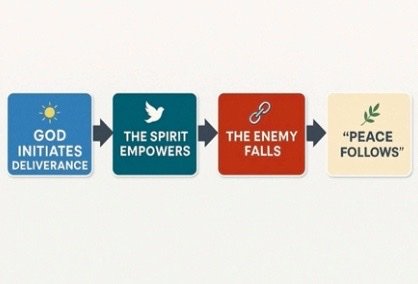
Judges 3:9 tells us that “God raised up a deliverer for the children of Israel who delivered them”. The Hebrew root for deliverer is y-sh-c, which means to save, to rescue, or to make wide and free. This is one of the most important roots in the Bible because it is the same root behind the name Yeshua. Therefore, every time we see this word used in the book of Judges, we are seeing the vocabulary for salvation itself.
It is God who always initiates His pattern of deliverance. And here is the deliverance pattern:
Let’s start a list of the sin cycles in this book because we are getting ready to encounter the first one.
Cycle #1
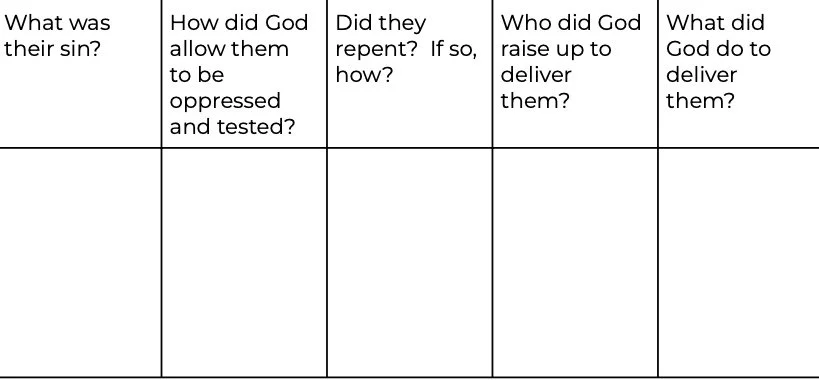
I’d like to tell you that they eventually learned their lesson, but they didn’t. We will see this cycle repeated 6 more times in this book.
38.What happened as soon as Othniel died?
Because the children of God committed evil in His eyes, v. 12 tells us that “the Lord strengthened the Eglon, the king of Moab against Israel”. There was a point in Gabe’s childhood that I had him convinced that I knew when he was lying and when he was misbehaving. I did know lots of times, but I didn’t know all the time. God knows ALL the times we misbehave.
39.Read Judges 3:15-23. Fill in the chart below.
Cycle #2
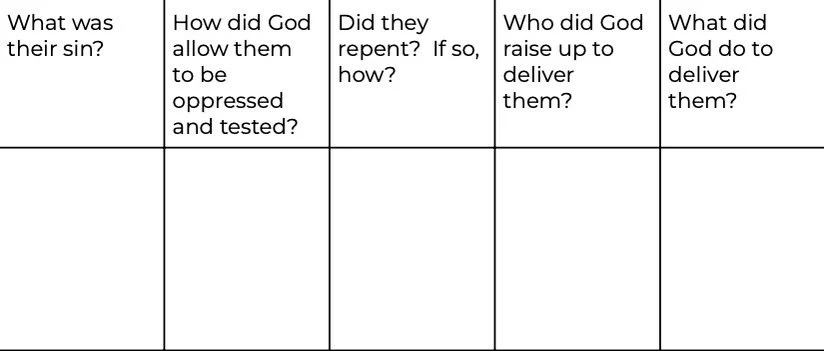
Folks, we ain’t doin too good here! We’re not even finished with chapter 3 and we’ve already gone through 2 sin cycles!
40.How much time passed when Othniel was raised up to deliver them? 41.How much time passed when Ehud was raised up to deliver them? 42.What was significant about Ehud’s hands?
Do you wonder why Scripture mentions this? I do. There are tiny details in the Bible that we don’t want to just gloss over. If they’re there, they’re there for a reason. I did a little digging and here is what I discovered: The fact that Ehud was left-handed gave him a tactical advantage in this situation. Most people are right-handed and right-handed warriors at that time in history would strap their weapons to their left thigh. Because Ehud was left-handed, his weapon was strapped to his right thigh. Palace guards generally only checked the left thigh.
The name Ehud in the original Hebrew means “left-handed and bound as to his right hand”. Only 10% of the population is left-handed. This is so fascinating because you know that when he was born, his parents would not have known that he was left-handed. That is not discovered generally until some time in the toddler or early grade school years. So, this begs the question as to why Ehud’s parents would have named him Ehud. Many commentaries I read said that he probably had a crippled or withered right hand which would have made him disabled in some way. It would make sense that they would name him as such if he had a disabled hand from birth. Ancient cultures, (Jewish included) considered the right hand to be the hand of power, favor, and strength. And yet, God chose someone who was left-handed to rescue Israel from the consequences of their sin.
43.What tribe was Ehud from?
If you recall, Benjamin was the youngest son of Jacob and Rachel. His name literally means “son of my right hand”. God is into ironies I think!
44.What do you learn about ironies in 1 Cor. 1:27-29?
Our standards of measurement are not always God’s standard of measurement. We would look for the strongest, most knowledgeable, handsome and most socially appropriate, etc, etc. etc. But God doesn’t always do that. It is rare in Scripture when He does. In choosing someone who might be considered weak, handicapped, and of the smallest tribe, God is able to demonstrate His power and wisdom. Jesus chose men who were blue-collared workers to be His disciples. He did not choose the elite of His day for that 12 man band. And He died the death of a scoundrel. The Jews certainly didn’t expect their Savior to be poor and plain and they certainly didn’t expect Him to be executed on a cross.
45.What was interesting (and funny) about Eglon, the king of Moab?
I came in the other day and told Todd that I had run across a fella that neither of us had seen in years and I said, “Honey, he looked just like Jabba the Hutt from Star Wars”! This is the picture that comes to mind when I think about Eglon.
46.How exactly did Ehud fool Eglon and his men?
A tribute is like a tax. It’s a payment of some sort that the children of God had to pay to King Eglon of Moab. This tribute not only put them under economic oppression, it also put them under political oppression. More than likely, this tribute was a good part of their grain, livestock, and other valuables. Perhaps King Eglon ate all the tributes! Who knows! But the political and economic oppression they were under because of their sin was nothing compared to the spiritual oppression.
47.What did Ehud ask everyone present to do once he was in the presence of King Eglon?
48.What did Ehud tell Eglon that he had for him?
The best surprise is no surprise! I’m sure if Eglon was alive today, he’d agree with this! Judges 3:21-22 is something that all little boys would think is cool. Boys like anything gross and these verses are certainly gross.
49. Go back to Judges 3:16. How long was Ehud’s dagger?
This is approximately 18 inches long or a foot and a half. If you have a belly big enough for a foot and a half sword to go into you and still have room for the handle of the sword, then you have a big belly!
50.Read Judges 3:23-30. When Ehud had killed Eglon, he locked the doors to the room. Eglon’s men were surprised to find that the door was locked. What did they assume Eglon was doing?
There are 2 kinds of thrones, a kingly throne and a bathroom throne. They assumed he was sitting on the latter. Ehud escaped and went to Seirah.
51.What did Ehud do when he got to Seirah?
Blowing the trumpet could have various meanings depending on how many times it was blown and how long the blasts lasted. This trumpet sound was a call to arms. The Israelites in the surrounding hills would have heard the trumpet and gathered together for combat.
52.Who led the charge?
The Israelite army prevented the Moabites from crossing over any area of the Jordan River.
53.How many men were killed on that day? 54.Did anyone escape?
55.How long was there peace in the land after the Israelites defeated the Moabites?
This is the longest stretch of peace in this book. So, let’s add up all the time that has elapsed since the judges started their jobs:
After the death of Joshua, the son’s of God were in servitude for 8 years. (Judges 3:8)
Under Othniel’s leadership, there was peace for 40 years. (Judges 3:11) After Othniel’s death, the Israelites fell back into sin and were under the control of the Moabites for 18 years. (Judges 3:14)
When God raised up Ehud and he defeated the Moabites, the land rested for 80 years. (Judges 3:30)
So, we have 8 +40 + 18+ 80 = 146 years of time has elapsed since Joshua’s death until we get to Judges 3:31 and we are not told how long there was rest after Shamgar delivered Israel.
There is a very interesting pattern that you will see emerging in the various oppressions we will be studying. The various oppressions lasted 8, 18, 20, and 7 years. But the length of peace that followed was always 40 years except in Ehud’s case, it was twice that much, 80 years. The interesting thing here is that 40 years = 1 generation. This is why we look at this book in a generational sense. Remember the old saying, “What 1 generation tolerates, the next will accept”. Oh, how true that is!
56.Read Judges 3:31. Who was the next judge?
57.This is it for this guy! What did he do and how did he do it?
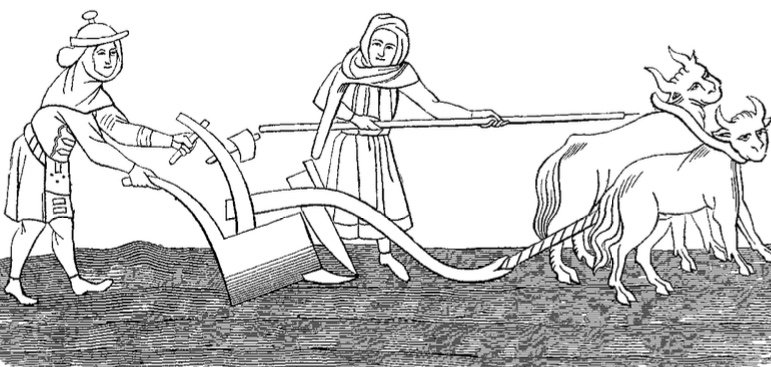
An oxgoad is a wooden tool that is about 8 ft long and it had an iron spike on one end which was used to spur the oxen as they pulled a plow or card. This tool is only mentioned by this particular name here in Judges 3:31. The fact that Shamgar used an oxgoad tells us that he was likely a farmer....another blue-collared worker. I don’t know exactly how he wielded this farm tool to kill all those Philistiones, but he did and he did because God gave him the strength and the know-how to do it.
There is considerable disagreement amongst scholars as to whether Shamgar was even an Israelite since his name is not Jewish. We are told that his father’s name was Anath, which is actually the name of a Canaanite warrior goddess. Some theologians speculate that Shamgar could be the son of an Israelite and a Canaanite.
We are not told about the cycle of sin after Ehud. We are only told that Shamgar was the next judge.
I love what Paul David Tripp said about cycles of sin, “Cycles of sin are predictable patterns of human rebellion, consequences, repentance, and deliverance. Across theology and biblical history, they reveal that misplaced desires lead to habitual bondage. Breaking these patterns requires radical accountability, daily renewal, and relying on spiritual strength over human willpower”.
The book of Judges, more than any other book of the Bible lays out this concept of the sin cycle. I can tell you as a mental health counselor that I see lots of cycles in the lives of others. Sometimes there’s a cycle of abuse. Sometimes there’s a cycle of trauma bonding. And sometimes, there’s just a cycle of sin. The root of all of these cycles is deception. The lies we chose to believe can shape our thoughts and those thoughts can result in habitual behaviors.
We may very well see a little bit of ourselves as we go through this book.