Judges Chapter 1 Lesson 1
Let’s talk about separation of Church and State. President Thomas Jefferson was the one who coined this term to the Danbury Baptist Convention in 1802. The Baptists in Danbury, Connecticut felt that their rights of religious freedom were being threatened.
This is why so many fled religious persecution to go to a new country where religious freedom was afforded to them. Jefferson famously declared in this letter that the 1st Amendment built a wall of separation between Church and State. In Connecticut at that time, there was a state-supported Congregationalist Church and they were in the majority.
The Baptists were in the minority, and they felt that instead of religious freedom being an unalienable right (a right given to all human beings), it should be seen as a privilege granted by the state legislature. While I do believe that religious freedom is an unalienable right, I also know that there is no true justice in this world. The best of justice systems will mess up sometimes.
What Jefferson alluded to in this letter was a boundary that allowed for religious freedom separate from the civil government. This “wall” was intended to keep the government from sticking their nose in the affairs of the Church.
This basically means that they wanted the organization of the Church to be completely separate from the organizational leadership of the civil government. This is wisdom folks! I don’t think any of us ever want to live in a country where the leader of the religion of that country is also the leader of the government. That is what has been happening in Iran for the past 47 years and you see where it has gotten them.
So, where did this brilliant idea of a separation of Church and State come from? It came from the heart of God through the Word of God. There is the foundational concept of distinct spiritual and civil areas of leadership expressed throughout Scripture.
All the way back in the early days of Israel as a nation, God divided the civil leadership from the religious leadership. Ancient Israel was still under a theocracy, but that theocracy still separated the civil from the religious.
When Moses led the children of Israel out of Egypt, there were estimates that 2 million or more left with him. That’s a lot of people trailing along. And there is no doubt that at times, it would have been like herding cats!
Deut. 17-18 sets this up for us. Moses divided the people into groups and put civil leaders over them. Eventually, that was translated into a system of judges. It was never God’s intention for Israel to have a king because He was their king. But because they demanded and longed for a king, God allowed it and Saul was anointed as the first king.
The Levites under the initial leadership of Aaron as the high priest, were over all religious matters. In many ways, the civil and the religious were connected, but only in the coordination of the law of God. If you were in the royal line, you could not be a priest. If you were a priest, you could not be a royal. They were always separate. Hence, the separation of Church and State.
1.What did Jesus say in Matt. 22:21 and how does this express the separation of Church and State idea?
2.Read Rom. 13:1-7. What is the role of civil governments?
In the winter of 2025, we finished up with our study of the book of Joshua. I loved, loved, loved that book! For this study, we are going to pick up where Joshua left off.
3.Let’s go back to the last chapter of Joshua, chapter 24. Read this chapter. Who was called for this important meeting?
This chapter begins by the recapping of Israel’s history and by reminding them how God had intervened on their behalf.
4.What were Joshua’s instructions to the people in Joshua 24:14?
And then in v. 15, that famous verse that should be the battle cry of every home, “Choose for yourselves today whom you will serve.....but as for me and my house, we will serve the Lord”.
5.What was the response to this statement from the people?
Joshua would never have instructed them to get rid of the gods of their fathers had they not brought idols into the land of Canaan with them. Joshua 24 is the last sermon Joshua ever preached and it was a doozy! But it was not preached to the entire nation.
It was preached only to the leaders. You see, God has an order to things and when churches or families or individuals conduct business according to the order of God, then a church becomes one that can discern right from wrong and good from evil, and keep the main thing the main thing, and a family can operate in peace and unity, and an individual can manage himself or herself in a way that brings glory and honor to God. But, when these entities operate outside of the prescribed order of God, then nothing works right. It can become like an engine without oil. It can be chaotic at best.
The generation that was alive to see the Jordan River part, the walls of Jericho fall down, and the sun stand still were all dying out. This generation had first-hand experience of the miracles of God. For a very limited time, until the deaths of Joshua and the elders, the people followed the precepts of God.. Friends, we are always only 1 generation away from forgetting about God and the things of God. The book of Judges is going to make this statement abundantly clear.
6.What does Judges 2:10 say about this?
We go from the last chapter of Joshua to Judges 2 and read “Then the sons of Israel did evil in the sight of the Lord and served the Baals, and they forsook the Lord...” (Judges 2:11-12a) Well, that didn’t take long! My son, Gabriel, shared his testimony at church a while back. He spoke of getting caught up in the wrong crowd when he was in high school and felt as if he was entangled in a prison of his own choosing.
Then he got saved and he was relieved to know that he had eternal salvation. But unfortunately, he still had the same old friends. Only after he got saved, he was even more miserable around them because he had the Holy Spirit taking up residence within him. He felt trapped and hearing them curse the Lord and conduct their lives in such an ungodly manner took a toll on his mental/emotional health. Cancer was what he described as the thing that God used to take him out of the prison he had allowed himself to go back into after his salvation.
The tribes of Israel were no different. They had come out of their prison in Egypt. God used Moses to lead them out. They sinned in the wilderness on their way to the Promised Land and spent 40 years in a different kind of prison, one that kept them hanging in limbo.. Only the children of those adults who left Egypt were allowed to enter the new land. (Joshua and Caleb were also allowed to enter.)
God went before them into battle. He gave them godly leaders. He resided with them in the Holy of Holies over the Mercy Seat. And yet, when those leaders died, the people slid right back into their idolatrous ways. In other words, they got out of prison in Egypt, went into paradise in the land of Canaan, and then went right back into a different kind of prison. Sometimes, I really don’t know why God strives with mankind. We are a crooked lot!
The whole concept of judges didn’t come after the death of Joshua, it came while Moses was still alive. Go back to Exodus 18 and read the entire chapter.
7.What was going on with Moses at that time?
8.What counsel did his father in law, Jethro, give him?
9.How was the nation divided so that judges could manage their civil needs?
10.Do you think this was wise?
11.What was Moses experiencing when he was trying to handle all of the disagreements of all the people all by himself?
Once again, we see that our God is a God of order. I will be saying this repeatedly throughout this study. When an individual tries to handle everything himself/herself, then things become burdensome and unachievable. When there is order, things run like a well-oiled machine. Moses was literally wearing himself out. That could not have been sustained.
I remember a few years ago when Colton was working for a trucking company, he was on call 24 hours a day, 7 days a week. He got very little sleep and it began to affect his health. Once he was called in the middle of the night with a need to come immediately to the neighboring state because one of his 18-wheeler drivers had rolled his truck and there were a few thousand chickens on board in cages on their way to the processing factory. Injured chickens cannot be processed.
When Colton arrived on the scene, the driver was okay, but had to be taken to the hospital. There were, however, about 500 injured chickens and Colton had to singlehandedly wring all their necks and kill them. That whole incident is another story for another day! I told him that what he was doing was not sustainable. A person’s mind and body can only do so much before they completely wear out mentally, physically, emotionally, and yes, even spiritually. Thank goodness he listened to me and found a new and better job somewhere else.
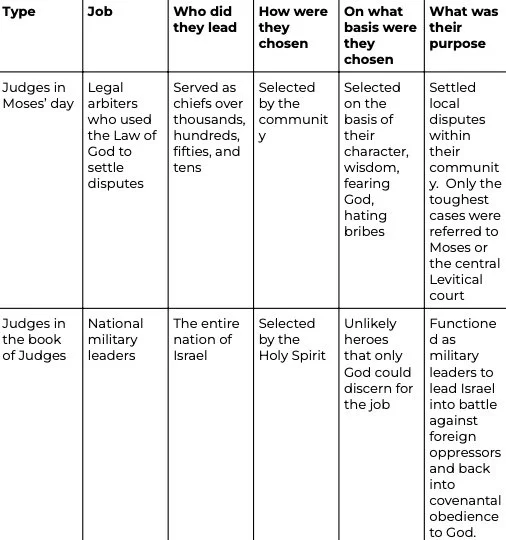
Moses listened to the wise counsel of Jethro. Only the wisest men were selected to be judges over the people and this freed up Moses to attend to more important things. Therefore, judges were already in place prior to the book of Judges and even prior to going into the Promised Land of Canaan. But the judges that Moses appointed and the judges we read about in the book of Judges were quite different in their scope of practice. I have put together the chart below to help you understand the differences between the two offices called “judge” in the Old Testament.
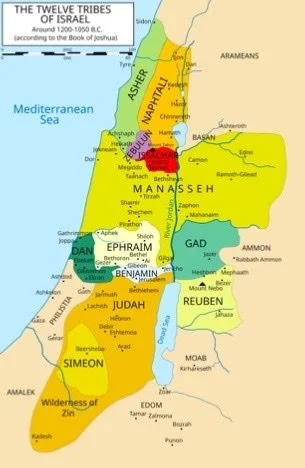
Before we jump into Judges 1, let’s revisit the layout of the land of Israel and the allotment of land that was given to each tribe. I will go ahead and tell you (most of you already know this) that when you see these names mentioned in chapter 1 and throughout the rest of the book, it is not a reference to a person, but to a tribe. The sons of Jacob/Israel for which these tribes were named had long-since been dead by the time we get to the book of Judges.
The book of Judges is sandwiched between the entrance into the land of Canaan and the beginning of the monarchy with King Saul, King David, and King Solomon. It is a period of about 350-450 years and covers the time between Joshua and Samuel.
The indication from Joshua in Joshua 24 is that the people would have a tendency to return to their sinful ways. This very much reminds me of that old precious hymn, Come, Thou Fount. The last verse says:
O to grace how great a debtor Daily I’m constrained to be!
Let that grace now, like a fetter, Bind my wandering heart to thee.
Prone to wander, Lord, I feel it, Prone to leave the God I love; Here’s my heart; O take and seal it; Seal it for thy courts above.
The author of this hymn, Robert Robinson, heard a sermon preached by the great English evangelist, George Whitefield, in 1752 entitled, “The Wrath to Come”. It was from his conviction after hearing this sermon that he wrote this song, and oh how true those words are....”prone to wander....prone to leave the God I love”. These very words are played out in the book of Judges.
There was no main leader in Israel during this time. Moses had died in the wilderness. Joshua and Caleb were now dead. Each one of these tribes did their own thing. During this 350-450 year period of time, God raised up 13 judges to lead the people. Twelve of them are men and one is an amazing woman. Some biblical scholars believe there are only 12 judges because they do not consider Barak to be a judge (because Scripture doesn’t say explicitly that he is). Others say there are 14 or 15 judges because they consider Samuel and Eli to be judges, but they are not in the book of Judges. We don’t find them until we get over to 1 Samuel. For purposes of this study, we are only going to be mentioning the judges included in the book of Judges.
There are 7 minor judges and 6 major judges with the last 2 serving in unique categories. This is not an indication of the importance or influence these judges had. It is more of a measure of the amount of information we have on them. This is kind of like the major and minor prophets of the Bible. Also, there are many who do not consider Barak to be a judge. I happen to concur with that since he was not actually referred to as a judge.
He was a military leader with Deborah. I’m keeping him in the lineup though because many scholars consider him to be a judge. Judge #1 has nothing negative said about him. After #1, every judge that follows is an unlikely candidate, and yet, it is very often in Scripture that we see God choose those who we would never choose. And when we get to judge #13, he ends up dying blind and chained. What happens between judge #1 and judge #13 is the most pronounced downward spiral into sin in all of Scripture.
Judges of Israel
Othniel - Major
Ehud - Major
Shamgar - Minor
Deborah-Major
Barak - Minor
Gideon-Major
7. Tola - Minor
8. Jair-Minor
9. Jephthah-Major 10. Ibzan - Minor
11. Elon - Minor
12. Abdon - Minor 13. Samson - Major
I know a few judges. Some I consider good and some I consider outright corrupt and beneath the level of intelligence and wisdom needed for such a position of power. The judges of Israel are not like the judges we have today who wear robes and walk into courtrooms and listen to cases presented and decide who is guilty and who is not.. The judges of Israel were military leaders who defended Israel in the name of the God of Israel.
The Hebrew word we see used repeatedly in this book is shaphat and it was far more expansive in its meaning than the term judge that we use today. Shaphat means “to govern, to set right, to vindicate, to deliver”. The judges of Israel rescued the people of Israel from their consistent pattern of falling into sin. However, most of these judges were not the pillars of virtue that one might think they were. Yes, each one was used by God to accomplish a military victory and save Israel from sure ruin. But when we read about the character formation of most of them, they are far from those we’d want to pattern our lives after and yet, God used them and accomplished great things through them and some of them even made it to the Hebrews 11 hall of fame!
God does not color-coat or tame down the good, the bad, and the ugly in this book. He allows the true colors of everyone involved to emerge through the ink of Scripture. Regardless of the shortcomings of most of these judges, God used them to dispense His great love and faithfulness to the nation of Israel.
I also want to let you know that some of these judges likely governed simultaneously. It’s hard when you are reading one story after another to understand this, but in all likelihood, this is the case.
12.How does Scripture define the mindset of the people at this time? (Judges 17:6, Judges 21:25)
Are we really any different today? We live in a day and time when moral relativism is the norm and people will say this or that is “their” truth. Well, if you have “your” truth and I have “my” truth, is there really any truth at all? This was the culture of Israel during the time of the judges. The people had rejected absolute, divine authority. The result of this led to widespread idolatry, tribal violence, and social depravity.
There are stories in this book that may make you blush a little bit. Some of these stories are pretty salacious in nature. It’s all laid out just as it happened. There are stories that are gruesome and may turn your stomach a little bit. Chapter 1 opens up with such a story.
The years outlined in this book are representative of a very low time in the history of the nation of Israel. The people were rebellious and had slipped away from following the laws of God. I think we can relate to that today! If you try to even infer that the Word of God is the standard of justice and judgment, then you’re considered a hater in today’s culture. What is right and what is wrong should not change with the culture. The culture should always adjust to God’s standard, but we all know that is not how it works today and that is not how it worked then.
There was a Scottish historian and judge in the 18th century named Alexander Tytler. He is famous for his quote regarding the lifecycle of a democracy:
The average age of the world’s great civilizations is about 200 years. All travel through the same sequence, from bondage to spiritual faith, from spiritual faith to great courage, from great courage to liberty, from liberty to abundance, from abundance to leisure, from leisure to selfishness, from selfishness to complacency, from complacency to apathy, from apathy to dependence, from dependence to weakness, and then back to bondage.
This slip doesn’t happen all at once, it happens in small increments where people might not even notice. He wrote that the final stage of the demise of a culture is political anarchy. Let’s look at America and those small incremental steps that have been taken in the direction of bondage:
1943 - A Supreme Court decision ruled in the West VA Board of Education that students did not have to stand and recite the Pledge of Allegiance because it violated the 1st Amendment. Today, if the pledge is recited, there will be students across the country who remain seated. This ended a 165 year tradition in our public schools. And then in 2016, when Colin Kaepernick, a former NFL player decided to take a knee during the national anthem to protest police brutality and systemic racism, others followed suit.
1962 - Prayer is removed from public school.
1970s - The federalization of union education and Common Core meant that teachers spent far less time teaching history, English, literature, civics, music and art. Instead, schools began to fixate on social justice, environmentalism, CRT (Critical Race Theory), LGBTQ relationships, and having safe sex. National test scores began to decline and young people started losing respect for America and her institutions.
1973 - In the U.S. Supreme Court decision, Roe v. Wade, abortion on demand was legalized in all 50 states. Today, many refer to abortion as part of women’s healthcare.
1973 - Also in this monumental year, the first openly gay person, Robert Bauman from Maryland, was elected to Congress. He was later arrested for soliciting sex from a 16-year-old boy.
1999- President Bill Clinton declared June as Gay and Lesbian Pride Month. And now, even in our seemingly protected corner of the country, there are hundreds, if not thousands who show up every year for the Tri-Pride Rally and even some area churches participate.
2006 - Keith Ellison of Minnesota was elected as the first Muslim to the U.S. House of Representatives. Since then 4 more Muslims have served in national Congressional positions. According to CAIR (Council on American-Islamic Relations), over 235 American Muslims have been elected to local, state, and national office.
2010 - It began to be legal for children in certain states to be given puberty blockers and to get sex-change operations because the child (or the parent of the child) felt as if he/she was not born the correct gender. This gave way to a whole movement called “Gender Affirming Care”.
2010 - Deregulated campaign finance allowed political spending limitations to be removed with a Supreme Court decision that equated political spending to free speech. The notion that elections can be bought is absolutely possible.
2012 - Democrats removed references to God from their party platform at their national convention and this still holds today.
2015 - Gay marriage was legalized and then it started being applauded.
2021 - Hamtramck, Michigan became the first municipality in the U.S. to elect a completely Muslim-American city council and mayor and since then cities across the country have Muslim populations who are attempting the same thing and attempting to institute their own form of law and order.
2025 - New York City elects a socialist, Shia Muslim mayor.

How do you eat an elephant? One bite at a time. How do you destroy a country? One bite at a time.
That is what we see in the book of Judges and that is what we are seeing in the United States today. This is a sobering thought.
Tytler also wrote,
A democracy is always temporary in nature and cannot exist as a permanent form of government. It can only exist until the people discover they can vote themselves largesse out of the public treasury. From that moment on, the majority always votes for the candidate promising the most benefits from the public treasury, with the result that democracy always collapses over a loose fiscal policy followed by a dictatorship.
On September 17, 1787, as Dr. Benjamin Franklin left the Constitutional Convention in Philadelphia, a woman named Elizabeth Willing Powel asked him, “Well, Doctor, what have we got, a republic or a monarchy?” to which he replied, “A republic, if you can keep it”.
Manmade governments can never survive in perpetuity. The only government that will ever survive is the one that Christ will establish at the onset of the millennium and that government will be eternal because He will be in charge. Flawed mankind is always susceptible to falling away from God and thus, being overtaken by evil men and evil policies.
Have you ever played a game with a child and the child makes up the rules or changes the rules as they play the game? Translate this over to real life and you have a real problem.
13.Record below the very last verse of the book of Judges:
Therefore, as we head into this book, the ending explains the beginning. We aren’t told who wrote the book of Judges. Jewish tradition says that the prophet, Samuel did and I think that is a good possibility. However, it could have been written by multiple authors over a period of time.
The date of events is between either the mid-14th or 13-th century and the time of Samuel and Saul in the mid-11th century. This book is named after the type of leadership that was over Israel between the time of Joshua’s death and the beginning of the monarchy. Israel was always supposed to be a theocracy under the control of God, but they had difficulty maintaining that because the sinful nature of mankind always interrupted that form of government. It is for this very reason that God sent Jesus to us, so that we could be rescued from our perpetual cycle of sin.
14.Go ahead and read Judges 1:1-10. What was the initial question asked by the people?
When we see the word Canaan, we understand that to be the Promised Land of Israel. There were wicked people who lived in this land prior to Joshua leading the children of Israel into the land. The Canaanites encompassed the Jebusites, Amalakytes, Amorites, Hittites, Perizzites, Hivites, and Girgashites. There were also the Philistines and the Anakites who were in the coastal lands and hill country, and the Amalekites who lived in the Negev Desert and the Sinai Peninsula. When we use the word Canaanites, it can mean any of these populations or all of them. When the Jewish people arrived in the land, it was divided into sections with each section being like a city/state and each having its own king.
15.Who did the Lord say would go up to fight against the Canaanites?
We are not told exactly how the Lord communicated this to them, but we do know that at that time, the High Priest would inquire things of God and then they would do something akin to rolling a dice with these 2 stones called the urim and the thummin. There was a white stone and a black stone.
The High Priest would ask God certain things and then utilize the 2 stones to reveal God’s answer. These 2 stones were kept in a little pouch behind the breastplate (ephod) of the High Priest. The exact nature of how this worked is not spelled out in Scripture. We know what they were. We know what they were used for. We just don’t know exactly how they used them. This is often how they decided what the will of God was.
16.I wonder why Judah went first. Do you have any ideas on that?
Judah was the 4th born son to Jacob, but he was the one who received the biggest inheritance in Gen. 49.
17.Where was the area the battle would take place?
18.Who did the tribe of Judah ask to go with them? 19.Did God instruct them to do this?
Already, we see that they are operating 1⁄2 on the will of God and 1⁄2 on their own will. That is not generally a good equation. The area known as Bezek was in the northern territory of Israel. If you can locate Mt. Tabor on the map we looked at earlier (just above the tribal allotment for Issachar), then Mt. Gilboa, which is not marked, is opposite of this. These 2 mountain ranges are separated by the Jezreel Valley. A little north of this area would have been the area known as Bezek.
20.How many men did they defeat while there?
21.To your knowledge, has Israel ever possessed all the land that God gave to them?
22,When will this actually happen?
23.What gruesome thing did they do to Adoni-bezek when they caught him? 24.Why do you suppose this was?
25.Did God instruct them to do this?
Already, we see 2 things that Israel has done without God’s instruction. They took the tribe of Simeon with them, and now, they used the pagan practice of cutting off thumbs and toes to disable their enemy. Did they not consider that if God was giving the enemy into their hands, He could deal with the situation His way? Apparently not!
In any event, you need your thumbs to wield a sword and to shoot a bow and arrow, and you need your big toes to run. That kind of allows one to incapacitate the enemy without actually killing them. Today, you’d need to take out their tongue as well so that they could no longer run their big mouths and give orders!
When we see the word “Adoni” in v. 5, we recognize this as a word that we often use in conjunction with Jesus because in Hebrew, it means “lord” or “master”. So, all this means when we see it as a reference to someone else is that the person was the leader or the king.
26.What was the response of Adoni-Bezek?
Israel didn’t come up with this method of handicapping the enemy. As I just mentioned, it was a pagan practice, and ole Adoni-Bezek was dealt a little bit of karma as he apparently had done this many times to those he’d captured in the past. There’s a biblical term for karma and that is the sowing and reaping process. You plant an apple seed, you get an apple tree. You plant an orange seed, you get an orange tree. You plant seeds of evil, then evil will be returned to you.
27.Did they kill Adoni-Bezek? What happened to him?
It doesn’t say that they didn’t kill him, but I have to believe that if they had wanted him dead, they would have killed him when they captured him. It is also highly possible that infection could have set up in his hands and feet as a result of having his thumbs and toes cut off and that led to his death. That’s just my own brain thinking out loud. Truth is, we don’t know how or why he died..
28.What did they do to the city of Jerusalem in Judges 1:8?
I want to point out here that just because they captured the area does not mean that it was completely conquered. It would not be fully conquered for another 400 years until the time of King David. The people end up living in this area with the Jebusites.
29.Read Deut. 20:16-17. What does God instruct the Israelites to do?
30.Did they do it?
They’ve been paying the price ever since then for over 3400 years!!!! That’s a long time to pay a price for anything. If they had done back then what God instructed them to do, the mess in the Middle East that we have going on today would not be going on. And this “mess” has pulled in the entire earth!
31.In Judges 1:9, what 3 topographical areas did the sons of Judah fight against?
The Negev was another way of saying the desert. They went from the mountains to the desert to the lowland. They literally covered all three topographical areas that could be covered in Israel today. There is a “spine” of mountains that runs north to south in Israel:
North - The Galileean Mountains
Mount Meron Mount Tabor *Mount Arbel
Center - The Central Mountains (from the Jezreel Valley to Judea)
Samarian Hills
Judean Mountains (and hills) *Hebron Hills
South - The Negev
*Mount Ramon
The Negev Highlands
**Some would also include Mount Hermon which is in Israeli-controlled territory, but is actually at the southern end of Lebanon.
32.There is a biblically important city mentioned in Judges 1:10. What is it?
Up until this point in Scripture, Hebron is mentioned numerous times and has a unique distinction. Even after the book of Judges, the city of Hebron figures prominently in Scripture.
33.Look at the verses below and note what you discover about Hebron. This will bring us to the place where we are in the book of Judges.
Gen. 13:18 Gen. 23:17-20 Gen. 25:10 Gen. 47:29-30 Gen. 49:30-32 Joshua 14:13 Joshua 20:1-7
We won’t be getting into the significance of Hebron after the book of Judges with the exception of noting that it was the first capital for King David before he captured Jerusalem and moved the capital there.
34.In Judges 1:11, where was the next place the tribe of Judah went?
The early name of this place was called Kiriah-sepher. “Sepher” in Hebrew means book. In other words, this was the village of the book or books. Perhaps there was a library there, I don’t know. In any event, if we turn back to Joshua 15:13-19, we read about the same story recounted here in Judges 1:11-15.
35.Go back several pages in this lesson and note who is listed as the first judge in Israel.
If you recall the rite of the ancient Jewish marriage, there was a dowry given by the groom and his father to the father of the bride. This protected the bride in the event that the groom later divorced her. Fathers in those days would invest that money so that it would grow for his daughter. Women had very few rights in those days and the dowry was security for her. But what if the groom-to-be had no money and no dowry to pay? He could do something like we see here to gain his bride's hand in marriage.
36.What was the challenge set forth by Caleb?
37.Who was Othniel anyway? What would his relationship be to Caleb’s daughter?
YIKES!!!! That’s a little too close for comfort, but it was not culturally out of the norm for that time.
38.What did Caleb’s daughter ask of him? 39.What did he give to her?
When we get to Judges 1:16, we turn the time clock back a few years to the time of the wilderness wandering. Moses' father-in-law, Jethro, was a Kenite. The Kenites were a nomadic people who were on friendly terms with the Israelites. When Moses fled Egypt after killing the Egyptian, he went to Midian and it was there that he met Jethro and married one of Jethro’s daughters, Zipporah. Moses lived amongst the Kenites for several years before returning to Egypt. In fact, when Moses led the children of Israel out of Egypt, there were many Kenites who joined them.
40.In Judges 1:16-19, what areas of Israel did the tribes of Judah and Simeon take possession of?
41.What areas did they not take possession of and why?
If you recall from our study of the book of Joshua, Caleb was a he-man, a real brute of a fella! He was a man’s man, a guy’s guy! It seemed as if he was fearful of nothing and nobody.
42.Who did Caleb drive out of Hebron?
The Anakim were the sons of Anak. The “im” makes the proper noun, Anak, plural. The name Anakim was synonymous with Anakites. These people were described as giants. They were living in the area of Hebron when the children of Israel first entered the land. The Hebrew people considered the Anakim to be descendants of the Nephilim who were a race of people from Gen. 6 who descended from the union of fallen angels and human women. When Moses sent the 12 spies to go into the Promised Land and bring back a report, 10 of those spies reported that they (the Israelites) were like grasshoppers compared to the sons of Anak. It was only Joshua and Caleb who brought back a favorable report. God called the 10 spies and all those who sided with them evil. Only Joshua and Caleb trusted God enough to conquer that land and only Joshua and Caleb and their families were amongst the original group who left Egypt who actually got to go into the Promised Land of Israel. As a result of the people failing to trust God, they had to wander 38 more years in the wilderness.
“Objects in mirror are closer than they appear”. Ever read that one? That is an analysis of something that lets us know that looks can be deceiving. You see the original group of people who left Egypt saw the giants in the mirror and they appeared bigger than their God. Only 2 men had an accurate estimate of the greatness and power of God.
This is a lesson for all of us to not measure what we know by what we see. We are to measure what we see by what the Word of God tells us. If He tells us that He is greater than our heart, then He is greater than our heart regardless of how our heart might be breaking. If He tells us that the victory has already been won, then start celebrating. If He tells us that He will never leave us or forsake us, then believe that He is near even when we can’t see Him or feel His presence. Only Joshua and Caleb saw God as He really was and as He really is, and therefore, only Joshua and Caleb were allowed entry into the Promised Land.
During the conquest of Canaan, Joshua eliminated the Anakim from the hill country, and Caleb finally drove them out of Hebron completely. If you recall, Caleb stated in Joshua 14 that he was 85 years old at the time and was still as strong as he was when he was 40. He (being the he-man that he was) said to Moses, “Now, give me this mountain!”. (Josuha 14:12).
Caleb was actually anxious and excited to rid out the Anakim. Unfortunately, a small remnant sought refuge in the cities of Gaza, Gath, and Ashdod. (Joshua 11:22) There are many biblical scholars who believe that the Philistine giants who David encountered as a boy were the descendants of the Anakim.
43.Read Joshua 1:21-26. Who did the tribe of Benjamin coexist with and why?
44.What happened at Bethel?
45.What city did the house of Joseph (tribes of Ephriam and Manassah), take?
46.How did they do this?
In those days, when an army attacked a city, they were always looking for a secret way into the city. If you recall from the book of Daniel, the Persian army came in through the moat of the city of Babylon and didn’t even have to fight. It was a done-deal as soon as they gained entrance. It appears that a similar thing happened here. Once they figured out the way to get in, the battle was theirs and so was the city.
47.There is another name here for Bethel. What is it?
Bethel means “House of God”. It is mentioned about 70 times in the Bible. There are actually 2 Bethels mentioned. One is fairly insignificant compared to the other. We are interested in the more significant one as it pertains to what we are studying. Bethel was located about 11 miles north of Jerusalem near Ai. Bethel was the dividing line later on in the Old Testament between the northern kingdom of Israel and the southern kingdom of Judah. If you look at our earlier map, you will find Bethel in the tribal allotment for the tribe of Ephriam.
48.Let’s look at a few references to Bethel and note why it was important: Gen. 12:8
Gen. 13:3-4
Gen. 28:10-13
Judges 20:18-28
There’s more to come in this series of lessons about Bethel. I don’t want to spoil it all for you now. Interestingly, it is not mentioned at all in the New Testament.
I had hoped to squeeze in the entire first chapter of Judges in this first lesson, but just couldn’t get there. We will finish out the chapter next week. We have kind of laid the groundwork for the rest of the book. Judges 2 will continue that groundwork and then we will get into the time of the judges of Israel.
“What one generation tolerates, the next will embrace” is a quote that is attributed to the great 18th Century English theologian, John Wesley. This sociological concept is one that I fully agree with. If the first generation views something as not ideal, but tolerable, then they will not actively fight against that ideal. Because they saw their parent’s generation tolerating these thoughts and Ideals, they grew up not even seeing it as a compromise, but as something normalized to that culture and time. And once something is fully normalized, then it is actively embraced and then it is celebrated.
This was what was going on in Israel at the time of the Judges and as we progress through the book, we will see just how dramatic and traumatic that compromise ends up being.
Friends, we are living in similar days. You don’t have to be mean and condemning to stand up for truth. We must contend for the truth! If we don’t, who will?