Revelation Lesson 4
Video posted below after class is completed.
Or, keep scrolling to read the lesson on this device
Download Questions Here
The Book of Revelation
Lesson 4, Chapter 3
By Cindy Ketron
On The Edge of Eternity
This week, we’re going to finish up the last 3 letters to the 7 churches in Asia Minor. The next letter in this series goes to the church at Sardis. Sardis is about 50 miles east of Smyrna. We need to keep in mind that all of these letters were meant for the individual churches they were addressed to, for all the 1st century churches, for the Church corporately, for our churches locally, and for us individually. I think that pretty much covers all the bases.
The church at Sardis
Of all 7 of these churches, it appears that the one at Sardis was the least persecuted. I remember so many times growing up, I heard that if you aren’t having hard times and being pestered by Satan, then he might not be bothering you because he already has you in his clutches. That may very well be the case with this church. The city of Sardis was a well-defended one and it was quite wealthy. It had, at one time, been the capital of the ancient kingdom of Lydia and was on a major commercial trade route running east and west. Much of the trade done there was in textiles, dye and jewelry. The amazingly beautiful temple of Artemis was there and most of this city was into pagan worship. There were a lot of cults and secret societies there. Even today, the ancient ruins of this temple still stands. The Christian church planted in this city survived until the 14th century.
The commendation and condemnation for this church are reversed. Interesting that the least persecuted amongst the 7 appears to be the one that is the most spiritually dead. For those of you who know me, you know that one of my favorite all-time movies is The Princess Bride. I sometimes make analogies from this movie when I’m writing. There was a scene in this movie where the giant and Inigo Montoya took Wesley (who was presumed to be dead) to see Miracle Max, played by Billy Crystal. After examining Wesley, Miracle Max said, “It just so happens that your friend here is MOSTLY dead. There’s a big difference between being mostly dead and all dead. Mostly dead is slightly alive.” I think you will discover that the church at Sardis was mostly dead and slightly alive.
1. Read Rev. 3:1-4. Do you notice anything different about the salutation of this letter?
Christ is described in this letter in the same manner He was described in Rev. 1:4. And because He is the One who is the possessor of the 7-fold spirit and because He is the One who holds the authority over these 7 pastors/messengers, then He alone is who the pastors are responsible to.
2. What did Jesus say to this church about its “life?”
Evidently, this church was known as being a church. It was considered to be spiritual, considered to be a witness for God, and considered to have a testimony to the Gospel. But you see, the piercing eyes of the Lord saw past what others saw. He saw into the hearts of those in this church and into the heart of the church as a whole. I have heard some pastors say that nobody in this church was truly saved and that the entire church was spiritually dead. I do not believe this. Like I said in the beginning, I think it was just “mostly dead.” If there had not been any spiritual life in this church, the statement in Rev. 3:2, “strengthen the things which remain” would have made no sense. But for all practical purposes, the church as a whole was a spiritually dead church.
The parable of the wheat and the tares could be closely associated with this church.
3. Read Matthew 13:24-30 and answer the following questions:
What happened to the man’s good field?
Where did the enemy go?
Why was the servant told to not gather out the weeds?
When would the master be able to get the wheat?
The kingdom of heaven is synonymous with this wheat field. There are believers and unbelievers in the Sardis church. At some point, someone/s had sown some kind of evil in this church and it took root and that person/s could have been long gone by the time this church morphs into a mostly unbelieving congregation who still hangs out a shingle saying, “Church”, but they are really not a church in the spiritual sense of the word. When God takes believers out of this world, He will deal with us by taking us home to be with Him. The unbelievers will be gathered together and burned. This is a reference to the lake of fire that we will address towards the end of this book.
Do you ever wonder why faithful people remain in faithless churches? I do. People attended dead churches 2000 years ago and some attend dead churches today.
4. What was the warning to this church if they were not watchful?
The same warning that was issued to the church at Sardis is the same warning that is issued to those upon the earth in regard to the 2nd coming of Christ in Matthew 24:43 and 1 Thess. 5:2.
Those who remained faithful in this church were told that they would eventually get to attend a great feast. I’m all in for that! Read Matthew 22:1-14. This passage is all about a royal marriage feast. For believers, we will get to attend the most royal feast that has ever been given, the marriage supper of the Lamb. Did you know that in ancient Jewish weddings, everyone, guests and participants, all wore white robes? If you showed up at a Jewish wedding without a white robe, one would be provided for you.
5. In these verses, how would we know that an uninvited wedding guest tried to get into the wedding?
Nobody is going to be able to sneak into this feast. God knows who is worthy to attend in their white robes and who will be cast into outer darkness.
6. What does Ephesians 4:1, Col. 1:10, and 1 Thess. 2:12 have to say about being worthy?
The church at Sardis was deceptive. I know I don’t have to tell you this, but appearances can be deceiving. There will always be people who assume that because they go to church, pay their tithes, and do kind things for other people, they will be among those wearing white to the wedding feast. They might be shocked to learn in the end that no white garment exists with their name on it.
The letter to the church at Sardis frightens me. Remember the old Holiday Inn slogan, “the best surprise is no surprise?” Salvation is definitely one thing that you want to be sure about! Nobody wants to be surprised by being sent to the lake of fire!
Rev. 3:5 contains a troubling bit of information and I don’t think we can know with absolute certainty what this is. I do know with absolute certainty what it is not. This verse is in NO way saying that a person can lose their salvation so that their name will be blotted out of the Book of Life. It is also NOT saying that somehow by holding on til the end, you can somehow gain salvation. If that were true, then that would indicate that salvation is works-based and not grace-based. The “overcoming” might cause some to read this verse to mean something that it does not mean. You might want to look back to lesson 2 to refresh your memory about what overcoming in the biblical sense actually means.
In Psalm 69, King David is pleading with the Lord to take care of his enemies.
7. What specifically does he ask God to do in Psalm 69:28?
8. Is there any indication from the rest of this chapter that God actually did what David asked of Him?
There’s a lot of God’s people who ask a lot of things from God. That does not mean that He answers all of their requests in the way they requested, nor does He answer all of our requests in the way we request. Ps. 69 does not indicate that God would blot the names of David’s enemies out of the Book of Life. And in the context of Psalm 69, the Hebrew word for this book means “the book of the living”. We’ll save some of the conversation surrounding this verse until we get to Rev. 20 and look at the Book of Life.
The church at Philadelphia
The church at Philadelphia is the 2nd church that Jesus didn’t have any condemnation for. This is the church I want to be a part of! We know this church as the church of brotherly love. America even has a city in Pennsylvania named after this place. This church along with the church at Smyrna are the only 2 churches that do not have any mention of condemnation from Jesus. Philadelphia was on an important trade route and stood on the river Cogamus. It was a lush and beautiful area with farming communities all around. The location of this church made it a center of communication and business. Unfortunately, there were frequent earthquakes in Philadelphia and it was almost completely destroyed by an earthquake in the first century. There was a Christian presence there until the 14th century.
9. Read Rev. 3:7-13. What 2 adjectives are used to describe Christ in v. 7?
Truth is a big issue in today’s culture. A big deal is made of “misinformation” and so often, the ones who are claiming that someone is spreading misinformation are themselves the very ones who are guilty. It seems that if you don’t watch the news or read the newspaper, you are uninformed. But, if you do watch the news and read the newspaper, then you are misinformed! How in the world are we to ever decipher the truth from a lie? Jesus Christ is the one and only source of absolute truth that exists in our world. It is His Spirit that will give us the discernment to distinguish between the truth and a lie.
10. What does 1 Pet. 1:15 tell you about right living?
11. Therefore in Rev. 3:7, we learn that truth and right living go hand in hand. There can never be any holiness without truth. Also in v. 7, a key is mentioned. What kind of key is this?
We had another reference to keys in Rev. 1:18. This is a very different kind of key than the one mentioned here in Rev. 3:7.
12. What kind of key/s did Christ possess in Rev. 1:18?
I remember several years ago when I was working at Indian Path Pavilion, which for those of you who don’t know, was a mental health hospital. One day at work, I overheard a nurse who was trying to make one of the patients there feel better about the fact that she had been admitted into a mental health facility. The nurse told the patient, “The only thing that separates me and you is a set of keys!” Keys are indeed a great separator. They keep us in and lock others out. The reference to David’s key is found in the Old Testament.
13. Read Isaiah 22:22. Who is the “he” spoken of in this verse?
This is a messianic verse. There are many of those in the Old Testament. Messianic verses have a 2-fold inference:
The verse would be speaking contextually about an individual or a situation that existed at the time the verse was written.
But, it would also hold a deeper meaning that might not be so apparent and would be a future reference to the coming Messiah.
We have already spoken about the fact that the ancient Jews viewed prophecy in a more circular fashion as if what had transpired in the past would evolve into some kind of a pattern in the future. If you read Rev. 3:7 within the time context it was written, it appears to be written with a man named Eliakim as the possessor of the key. That is the 1st layer. The 2nd layer goes deeper.
14. Who do you think will ultimately have the key to the house of David on his shoulder?
Keys, in the Bible, are most often a reference to sovereignty. The sovereignty of God means that all things are under His almighty control. He does not cause everything to happen, but nothing happens that He does not allow. Jesus came from the house and lineage of David. This is why the key is referred to as the key to David’s house.
The knowledge that God is sovereign gets me through some really tough times in life. Do you ever say any of the following to yourself when you’re going through an especially tough patch:
God could change this if He wanted to. (Wish He would!)
God chose to allow this to happen in my life. (Not really the answer I want to hear.)
What possible purpose does God have for allowing this to transpire in my life? (May take a while to get to this.)
Congratulations! If you can identify with these statements, you recognize the sovereignty of God in your life! Generally, when many believers are stuck on #1, they are not happy. And if you’re completely honest with yourself, when #1 hits, you’re not yet submitting to #3.
As I am typing this, my heart is grieving over the flood that happened at a Christian camp in Texas just a few days ago. My mind reverted back to 2024 when hurricane Helene hit our area of the world with such force and devastation and lost lives. Even a year later, we still cannot fathom the depths of that tragedy. But what happened in Texas occurred at a Christian camp…a Christian camp of all places!! So many children, teens, and adults killed and still yet, some are missing and suspected to be dead. It is a tragedy that none of us even want to conceive is possible in our own lives. Anytime something unthinkable like this happens, we are faced with the fragility of life and we ask ourselves a myriad of questions. What if something like this happened to my child? What if something like this happened to my grandchild? Would I ever be able to cope with knowing that the last moments of my loved one’s life would have likely been one of fear and powerlessness. The waves of such strong waters would have rendered even the strongest and best swimmers unable to manage the deluge.
And yet, we must admit, we have to admit, that God is sovereign. Why didn’t God step in and stop this? These were little children and they were there to learn about Him. I’m going to quote something from a pastor by the name of Scott Reese, “There are moments in life where divine sovereignty doesn’t align with human expectation, and in those moments, our theology must not collapse, it must deepen.” The sovereign authority of God over all of creation sometimes makes no sense to us, but He is there nonetheless, and He’s in charge. And regardless of what happens, He loves us.
Yes, Jesus has the keys to everything and everyone in heaven, on earth, and under the earth. We may see through a glass dimly now as the Apostle Paul said in 1 Cor. 13:12. However, there will be a day for us as believers when we are face to face with the One who holds those keys and the things that were once fuzzy, will be met with full understanding.
In addition to the city of Philadelphia having a lot of earthquakes, they also had volcanoes that periodically erupted. The principal crop there was grapes and the god Dionysus (also known as Bacchus) was worshiped there. He was the Greek god of wine, festivity, and ecstasy, not exactly a good combination. This god became the poster child for madness and wild, untamed behavior (hence, drunkenness). This was the culture in which the church at Philadelphia had to operate under. The push for ungodliness would always have been crouching at their door.
15. Do you think the church at Philadelphia was a large or small congregation? Why or why not?
The reference in v. 8 to “having little power” might be an indication that the church was not a big, wealthy church. They too were harassed and oppressed by a certain group of people that we have already seen in the church at Smyrna.
16. Who was this group?
17. What is God going to do with this group?
We see the “synagogue of Satan” mentioned again in Rev. 3:9. It was also mentioned in Rev. 2:9 regarding the church in Smyrna. Obviously, this is a metaphoric statement meaning those who were ethnic Jews and who opposed and persecuted the Church. In the 1st century, most of the persecution towards Christians came from the Jews. For a while, the Roman government saw the Christians as being under the same religious authority as the Jews. This caused them to be in a somewhat protected category from having to observe certain aspects of the Roman religion. However, it didn’t take long for the Roman government to categorize Christianity as a new religion completely separate from the Jewish religion. Once this happened, Christianity was fair game for persecution, not just from the Jews, but from the Roman government.
Pastor, author, and seminary professor, William McCarrell writes:
The Philadelphia letter reminds that any true church at any time, and especially during the last days, meets Satanic opposition……through imitation, religious ritualism, and hypocrisy….opposition strengthened by mixture of worldliness and religiousness - Church and State. William McCarrell, Christ’s Seven Letters to His Church, p. 57.
I am adding this note following the assassination of Charlie Kirk. In the days since his killing, there have been many conspiracy theories about Israel and the Mossad having something to do with this tragedy. Even some who call themselves Christians take the "synagogue of Satan” from Rev. 2:9 and Rev. 3:9 to mean current-day Israel and they demonize all Jews. These people obviously ignore the last part of Rev. 3:9 where Jesus says of the Church, “and they (the synagogue of Satan) will know that I have loved you.” The Church was then and will always be compiled of both Jew and Gentile believers.
The Church - All believers in Christ from the time of Pentecost til the rapture. Anyone of any ethnic race can be a part of the Church.
Jews/Israel - All who are descended from Abraham. Some Jews are part of the Church and some are not. The Jewish people are connected with the land of Israel. You cannot disconnect them.
The Church and Israel are 2 different entities. God loves them both and has a plan for both.
The synagogue of Satan was a group of trouble-making Jews who were in Smyrna and Philadelphia. To transpose that into any kind of modern-day connection with Israel and the Jewish people who are alive today is a gross misinterpretation of these verses.
18. What will this church be delivered from?
The Greek word used for the preposition “from” is ek. This word carries the understanding of being delivered from something, not through something. This is one of the verses that one can use to understand the rapture of the Church. When we get over to Rev. 7, we will learn about 144,000 Jewish witnesses who are sealed. By contrast, this group will actually go through the tribulation. The tribulation which will come upon the whole world will apparently not come to this church and we must surmise that it is because they are already in heaven with God. Whatever they might have been experiencing at the time was small in comparison to the hell on earth the rest of the world will experience during the 7 years at the end of time.
Just as all the letters were meant for all 7 churches, they are all meant for us. And just like the promises that were given to the church at Philadelphia, we too have the same promises to be removed from the suffering yet to come upon the earth. This is the blessed hope!
19. In Rev. 3:12, what will God make of those who overcome?
The word pillar might seem an odd word to use, but in this context and in the Greek language, this word means a support.
20. What do you learn about pillars and cornerstones from Gal. 2:9 and Eph. 2:19-22?
Because this city was frequented by earthquakes, they were accustomed to having buildings collapse and all that would remain would be the pillars. We will discuss the spiritual temple of God that will reside in the New Jerusalem near the end of Revelation. That temple will have pillars which will never be destroyed. Pillars stand up straight and they hold up buildings.
21. What are the descriptions of this temple from Rev. 3:12 and Rev. 21:22?
22. Based on these verses, what will the role of Jesus and the role of the overcomer be in the New Jerusalem?
I love this church! It gives me hope! It helps me to see that in God’s sovereignty, there is a plan, a grand plan, and you and I are going to be the recipients of the provision of that plan. I pray today if you are in a season of turmoil in your life, that God would shine the light of the church of Philadelphia in your heart and mind to give you the endurance you need to keep overcoming!
The church at Laodicea
The letter to this church is the last one. Laodicea was located about 40 miles east of Philadelphia on the road to Colossae. In fact, when the Apostle Paul wrote his letter to the Colossians, he had that letter read in Laodicea as well. (Col. 4:16) It was the southernmost of all the other churches. It was a wealthy city. They were famous for a black wool used to make clothing and carpets. There was a great medical community in Laodicea where ointments for ear and eye diseases were made. Because they had no water supply, this city built sophisticated water aqueducts to transfer spring water from 6 miles away. This meant that by the time the water got to the city, it was tepid and slightly warm. This alone often caused others to consider Laodicea inferior to some of the other 6 locations. You will see that Jesus uses all of these novelties about this city to communicate and connect with this church in a way they would understand.
There is a spiritual danger in having no financial stress as a society. I believe that part of the reason the church today in America is so complacent is because we are so economically blessed. Even the poor in America are blessed in comparison to the poor in most 3rd-world countries. Too many around us don’t see a need for God because as they see it, their lives are just fine without Him. Missionary societies around the world have reported for years that there are fewer people led to the Lord in affluent countries than in poor countries. And, interestingly enough, the more our children have, the more depressed they become. American children are spoiled beyond what our grandparents could ever imagine. They are given expensive items (Iphones, Ipads, computers, tvs in their rooms, etc.) that they didn’t earn and many times do not appreciate. Our children have become buckets with holes and the more we pour in, the more that escapes.
By the time this letter went to Laodicea, this church was already well-established. In contrast to the other 6 churches, there is nothing to commend this church for….NOTHING! Yikes! Can you imagine Jesus inspecting your church and finding zero things to commend it for? This church frightens me more than the others.
23. In Rev. 3:15-17, how many times does Jesus make mention of the lukewarm aspect of this church?
24. If you are really thirsty and take a big gulp of slightly warm water, does it satisfy your thirst?
Lukewarm water can be gross! The Laodiceans were very familiar with this term. I don’t know about you, but when I’m dealing with someone, I kinda like to size them up so that I know what I’m dealing with. It’s easy for me to figure out how to deal with a person who is hot because they love me and I know it. It’s easy for me to deal with a person who is cold because they hate me and I know it. But if someone is indifferent to me and I have to keep guessing how he/she feels, I will never ever trust such a person. Such were the people in the church at Laodicea. There is a very fine line sometimes between love and hate. Hate is not the opposite of love, apathy is. They did not hate God, and they weren’t totally apathetic to Him, but they were teetering in the middle. It appears that both the pastor and the church in Laodicea were lukewarm. God wanted to vomit them out of His mouth!
Laodicea was a compromising church. We are surrounded today by compromising churches. I can’t help but think about the UMC (United Methodist Church) and their downward spiral into allowing the apostasy of the lgbtq community to be accepted into the highest leadership positions of their churches. And in many other denominations, mine included, there has been a gradual decline in tolerating and even celebrating what they once rejected as being heresy.
Jesus lays out a subtle irony to them in explaining what they think they are and what they really are in Rev. 3:17-18. They have physical wealth, but He wants them to have spiritual wealth and the comparison of the two would have made sense to them based on where they lived and what they had.
25. Make a list from these 2 verses regarding what they think they have and what Jesus says they need.
It is interesting that Jesus said this church, which was in the garment district of Asia Minor, was naked since they were famous for their wool fabric.
26. Read Gen. 3:7, Gen. 3:10, Amos 2:16, Habakkuk 2:16, and Rev. 3:18. What do you think nakedness symbolizes in these verses?
There is a difference between guilt and shame. Guilt means feeling bad for something you have done. Shame means feeling bad for who you are or what you have become. This congregation had become indifferent and apathetic and they didn’t even know it! In Rev. 3:18, there is a reference to the eye salve that Laodicea was famous for. Apathy brings with it a spiritual blindness. They might have been wealthy and had beautiful clothing, and lots of material things, but spiritually, they were bankrupt and blind.
27. What does Isaiah 55:1-2 say about wealth?
Laodicea had a poverty of riches. They thought they were rich because they had material wealth, but they were desperately spiritually poor and destitute. There is only one place/person to fill us up. Jesus Christ is a one-stop shop! He is the only shop that can fill the empty void inside of us. And, if you are like a bucket with a hole in it that I described earlier, He is the only one who can plug that bucket. Otherwise, the more that’s poured in, the more that escapes. There will never be enough.
This church was completely unaware of the fact that they needed to know the God of the Bible and because they were so blind to this, they had been lulled into thinking they were content.
28. What does Jesus say about love in Rev. 3:19?
29. Do you think Jesus loved this church? Why or why not?
30. Read Hebrews 12:6-11 and Rev. 3:19-20. Would you say that the members of this church were truly saved? Why or why not?
Just as we discipline our own children, so the Lord disciplines His own. Our children can be the object of our love and affection as well as the object of our rebuke. This church was His church. I once heard someone who had gone on a mission trip to Jamaica give a report on their trip. This person said that if any child in the congregation at this church in Jamaica got out of hand during the church service, then anyone who was close to that child would reach over and bop the kid on the head or on the leg, whether they were the child’s parent or not. Apparently, the entire congregation had leniency to discipline any child in the church! That is not the way we work in this country. If someone laid a hand on my child without my express permission, then I promise you, I’d lay both of my hands on that person! God doesn’t work this way either. He disciplines His own.
There are so many verses in Scripture that are misused. Rev. 3:20 is one of them. There was even a famous painting done by Warner Sallman depicting Jesus standing at the door knocking and there’s no door handle on the outside of the door indicating that He can’t come in unless the door is opened from the inside.
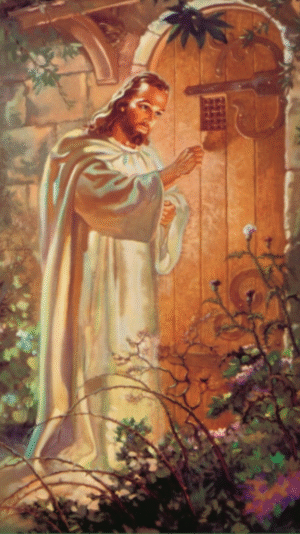
I cannot count the times I’ve heard this verse used in an evangelistic way to say that “Christ is knocking on the door of your heart. Let Him in and be saved today.” That is not the inference here at all! Christ loved the church at Laodicea because some in this church were obviously His children. They had unfortunately grown indifferent to Him. He was knocking on their door because He wanted to have fellowship with them. Think about that for a moment. The God of the universe wants to sit and chat with you! Many in this church didn’t need to get saved. They needed revival!
31. Rev. 3:21 is an interesting verse that most of us just gloss right over. How many thrones are mentioned here?
32. There is a throne in heaven and a throne on earth. Where is Jesus right now?
33. Read Luke 1:32-33. Where will Jesus eventually sit?
He is not there yet, but he will be! As we get towards the end of Revelation, we will learn about this time. The eventual throne of David will be the eternal throne of Jesus, but we’re a long way from that right now. Let’s just say that if the rapture happened tonight, we’d be at least 7 years away from this throne being established!
Political commentator, Candace Owens, famously said when she was fired from The Daily Wire, “Jesus is King!” She posted it repeatedly on social media and said it repeatedly on-air. On the surface, that sounds good. It was, however, a jab at her former boss, Ben Shapiro (who is Jewish), and she said it in a way to throw her religion in his face. In other words, she weaponized her religion. She is still weaponizing her religion. I don’t think God wants us to use His name in that manner. When Samuel anointed David as King of Israel, he was just about 14-16 years old. He did not actually take the throne until he was 30. Therefore, there were about 15 years between the time he was anointed and the time he became king. We know that Jesus is King and we know that He is seated on His throne in heaven at the right hand of God the Father. During the millennial reign of Christ on the earth, He will occupy the throne of David, His ancestor.
Friends, we have all, at one time or other been indifferent to Christ. Don’t allow yourself to be lulled into that kind of apathy. Each of these 7 letters were sent to the church it corresponded to. These letters would have been read aloud. Then, they were copied and sent to the other churches and still many more than just those 7 ended up with copies. And 2000 years later, these letters are in our hands. That was God’s plan.
What do we learn from these 7 letters?
I want us to take a look at these 7 letters through a contemporary lens. In other words, how do they apply to us today? But first, we need to look at the original purpose of the Church and a church. The Church with a capital C refers to the body of believers from the Day of Pentecost who call themselves Christian. There are going to be different groups of believers in heaven with us. There will be the Old Testament prophets and the Old Testament saints. There will be the tribulation saints. There will be the Jewish remnant who are saved during the tribulation. And, there will be us, the Church.
34. A church (with a little c) is a local body of believers. We are told in Hebrews 10:25 that we are not to forsake assembling together. Why?
As the Church, we are called upon to disciple and assemble. That assembling is the church (with a little c). If you haven’t figured out yet, the little c’s are all part of the big C. In looking at what the Church was supposed to be, we’ll discover how far 5 of these 7 churches veered off the path and hopefully we’ll see how far we’ve veered off that path, both individually and collectively.
35. Read Matthew 28:19-20. This is the Great Commission. These are the words of Jesus to His disciples and to us. What is our primary purpose as believers?
The terminology, “Go ye therefore” means,as you are going. As we are going about our lives, we must be intentional about discipleship. Okay then, what is discipleship? A disciple is a follower. It is a person who intentionally spreads the doctrine or beliefs of another. A disciple is not a person who picks and chooses the stuff he/she wants and then spins those ideas in a palatable way. The person or idea the disciple of any faith is perpetuating is the most important element of that religion.
36. What does Mark 8:34-38 say about our priorities as believers in Christ?
37. True disciples follow the Word of God. What does John 8:31-32 have to say about this?
38. Jesus gave us a beautiful analogy of our relationship with Him in John 15. What does John 15:4-8 say about whether It is our job to abide or to produce fruit?
Abiding has to do with 2 other words we’ve looked at in this study, perseverance and endurance. Abiding in Christ also has much to do with staying in His Word. If we love Him, we will do this. And, if we do this, there will be fruit produced, but fruit production is the work of the Holy Spirit within us. Our primary job is to abide.
Let’s see what we have so far. To be a disciple, a part of the world-wide Church, we need to:
Assemble together. In other words, have a worship service and fellowship with one another. You can’t do this on a golf course or in the woods or sitting on the couch watching Charles Stanley on Sunday mornings.
Be intentional about discipling others. We are to teach and preach the gospel of Jesus Christ.
Be obedient to the Word of God.
Put Christ first.
Stay/abide in a close relationship with Him.
And finally, we are to love one another. That love should set us apart from others. Matthew 24 chronicles the state of the world prior to the 2nd return of Christ.
39. The part of that chapter that has always been like a dagger to my heart is Matt. 24:10-12. What does it say about the affection of people as we near the time of the end?
We are already seeing this hatred play out across our world, especially towards those who are Jewish. However, it will get much worse once that last 7 years begin.
40. What does God tell us in 1 John 3:10 will be the mark of true believers?
I love that old Tina Turner song, What’s Love Got to Do With It. Spiritually speaking, love has everything to do with it! Only true believers can love and pray for their enemies. Only true believers can overcome spiritual oppression and persecution and still have love in their hearts. We will be known by our love! I once had a counseling client, an elderly lady who was a resident at a nearby nursing home and let me tell you, this lady had an intense love for chocolate. In fact, I’ve never seen such an obsession with chocolate! She was all alone in this world as she had outlived her entire family. Once, she told me a story about receiving a whole box of chocolates for Christmas when she was a little girl and she was so overjoyed that she just sat down and bawled! The next time I went to visit her, I took her 2 bags of chocolate chip cookies (the good kind!) and she began crying. She looked at me and said, “Who loves me so much to give me this?” to which I replied, “I do and God does.”
Oh that everyone who came across my path would see the love of Jesus in me to such an extent they would ask the question, “Who loves me so much as to give me this?” The “this” referred to in that question is the gospel. The more we abide, the more we shine. When I’m not abiding, I can be downright mean, just ask my husband!
As we look at these 7 churches in Asia Minor, I want you to be able to gauge which of these 7 churches were true to their calling and which ones were not. I also want you to be able to look at yourself and your own local body of believers to to measure it against God’s measuring rod.
We do a lot of talk about the gospel. Do you know how to explain it? I sure hope so, but if not, here it is in a nutshell: God is holy. I am not. I cannot live in the presence of a holy God without the cleansing of my sin. Therefore, God sent Jesus, His only begotten Son, to this earth in a human body, to take away my penalty for the sins I commit while still in this mortal body. Jesus died on the cross to atone for my sin, and whoever repents of their sin and believes in Him will get to live forever with Him forever.
41. The Apostle Peter said it best in his sermon on the Day of Pentecost from Acts 2:23-24, 32-33, and 38. What do you learn from this sermon?
This is the gospel, the good news of Jesus Christ! Our current culture has tried to pervert and meld the true meaning of the gospel to incorporate all sorts of things. Perhaps the biggest perversion of the gospel today is the desire of some to connect it with the concept of social justice. What ends up happening as a result, is that many churches present a false gospel.
Social justice contains the concept of fairness and equality in society. The measuring stick for social justice can be found in the distribution of wealth, the opportunities that are afforded to the privileged, such as legal, employment, and political rights. “Me Too”, “Black Lives Matter” and the whole “DEI (Diversity Equity and Inclusion) movements are all social justice movements.
42. Now, I must ask you, do these concepts of the gospel and social justice sound similar in any way to one another?
The gospel is all about Jesus Christ. Social justice is all about us. The concept of equality has at its root a much more sinister notion than most might imagine. Social justice will tell you that everything must be equal to be fair. However, if everything were truly equal, then nothing would be fair! Let me give you an example. Let’s say that there is a blind child in your classroom and you are the teacher. You are dead-set on making everything equal. So, when you write the homework assignment on the board and the blind child cannot see it, you say, “Everything is equal. This is your problem if you can’t see the board.” You might say, “Hey, that’s not fair!”, and guess what, it isn’t fair. We cannot assume that equality and fairness are synonymous.
Our culture today has shamed its members into the assumption that for true justice to be understood, we must do the good thing for all, which is to reform society into what is equal and fair. And in an unbelievable twist of fate, some rule-makers have convinced many of the evangelical churches to adopt such a forum as not only being acceptable, but as being preferable. The demand of social justice to be accepted as part of the gospel of Christ has now taken a step (or perhaps a giant leap) further down the rabbit hole of the doctrine of demons that we read about in 1 Tim. 4:1 in a true identity crisis. We were never meant to identify with such doctrines! Below is the progression of this kind of thinking:
We accept something….then we prefer something….then we identify with something
Do you see this?! Satan is such a creature of subtlety. He creeps in while many are asleep at the wheel! We have gone from accepting that social justice is something that we do because some say the gospel demands it, to making it a preferred part of the gospel, to saying that it is actually THE gospel. Oh the heresy! C.S. Lewis in his book, God in the Dock: Essays on Theology and Ethics, wrote,
Of all tyrannies, a tyranny sincerely exercised for the good of its victims may be the most oppressive. It would be better to live under robber barons than under omnipotent moral busybodies. The robber baron’s cruelty may sometimes sleep, his cupidity may at some point be satiated, but those who torment us for our own good will torment us without end for they do so with the approval of their own conscience.
We are so close to living under this tyranny now as those in the power grid of government, media, and Hollywood shame those who don’t agree with their social justice do-gooding for the good of all. Believers in Christ currently find themselves going up a down escalator and if we ever stop, we’ll be in the rabbit hole along with this culture.
Being a news junkie, I sometimes ask myself if certain politicians actually believe what they say. I believe many of them are intentional liars and charlatans, but there are others who are sincere in what they are saying, they’re just sincerely wrong in many cases. They truly believe that what they are saying and fighting for is truth and goodness. These are really the frightening ones, for with their intense conviction that they are right, they manage to convince others to believe the same and before you know it, much of the population (both in and out of church) are caught up in the deception. And in this deception, those who are in its midst develop a vitriol for those who are not. We see this played out every day in the media.
42. Christ told us that before the end came, there would be deceivers. Read 1 Tim. 4:1 again as well as Matthew 24:4. How do you think these verses relate to what we are discussing here?
John 14:6, “Jesus said to him, “I am the way, the truth, and the life. No one comes to the Father except through Me.”
Friends, we do not call ourselves Christian because we do social justice in this world. We call ourselves Christian because Christ died for our sins and we repented and believed in Him! He is not a way to God. He is THE ONLY WAY!
These 7 churches in Asia Minor teach us a lot!
The church at Ephesus teaches us that there is a danger of losing our first love. (Rev. 2:4)
The church at Smyrna teaches us that there will be suffering if we are truly doing the work of God and that we are not to fear that suffering because what lies ahead for us far outweighs the momentary pain we are dealing with. (Rev. 2:10)
The church at Pergamum teaches us that there is great danger in doctrinal compromise. (Rev. 2:14-15)
The church at Thyatira teaches us that there is great danger in moral compromise. (Rev. 2:20)
The church at Sardis teaches us to wake up from spiritual deadness. (Rev. 3:1-2)
The church at Philadelphia teaches us to hold fast, be patient, and hang onto the little bit of strength we might have because Jesus is coming. (Rev. 3:11)
The church at Laodicea teaches us that there is a real danger in being lukewarm and thinking that we are self-sufficient. This ultimately leads to being clueless about our spiritual need. (Rev. 3:15-16)
All of these churches are in Asia Minor. Today, this would be modern day Turkey. The gospel began at the cross and spread to different parts of the world. Asia Minor was the first real area of gospel expansion. The early church was birthed in this area of the world.
Jesus had a stern warning for 5 of the 7, “Repent or I will remove your lampstand”, meaning your gospel witness. By the 3rd century, Roman Catholicism had been created. By the 4th century, the Eastern Orthodox Church had been created. All of the 7 churches of Asia Minor maintained a Christian witness for a while, until these 2 institutional religions of Roman Catholicism and Eastern Orthodoxy entered the picture. Neither of these institutions are a picture of the biblical Church that Christ began.
None of the 7 churches are there today. Islam began in this area in the 7th century and continued to add to its numbers until the 11th century and all of this was done by force. Then, it went to northern Africa, the Middle East, and parts of Europe. From the 12th century to the 20th century, Islam spread with caliphates (a kind of state led by caliphs who were thought to be successors of Muhummad) and Empires. Today, in the 21st century, Islam is the fastest growing religion in the world, not just in the rate of those accepting this religion as a faith, but those Muslims are producing children at a much higher rate (5:1) than other groups. Today in Great Britain, there are more mosques than churches. Turkey today is 99.9% Muslim. So, where are the 7 churches of Asia Minor today?
Ephesus - Today, this city is 99% Muslim. There are no known Christian churches.
Smyrna - Full of secular modern Muslims (whatever that means). Many are disillusioned with Islam and there are a few Catholic and Orthodox churches and also a few evangelical Protestant believers there today.
Pergamum – There are no Christian churches there and only a few known believers. Again, most of the population are Muslim.
Thyatira - There is no known church and no known believers here.
Sardis - The ruins from a 4th century Byzantine church stand on the grounds of the ancient Temple of Artemis. There are no known Christian churches and no known Christians there today.
Philadelphia - When John’s disciple, Polycarp was burned at the stake, there were 11 Christians from Philadelphia who were burned with him. The church there died out by the 6th century. The town is mostly Islam and there are no known believers who still live there.
Laodicea - There is no known church there today and only a few Christians live there.
This is staggering and it should frighten every single one of us! Friends, it only takes 1 generation to forget about God and the things of God. If there are any additional lessons we can learn from these 7 churches and their whereabouts today, it is to remember Jesus and endure to the end because something great awaits us on the other side.
The Apostle Paul had such a way with words! His words to the church at Corinth is so appropriate to close our study this week:
1 Cor. 4:8-12 “We are hard pressed on every side, but not crushed; perplexed, but not in despair; persecuted, but not abandoned; struck down, but not destroyed. We always carry around in our body the death of Jesus, so that the life of Jesus may also be revealed in our body. For we who are alive are always being given over to death for Jesus’ sake, so that His life may also be revealed in our mortal body. So then, death is at work in us, but life is at work in you”.
Be blessed this week!
© Cindy D. Ketron. All Rights Reserved
Thank you for prayerfully considering partnering with us.