Revelation Lesson 3
Video is/will be posted below after class is completed.
Or, keep scrolling to read the lesson on this device.
Download Questions Here
The Book of Revelation
Lesson 3, Chapter 2
By Cindy Ketron
On The Edge of Eternity
We learned last week that John received his marching orders from the angel and that he was to write a letter to each of the 7 churches of Asia Minor. Read Rev. 2 and 3. Why these 7 churches? Why not send a letter to the churches in Colossae or Corinth or Thessalonica or even Jerusalem? We are not concretely told why. However, we can surmise some of the reasons once we put all of them together.
I will be honest with you, when I have taught the book of Revelation in the past, I just wanted to get to chapter 4 when all the juicy stuff begins to happen. Oh, what a mistake that is! Chapters 2 and 3 contain some of the most piercing condemnation and uplifting exhortation in all Scripture and it was written, not just for those 7 churches, but for all churches from the time of its writing until the rapture of the Church. And not just for all churches, but for all believers individually.
All 7 churches would have had access to all 7 letters. It is through these letters that we get to observe what Satan’s tactics were then and what they still are today. Although these churches were in the western part of Asia Minor, they were part of the Roman Empire. This part of the world is a beautifully lush area where east meets west. John had actually been to all 7 of these churches. He knew what was going on in each of them. While Scripture doesn’t explicitly state that John was the pastor of the church at Ephesus in his later years (after Patmos), early church tradition and historical accounts consistently link John with this church and it is believed that he died at a ripe old age in the city of Ephesus and is buried there. After Paul’s ministry in Ephesus, it is believed that John took a leadership role there and then later returned after his exile in Patmos.
The map below gives you a good idea of where these churches were and if you trace from the first church to the last, you will see that these churches were in a circle of sorts.
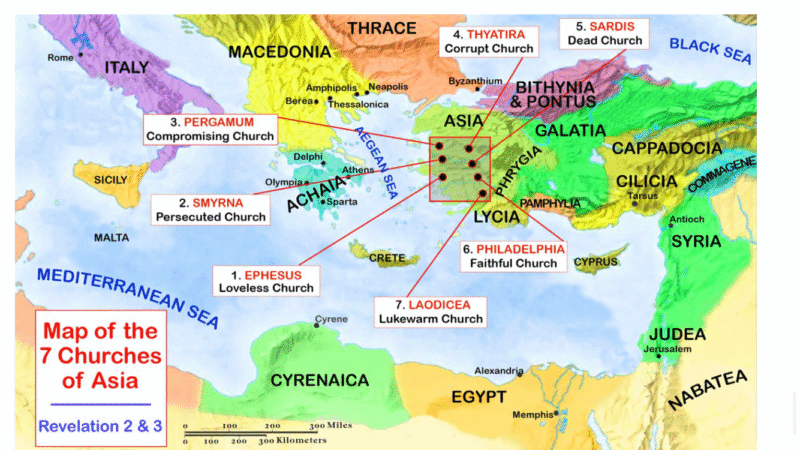
The letters to the 7 churches in chapters 2-3 all follow a similar structure and interestingly enough, there are 7 parts to each letter:
To
From
Commendation
Condemnation
What does God want them to do
If they do or don’t follow through, what will happen
He who has an ear
These churches had different issues going on. All but 2 had strong messages of condemnation. I think you will find that there are characteristics of all 7 of these churches in our present-day churches.
Some historians who have gone back and studied church history believe that there are 7 eras of church history and that each era corresponds chronologically to one of the 7 churches. This is the dispensational part of dispensationalism. I do consider myself a dispensationalist. However, I do not ever want to put God in a box and force Scripture to fit into man-made boxes. Extreme dispensationalists do just that. When I read these 7 letters from Jesus to the 7 churches in Asia Minor, I don’t necessarily think that the particular issues with each church is only for a specific era in history. I think even today if you look at churches around the world, you will see some of all 7 of the issues and praises in these churches that are discussed in these letters.
Basic tenets of dispensationalism:
God relates to humanity in different ways at 7 different eras of church history.
Belief in a literal, historical-grammatical approach to interpreting Scripture. This means that we believe biblical prophecies should be understood in their literal sense unless clear symbolic language is used. And everything must be examined in the context in which it was meant.
There is a clear distinction between the Church and Israel and as such, God has different plans for each. (Note – The Church is composed of both Jew and Gentile believers.) This point of view follows that the Old Testament covenant between God and Abraham (Israel) will be literally fulfilled, including promises of the land and future millennial kingdom.
A premillennial view of eschatology means that Christ will return prior to a literal 1000-year reign where He will sit on the throne of David. This also includes a pretribulation view where Christ returns for His church prior to the 7-year tribulation.
I never ever want you to take my word for it. Study it for yourself and see where the Lord leads you. This is definitely not an area where you want to fall out of fellowship with other believers. On this website under the “Articles” section, you will find articles on The Difference Between Israel and the Church and What is Replacement Theology. These go together because a large part of the evangelical church today denies the fact that Israel and the Church are separate and feel that God has abandoned Israel as His child and has chosen the Church in their place. You need to know this information as we get into this book.
Following the 7 parts to each of these 7 letters, I want you to fill in the outline. The first one is done for you below.
The church at Ephesus
To – the angel of the church at Ephesus
From – the One who holds the 7 stars in His right hand, the One who walks amongst the 7 golden lampstands.
Commendation – You persevere. You cannot tolerate evil. You put to the test those who call themselves apostles. You persevered and endured for My name’s sake and have not grown weary. You hate the deeds of the Nicolaitans.
Condemnation –You have left your first love.
What does God want them to do? – Remember from where you have fallen and repent. Do the deeds you did in the beginning.
If you don’t follow through – God will come and remove your lampstand.
He who has an ear- let him hear what the Spirit says to the churches. To him who overcomes, I will grant to eat of the tree of life which is in the Paradise of God.
(Question 1)
The church at Smyrna
To
From
Commendation
No condemnation for this church
What does God want them to do?
If you don’t follow through, what will happen?
He who has an ear
The church at Pergamum
To
From
Commendation
No condemnation for this church.
What does God want them to do?
If you don’t follow through, what will happen?
He who has an ear
The church at Thyatira
To
From
Commendation
Condemnation
What does God want them to do?
If you don’t follow through, what will happen?
He who has an ear
The church at Sardis
To
From
Commendation
Condemnation
What does God want them to do?
If you don’t follow through, what will happen?
He who has an ear
The church at Philadelphia
To
From
Commendation
No condemnation for this church.
What does God want them to do?
If you don’t follow through, what will happen?
He who has an ear
The church at Laodicea
To
From
Commendation
Condemnation
What does God want them to do?
If you don’t follow through, what will happen?
He who has an ear
2. Do you see any of your church in these letters? If so, what?
I can still hear my precious New Testament seminary professor, Dr. Huey, saying over and over, “Scripture is always culturally relevant and eternally valid.” He said this so many times that even 40 years later, I still remember it. Even at the time of taking his class, this statement had a tremendous impact on my thinking. We don’t live in Bible days. We don’t live in the ancient Asia Minor. But, the messages inside the letters of these 7 churches are always for believers, whether the believer was born in the 1st or 2nd century or the 21st century! Imagine the power of words that can transcend time! That is the supernatural power of Scripture!
The church at Ephesus
The church at Ephesus was the most prominent of all the 7 churches. The Apostle Paul on his 3rd missionary journey, went to Ephesus to begin a ministry. John later came and served as the pastor of this church. Then he was exiled to the Isle of Patmos for about 10 years and later returned to Ephesus. At the time of the writing of the book of Revelation, the city of Ephesus already had a lengthy history of Christian witness. Ephesus was on a major trade route and served as the capital of that province with about 200,000 people. One of the main features of this city was that the temple of Diana (also known as the temple of Artemis) was there. People came from all over the Mediterranean world to worship this goddess. This temple was one of the 7 wonders of the world, taking well over 200 years to build, and many claim that of the 7, it was the most spectacular.
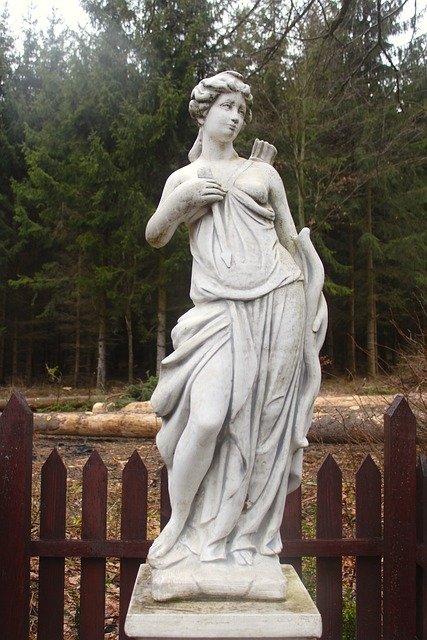
Above is a statue of Diana that was in the temple. She’s a looker ain’t she?!!! Those aren’t oranges that she has around her waist. They’re multiple breasts! Not sure who came up with that idea! This symbolized her abundant fertility. The Greeks believed that she fell out of heaven. There were only 2 times in the book of Acts that the Apostle Paul was opposed by Gentiles. Let’s look at one of these occasions and it happened at the temple of Artemis.
3. Read Acts 19:23-28. What was this disturbance about
The riot that came about as the result of Christianity in Ephesus is the reason that Paul had to leave this area. You often find out what people are made of when it comes to money. If you threaten to take the money source from certain folks, their claws may come out! Look at your own checkbook or bank statement. What do you spend most of your money on? If a business owner was suddenly informed that a competing business was going in across the street, that first business owner might panic! Perhaps the place where I see the most telling information regarding a person’s attachment to money comes when someone dies and the $$$ and “stuff” is divided up. I’ve seen some all-out brawls!
This was some of the situation that Paul was faced with in Ephesus and all this was going on while he was trying to establish the church there. The culture around this city was one of wealth and that kind of culture has a way of bringing in its own kind of sin with it. The church at Ephesus had a perpetual window into this heathen way of life occurring all around. It would almost be like going to Hollywood or to Las Vegas and trying to establish a church on the strand. There were no established churches in Ephesus when Paul arrived. There was also no knowledge of the 1 true God. Imagine walking into such a culture and a place and introducing the people to a brand new Savior they had never even heard of! I could not even begin to count the obstacles he must have been up against.
In spite of all the obstacles, this church became a large church. It is believed that Timothy became the leader of this church immediately after Paul left and then later John became the pastor. John, therefore, knew the ins and outs of this church and he definitely knew their shortcomings. About 30 years after Paul established this church, the first of the 7 letters was written to the church in Ephesus.
In Rev. 1, we learned that it was Jesus Christ who walked amongst the 7 golden candlesticks and who held the 7 stars (churches) in His right hand. The Greek word, kraton, means “to hold authority”. In other words, these 7 pastors in these 7 churches were under the divine sovereign power and authority of Jesus.
If you ever find yourself in the unfortunate position of having to give a criticism to another person, you might want to first tell them what is positive about themselves or about what they are doing that is right. Jesus does the same thing here with this church as He unveils His instruction to John about how to inform this church. According to Rev. 2:2, the believers at the church in Ephesus were hard workers. They had apparently been through some difficult times because the words perseverance and endurance are used to describe them, and this chapter even mentions that they didn’t bellyache and whine about all they had to go through, They knew how to discern false teachers and they refused to tolerate evil people, which is way more than I can say about a lot of churches these days.
4. Look back at your notes. What was it that Jesus had against this church?
I remember back a few years ago when I was writing this study the first time I taught it and my daughter in law, Abby, was with us. This was prior to her marriage to my son, Colton, and they were planning their marriage. I remember hearing them giggling in the other room as they talked about and looked forward to their lives together as man and wife. They even wrote out long-term and short-term goals for their marriage. Then, as now, I want them to always adore one another and to always love each other well. Have you ever had such a loving relationship with your Lord where you absolutely could not wait to meet with Him in the morning and your thought all day long was to please Him? While this church was doing so many things right, they lacked the pure devotion to the Savior that they had in the beginning.
Have you ever said “sorry” when you’ve ignored Him for a period of time? Some 30 years earlier, Paul wrote a letter to this church.
5. What did he commend them for in Eph. 1:15-16?
This church was no longer motivated by their love for Christ. They had left Him as their first love. They had sound doctrine and they were sticking to it! However, they substituted all the good things they did in the name of Christ for their personal and corporate love for Christ. In other words, they substituted works for love. The church at Ephesus was an imbalanced church. You can become so enamored with the Word of God that you forget the God of the Word!
6. In Matt. 6:31-34 what comes first, seeking the Lord or serving the Lord?
Let me just tell you, if Todd Ketron only worked to pay the bills here, but he never spent any quality time with me and he never looked me in the eyes and told me he loved me and he never worried about me when I’m sad or upset, then I’m not sure that I’d feel very loved by him. Marital relationships are a lot of hard work. The best relationships that we have are the ones we pour our hearts and time into and the ones where we allow ourselves to be vulnerable. Jesus wasn’t satisfied with the church at Ephesus because that relationship had become much more of a duty to these believers than it was true devotion. Jesus wanted them to want to know Him and to do that, they would have to spend time with Him. He still desires this from us today. So often, our lack of time with the Lord is an indication of the level of our love for Him. Passion in our relationships may come naturally in the beginning, but as time goes on, that passion can dwindle if we aren’t purposely focused on keeping the fire going.
Friends, a lot of churches know how to work for the Lord, but they don’t really know how to worship the Lord. True worship is always preceded by relationship.
7. In Rev. 2:6, what group’s actions did John mention that this church hated?
We know very little about the Nicolaitans. What we do know is that they were heretical in their doctrine. Irenaeus, an early church father in Lyons (modern day France) wrote that the Nicolaitans promoted fornication and a compromising position on eating food sacrificed to idols.
Jesus threatens this church in Rev. 5 to remove their candlestick if they didn’t correct what was wrong. A candlestick is a light. This light was the light of the Gospel and it was their witness. This light was fueled by the work of the Holy Spirit. While Jesus did not say that He would take the Holy Spirit out of their individual lives, He did say that He would remove their witness from this place if they didn’t straighten up. There are a lot of churches today who have lost their light, and they don’t even realize it. Unfortunately for this church, its light was eventually snuffed out and it ceased being a church centuries later in the 5th century.
8. What is the tree of life mentioned in Rev. 2:7? Refer to Gen. 3:22 and Rev. 22:1-2.
9. Who are the ones who are mentioned here in Rev. 2 who are conquerors or overcomers? (Also refer to 1 John 5:4-5)
In the beginning of time in the Garden of Eden, and in the beginning of eternity in the New Jerusalem, there will be life offered to us from this tree. This is what God wanted for us from the beginning and eventually, because of our faith in Jesus as our Savior, we will get to enjoy the fruit of this tree.
The church at Smyrna
Some years ago, I had dear family members who were missionaries in the place where the church at Smyrna was established. That city is now called Izmir. Smyrna is north of Ephesus and is located on the western coast of Asia Minor (modern day Turkey). The word Smyrna means myrrh and has the connotation of suffering.
10. What do you discover about myrrh in Matt. 2:11?
Myrrh was a product from Arabia and it had 2 main uses: perfume and embalming, but it could also be used in managing pain. In fact, myrrh was more valuable than gold when Jesus was an infant. When the wise men from the East offered it to Jesus, it was the last of the 3 gifts and it symbolized His future death. I don’t think they knew this in offering this gift, but hindsight is 20/20 and God weaves the details together in an amazing way. We see now the symbolic role myrrh played in the beginning of Jesus’ earthly life. It was also used in the anointing oil in the tabernacle in Ex. 30:23.
11. In Mark 15:23, what is Jesus offered on the cross?
When the soldiers offered this to Jesus on the cross, it was to numb His pain and dull His senses. It was customary to offer wine mixed with gall/myrrh when people were dying on a cross. Jesus, however, refused this drink (Matt. 27:34, Mark 15:23), choosing instead to endure the full experience of suffering with a clear mind. Later on, He stated from the cross, “I thirst”, and a sponge soaked in vinegar was given to Him. The Psalmist in Psalm 69 laments over the desperation of his soul.
12. How did he express what his enemies gave him in Psalm 69:21?
13. And then in John 19:39, what did Nicodemas bring to the tomb of Christ?
I find this so very interesting that myrrh was used at His birth, on the cross, and then in the tomb. The city of Smyrna is only mentioned here in Scripture and has been continuously inhabited since its beginning. Alexander the Great had a lot to do with the building of Smyrna into the beautiful city which it became. There were beautiful temples all over the city dedicated to various gods and goddesses. Like Ephesus, Smyrna was a wealthy city, though not as wealthy as Ephesus. There was also a large congregation of Jews in this city who openly opposed Christians. This church matched its name. It was a suffering church and it was a small church.
We have discussed Polycarp in previous books we’ve studied. Polycarp was from Smyrna. He was a Christian and was a disciple of John’s. He was also martyred for his faith at Smyrna sometime between 155-160 AD. Ancient writings state that Polycarp went voluntarily to his death to be burned at the stake and when the fire did not consume him, he was stabbed to death. Some of his last words were, “86 years have I served Him, and He has done me no wrong. How can I blaspheme my King and my Savior? You threaten me with a fire that burns for a season, and after a little while is quenched, but you are ignorant of the fire of everlasting punishment that is prepared for the wicked.” I had a seminary professor who recounted Polycarp’s life and death so dramatically in class that he cried and cried and said, “Poor old Polycarp!”, and then the rest of the class began to bawl.
14. Did Jesus have any condemnation for this church? Why or why not?
The words of Jesus to this church is a testament to their spiritual strength.
Unlike some of the other 7 churches, the church in Smyrna was a poor church and it was heavily taxed by the Roman government. It was mostly composed of slaves, ex-slaves, and many impoverished people who lost everything they had when they became believers. From Ephesus, it would have been about a 35 mile journey. These precious believers in this church held to their beliefs and faith in Christ until many of them were brought to their death.
15. What is the blasphemy spoken of in Rev. 2:9?
16. Read Romans 9:6. Do you think Paul is saying something similar in these verses?
How does a person get to heaven? By repenting of their sin and believing and confessing Jesus Christ as personal Savior. This was the same in the Old Testament although Christ had not been born yet. People like Abraham believed in the promise of a Savior still to come and it was counted to him and others as righteousness. Simply being born a Jew did not make one a follower of God. True followers believe in His Son as Savior. The 1st century Jews in Smyrna, for the most part, persecuted the Church. Therefore, regardless of their status as God’s chosen people, most of them rejected Christ. They might have been Jewish by birth, but they were certainly not Jewish in the spiritual sense. This is why Jesus refers to the Jews there as “a congregation of Satan.”
We really don’t know all of the horrendously evil things that were done to members of this church. We only know that many of them suffered and died for their belief in Christ.
In Rev. 2:10, Jesus tells them to not be afraid and then tells them some of the things that would happen to them. He is honest as He warns them of their possible fate, but also gracious as He tells them of their future inheritance. By the way, “do not fear” is an imperative command.
17. Let me ask you something personal. Have you ever been persecuted for your faith and if so, how did you handle it?
The absolute worst spiritual persecution of my entire life happened while I was working as a chaplain with other chaplains. I was told repeatedly that even the devotions I shared were sometimes “too biblical”! Every day, I felt as if I was walking into the lion’s den and every day, I fought to uphold the truth of God’s Word amongst co-workers who should have all been doing the same. This job took an incredible toll on me emotionally and spiritually, and eventually physically. But hindsight being what it is, I look back now and know that I was there for a reason and for a season. I was and am an overcomer, and yet, in light of what I know about this church in Smyrna, my suffering seems petty.
Satan often uses persecution as a weapon against the Church, but history proves that this may be his most ineffective weapon because persecution only purifies the Church and the Church throughout history has grown during times of persecution. As I am proof reading this lesson before I post it, I am grieving the loss of Charlie Kirk. What a hero of the faith! 48 hours after his death, Turning Point USA had 32,000 new applications to start chapters on college campuses across the world. Persecution has a way of spreading revival across the land and I’m praying that will happen as a result of Charlie’s martyrdom.
The wording in Rev. 2:10 regarding some in this church would be thrown into prison and tested and for 10 days they would endure tribulation is indeed an interesting statement. In reading what this could mean, there are a whole lot of conjectures. Some say this is literal. Some say this is symbolic of different eras of persecution that the Church suffered throughout history and some believe that it is symbolic for the periods of time just in the 1st century when the Church suffered. I have no idea and I don’t think it matters which of these you chose to believe. The important thing for me is that Jesus let them know that there were boundaries regarding how long they would suffer under religious persecution. That is an important issue today as we see the Church continually persecuted around the world. There WILL eventually be an end to suffering. That is the point. 10 days compared with eternity is but a drop in the bucket of eternal life.
18. What is the crown of life in Rev. 2:10? James 1:12 has an answer for that.
In Rev. 2:11, Jesus promises the church at Smyrna that they will not be harmed by the 2nd death. To understand the 2nd death, we must have an idea of what the 1st death is.
19. What does God tell Adam and Eve in Gen. 2:16-17?
You see, as image bearers of God, it was not natural for human beings to die. However, the immortality of Adam and Eve (and the rest of us) was conditional upon continued obedience to God. Through the sacrifice of Jesus Christ on the cross, we do get eternal life if we accept Him as Savior. But as mortal humans on this earth, we will suffer death (unless we are raptured first) at some point or other. This is the 1st death. For believers, this is the only death.
20. To understand what the 2nd death is, read Rev. 21:8. What do you learn?
The death of our human bodies is a universal experience. It is the consequence of sin. But that is the only death believers will experience. Unbelievers will be sentenced to the lake of fire at the Great White Throne Judgement. All of the inequities of this life and all of the evil from other people will be addressed on this day. For those who were in the church at Smyrna, that 2nd death will never come because they will be rewarded with the crown of life.
The church at Pergamum
This church is fascinating to me! But it is not fascinating in a good way. Pergamum was the northernmost of the 7 cities in Rev. 2 and 3. Pergamum was on a hill about 1300 feet high, which made it a secure city because the inhabitants could see trouble when it was approaching. It was about 20 miles from the Mediterranean Sea. There were many temples to other gods and goddesses in this city as well. Pergamum was later known for its enormous library housing 200,000 volumes. Parchment paper was thought to have originated here. The contents of that enormous library was later sent to Egypt as a gift from Anthony to Cleopatra. There were numerous healing spas. If the spa didn’t heal a person and the person died while there, a back door was always available through which they’d throw dead bodies! Yikes!
One of the massive foundations atop Pergamum is believed to be the foundation of the temple of Zeus also known as the Great Altar of Pergamum.
In 1879, in an agreement between the Ottoman Empire and the German government, the relief panels from the Pergamon altar along with some of the other fragments were taken to Berlin and placed into the possession of the Collection of Antiquities. It was disassembled and taken stone by stone to Germany and then reassembled. In 1930, the Pergamon museum was opened to the public. Only a few years after this, Abert Speer, the Nazi Party’s chief architect was commissioned by Adolph Hitler to design the parade grounds in Nuremberg with an altar erected exactly like the Pergamon Altar. Hitler would later use this monument to give speeches and to hold rallies. It was said that he would walk down the steps like a tribune in ancient Rome. Many scholars believe the Pergamon Altar is the throne of Satan referred to in Rev. 2:13.
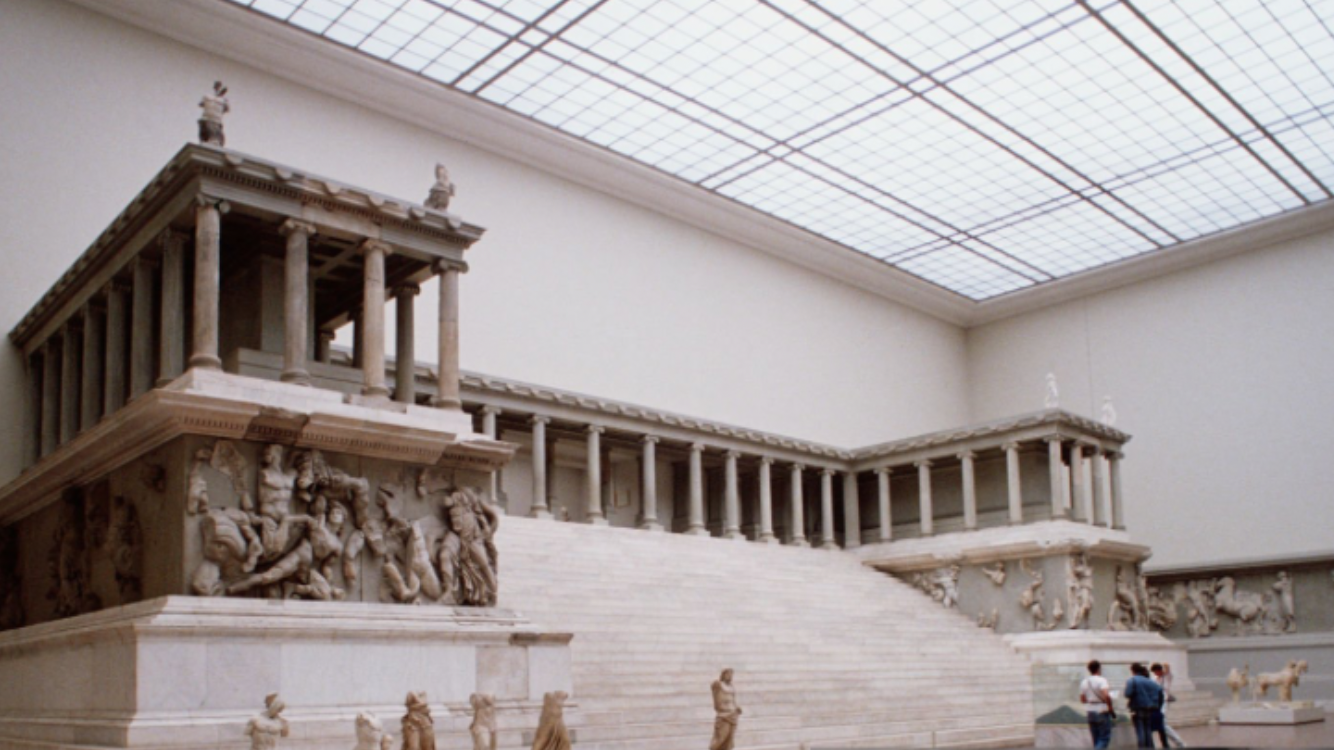
It was also in Nuremberg that Hitler used the phrase “Final Solution” for the first time in public. Hitler’s Final Solution is known as the Holocaust, a word that comes from a Greek word meaning “a wholly burnt animal sacrifice.” On the ancient Altar of Zeus in Pergamon, burnt sacrifice was practiced. Centuries later in Nuremberg, in the redesigned Pergamon Altar, Hitler announced his Final Solution to the world and this time, the burnt sacrifice was six million Jews. (CFI-USA)
This museum also houses a reproduction of the Ishtar Gate which was the northernmost entry point into Babylon. The Ishtar Gate is also known as the gate of hell! Have you ever considered that Satan might have a seat on this earth? Later on in our study, we are going to see this seat moved to the temple in Jerusalem. Perhaps during the days of Hitler, the throne of Satan was literally moved from Pergamum to Berlin. I find it interesting that artifacts referred to as the throne of Satan and the gate of hell are both located in the same place.
Can you imagine how difficult it would be to live in such a place? I live in the Bible-belt and I think it’s terribly ungodly here from time to time. But, to live in a place that Jesus Himself referred to as the throne of Satan would have been incredibly difficult. One of the early church martyrs, Antipas, is mentioned as living and dying in Pergamon.
21. As difficult as it was to live there, what does Rev. 2:13 say about how the church in Pergamon lived out their faith?
22. What did Jesus say He had against them?
23. Balaam and Balak, are referred to in Rev. 2:14 as teaching the Jewish people to do 2 things. What were they? (Also note that this is a reference to Num. 22-25)
The prophet Balaam had convinced King Balak to bring corruption into the camps of the children of Israel by having them intermarry with foreigners, which God had forbidden. As a result of bringing in foreign wives, these foreigners brought in their own gods and introduced the Jewish people to idolatry. Therefore, the doctrine of Balaam in this context refers to the belief that believers should intermingle with unbelievers and engage in idolatry. I want you to think about the slippery slope of false doctrine. Satan is a subtle creature. He rarely comes on hard and in your face. Most of the time, he introduces things in slow increments. Let’s look at the progression of false doctrine in a church and in individual lives:
There is an atmosphere either in the church or in a local culture where false doctrine is repeatedly taught and eventually it becomes characterized as normal and good. People do not stand against this kind of teaching. They tolerate it.
Because people tolerate this false teaching, it is eventually accepted as true and good.
In the end, people celebrate false doctrine as truth and criticize and demonize those who don’t.
The church at Pergamon held fast to the name of Jesus and didn’t deny Him, but look what they allowed! There should always be a clear distinction between the Church and the world. If we allow sin to take place in God’s house or in our own body, and do nothing about it, we cease to honor God. Whether we teach false doctrine, or allow it to be taught, or accept it as truth, we are sinning against a holy God.
The church at Pergamon lacked discernment and they lacked the guts to speak up and stand against what had crept into their church. In Rev. 2:16, we see another reference to the sword, or the Word of God and this church is told that God would actually fight against them. Friends, what we have in our Bibles is Jesus in writing. He is the Word!
24. Read 2 Thess. 2:8. When Jesus slays, how does He accomplish this? Does He use any kind of weapon?
25. What comes out of the mouth of Jesus is power! If we have that in writing, shouldn’t we consider its strength? Think about some of the unbiblical things that go on in churches around you and in our country that are tolerated, accepted, or even celebrated. What are some of those things?
Have you ever said anything or pushed back in any way against false doctrine? Perhaps you haven’t ever had the need to, but there may be a day when you have to take a stand against ungodliness. Don’t be surprised when that day comes. The Lord will be your strength and your mouthpiece.
One of the promises Jesus made to this church if they overcame was hidden manna. When the children of Israel were wandering in the wilderness, God fed them food from heaven called manna. The hidden manna mentioned here is likely a reference not to physical food, but to spiritual food. The other promise was of a white stone.
26. What is special about this stone?
Urim and thummim were white and black stones. They were sometimes used in judgements where the white stone represented acquittal and the black stone meant conviction. During the days of the Roman Empire, a white stone was also used as a ticket to gain entrance into an event. Those who overcome will be granted entrance into the kingdom of God because they have been acquitted of their sins. And on our white stone will be a new name that is given by the Giver of life Himself and known only to Him.
The church at Thyatira
Thyatira was located in a valley and was known for its trade merchants and linens and wool, potters, weavers, and tanners. The Roman elite guard was stationed in this city which gave many of the inhabitants a sense of safety. It was a small city about 40 miles southwest of Pergamon. Apollo, the sun god, was worshipped there. This letter is the longest of the 7.
27. Read Acts 16:14. Who else was from Thyatira?
This woman, the seller of purple, was Paul’s first convert in Europe. It might have been Lydia who started this church, but it is unlikely that she was still living at the time John wrote this letter.
28. Read Rev. 2:18-29. The church at Thyatira seems to have a whole lot going on, but what are they doing well?
29. In Rev. 1, Jesus is referred to as the Son of Man. How is He referred to and described in the letter to this church in Rev. 2:18?
I want to also note the usage of the word “like” in this verse. Jesus did not have fire coming out of His eyes and He did not have feet made out of brass. These words were all that John had in his own vocabulary and life experiences that allowed him to describe to us what Jesus looked like.
This church was obviously growing because they were doing greater and greater deeds as time went on. But, here again, we see that they are doing something familiar to what we have already learned in regards to these other churches. They were tolerating things they should not be tolerating. John Wesley so wisely said, “What one generation tolerates, the next will embrace.” I have a feeling that he would roll over in his grave if he knew what was going on in the United Methodist Church and the Southern Baptist Convention and the Presbyterian USA, and a host of other denominations today. For all of the incredible things this church was doing, there was a strong condemnation for them.
30. The name Jezebel is a familiar name from the Old Testament. Read 1 Kings 16:31-33 and record who Jezebel was.
31. What did Jezebel bring into her marriage with King Ahab?
32. In 1 Kings 18:4, what did Jezebel do to God’s prophets?
33. What else was Jezebel guilty of in 2 Kings 9:22?
34. What was her fate in 1 Kings 21:23-25?
The name Jezebel has become synonymous with a woman who is manipulative and evil in all her ways and seeks to turn the hearts of others in the wrong direction. She was one of the most wicked women in the Old Testament.
35. What connection do you see between the Jezebel of the Old Testament and the Jezebel at the church at Thyatira?
This woman was combining Christianity with other religions and this church tolerated it! She was promoting more than just fornication, she was encouraging those who were married to break their marriage vows and participate in adultery. Marriage is a covenant relationship. It is such an important relationship that God used this to describe the relationship that Christ has with His church (the bride).
Some scholars use the Greek word for woman in this verse to mean “thy wife.” So, this Jezebel-like woman could have been the pastor’s wife. It doesn’t really matter because she was in this church and they tolerated her behavior. Her children are referred to in Rev. 23. This does not mean her actual biological children although her actual biological children could be her disciples as well. It is instead referring to those who believe and follow what she says. It is her spiritual children that this verse refers to.
36. What will be the destiny of this woman and her children?
Are you beginning to see a theme as you review the issues these churches had? Although not everyone in the churches with a condemnation from Jesus were involved in the unbiblical actions and promoting of false doctrine, most of them were guilty by association simply because they did not stand up for the truth and oppose the lies. But Rev. 24-25 lets us know there was a godly remnant in this church. For that remnant, Jesus exhorted them to hold on until He comes. As bad as things were in the church at Thyatira, this remnant was apparently displaying the true inner and outer characteristics of a true believer. It is this church that Jesus first made reference to His coming. In the previous 3 letters, there was no such reference.
This church should be a lesson to all churches that small departures from the faith will eventually lead to major defections. The primary thing that kills a church is false teaching. We have a lot of dead churches!
37. In Rev. 2:26-27, what kind of authority will Jesus give this church if they can hold fast until He comes?
This is a message to the faithful believers in this church and in any church that we will share in the millennial reign of Christ and judge the nations at His return.
38. Some of this content was taken from Psalm 2:1-9. Read these verses. What is the analogy given of what the response of the wicked will be when they are broken “with a rod of iron?”
Think about being a potter and fashioning a vessel in whatever manner you choose. And then, if you are not satisfied with that vessel and you smash it with a rod of iron, then the vessel’s fragility is revealed. This imagery is often used to depict the power of a righteous ruler, like Jesus Christ to subdue and judge the nations. And guess what, He gives us the authority to be part of that judgement!
39. In Rev. 2:28, Jesus tells this church that if they do what He has instructed them to do, then He will give them “the morning star.” What or who is the morning star according to Rev. 22:16?
This letter closes like the others, “He who has an ear, let him hear.” This is a plea to those who were part of that church to choose to listen. It is normal for human beings to have ears. To not have ears would be considered abnormal. This is a call to pay attention and understand the deep things of the Spirit that are behind the physical words. We may hear things in our lives and not be receptive to what we hear. But when the Spirit of God tells us to listen, we had better heed that message. No person will ever hear the truth unless that person wants to know the truth.
© Cindy D. Ketron. All Rights Reserved
Thank you for prayerfully considering partnering with us.