Revelation Lesson 5
Video posted below after class is completed.
Keep scrolling to read the lesson on this device
Download Questions Here
The Book of Revelation
Lesson 5, Chapter 4
By Cindy Ketron
On The Edge of Eternity
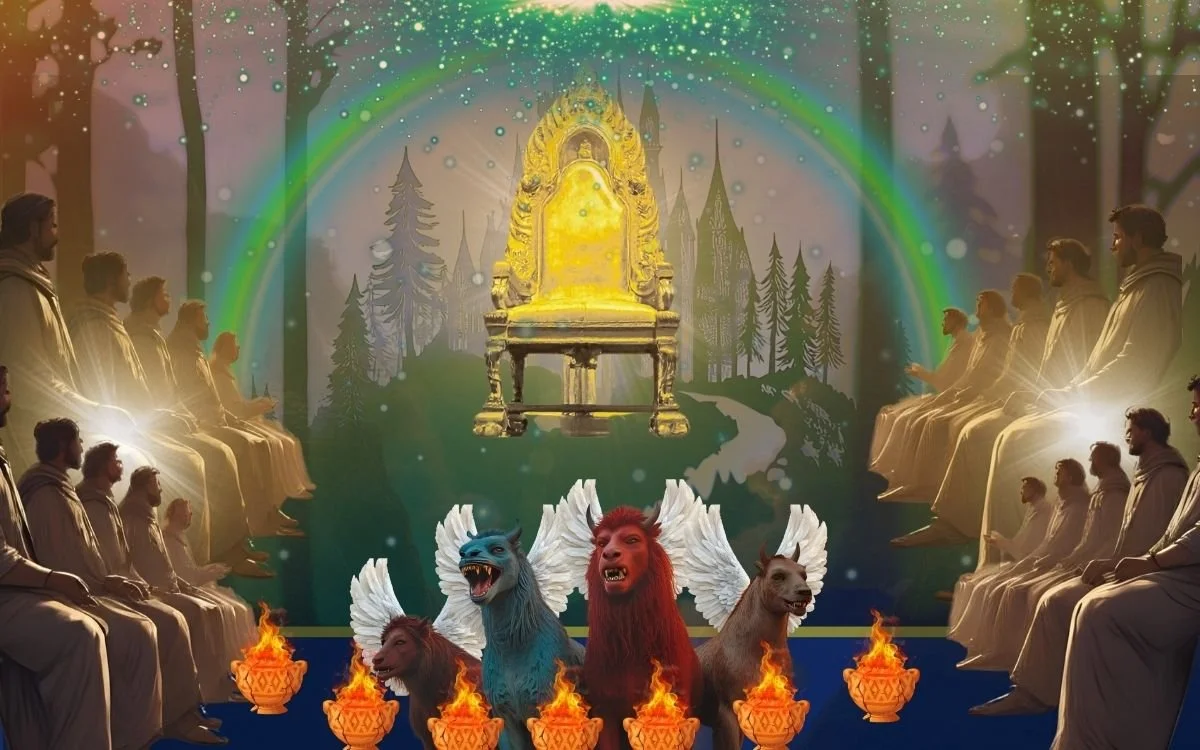
Ah, the throne room of God! That’s where we are headed this week! This begins the last section of the book. Let’s look at the outline again that was given to us in Rev. 1:19:
Section 1 - Chapter 1 - The things which you have seen - Jesus amongst the candlesticks
Section 2 - Chapters 2-3 - The things that are - 7 churches (Church Age)
Section 3 - Chapters 4-22 - The things which will take place after these things
As you can see, the last section is most of the book! Everything from chapter 4 til the end of the book is not in chronological order. However, most of it is. In some passages, we will be looking back at previous things in history. Before we jump into Chapter 4, we must answer a few questions. We have seen Christ amongst the candlesticks inspecting His churches. We have looked at all 7 of the churches in Asia Minor and examined the letter to each of them. When we get into Chapter 4, we are suddenly in the throne room of God in heaven. Here’s the question, when did the rapture of the Church occur? Every believer wants to know this with certainty.
I’ll tell you what my favorite theologian, Dr. John MacArthur says about this, “The rapture of the Church happens on the white part of the page between Chapters 3-4." There is no mention of the rapture in the book of Revelation. However, I believe that the rapture is absolutely in the Bible. Revelation 2 and 3 were written for us, the Church. The rest of the book deals with the Jewish people (ie-the nation of Israel). There are 19 references to the Church in Rev. 1-3. We don’t see the Church again until we get to Chapter 22, but the transition into the next stage of eternity begins in Chapter 19 with the Bride of Christ, that's us! Since this is the place in Scripture where the rapture would have happened, we’ll address this first before moving into the throne room. I am not going to try and convince you that my way of looking at this is correct. My prayer, as always, is that you will investigate Scripture yourself and come to your own conclusions about the timing of the rapture. We're going to expound a little more this week on the rapture of the Church.
We have already addressed the fact that in our culture, we look at prophecy as something that has not yet been fulfilled but will be in the future. This, however, is not how the Jewish mind looks at prophecy. The Jewish model is based on patterns that repeat. For example, something that has happened in the past and will repeat itself in some form or fashion in the future. In this regard, there is a pattern in ancient Jewish culture that mimics the rapture of the Church, and we see much of it in the pages of Scripture. That pattern is the ancient Jewish wedding. If you have not studied this before, I promise that you will receive a blessing from it.
Engagement/Betrothal
It was common in ancient Israel for the father of the groom to select a bride for his son. Once she is selected, a very long and elaborate sequence of events then takes place.
One of the key components in the ancient Jewish marriage proposal was the Marriage Covenant. The betrothal period began with the establishment of a marriage covenant. It would have been like our modern-day engagement period except that it was legal and binding. In this covenant, the groom would specify all that he would provide for the bride. The groom and his father would travel from his father’s house to the home of the prospective bride. There, he would negotiate with the father of the young woman (the bride to be) to determine the price he must pay to purchase his bride and this would all be spelled out in the marriage covenant.
The price paid by the father of the groom for the bride was called the mohar. Let’s translate this over to Scripture. The Father is God. The groom is Jesus Christ. The bride is the Church. In John 3:16, we learn the price that the Father paid for the bride of Christ, the Church. That price was His only begotten Son.
The betrothal contract/covenant was called a ketubah and states the bride’s price, the promises of the groom, and the rights and privileges of the bride. It also promises that the groom will work for her, will honor her, will support her, and will provide food, clothing, and necessities for her, as they live together as husband and wife. The groom further promises that their relationship will be based on truth. This contract had a provision in it that the bride would wait and be prepared for her groom’s return every night until the wedding feast took place.
1.Read James 2:5, Titus 1:2, and Phil. 4:19. What is God’s promise to us?
2.Read Ps. 23. This is also part of God’s ketubah/covenant with us. What does He promise us in these verses?
Mikvah/Baptism
3.Read Acts 2:38-39. What is God’s promise?
After the ketubah/covenant was signed, the bride and groom would separately go and cleanse themselves in the mikvah or cleansing bath. After the bride and groom’s individual mikvah, they would appear under the huppah or canopy, in public view and would express their intention of becoming betrothed or engaged. It was their way of publicly saying that they were now in a new relationship that was binding.
4.Read Gal. 3:27-28. Believer’s baptism would be the equivalent of a mikvah. For the Christian, what does baptism symbolize and how is it like the mikvah for a Jewish wedding?
Drinking the Wine
While under the huppah, the bride and bridegroom both share a glass of wine as a symbol of the covenant that has been established and they would then exchange vows. Afterwards, a betrothal benediction would be pronounced. This is the only ceremony the couple would have and although they were legally betrothed, they would not consummate the marriage until the groom returned at a later date to take his bride back to his father's house.
5.Read Matthew 26:27-29. How is what you read in these verses similar to what the betrothed bride and groom do under the huppah?
Departure
At this point, the bridegroom would leave and depart back with his father to his father’s house to begin building the bridal chamber. Just prior to departing, he would leave the bride a matan or bridal gift, just to remind her of his pledge of love for her during their days apart. He didn’t want her to forget about him.
6.Read John 14:16. When Christ departed to heaven, what matan/gift did He leave His bride, the Church?
The Holy Bride
From the moment of the betrothal, the bride was declared to be consecrated or sanctified, set apart exclusively for her bridegroom - HOLY. During this time, the bride would cover her head when she went out to signify that she was betrothed to be married.
This period of separation afforded the bride time to gather her trousseau and prepare for married life. The groom occupied himself with the preparation of living accommodations in his father’s house to which he could bring his bride to when the time was right.
7.John 14:1-3 is a set of verses familiar to all of us. How does this fit in with the groom’s return to his father’s home?
Friends, this is marriage talk! Your groom is preparing a place for you!
Preparing the Wedding Chamber
During the time of preparing a wedding chamber for the bride at his father’s house, the groom may work for a year or two. The place being prepared for her must be better than the place where she lived prior. Nobody knew when the father would say, “Son, go get your bride!” Only the father knew this. It was customary for the groomsmen and the bridesmaids to ask the bride and groom when the groom would come for his bride. The customary answer was, “No one knows, not the angels in heaven nor the groom. Only the father knows.” The bride would have to be ready to leave at a moment’s notice and so would her bridesmaids.
8.Read Mark 13:32. What do you learn in this verse about the return of Christ for His bride?
9.Read Matthew 25:1-13. Contrast the foolish and prudent virgins. What do you think the lesson is for us as the bride of Christ?
In the ancient Jewish wedding, the father of the groom would generally wake up his son at midnight and tell him to go fetch his bride. Once that happened, the groom and all his groomsmen would parade through the streets of Jerusalem with their torches lit, singing and shouting for the bride. The best man would be by his side and would sound the trumpet or ram’s horn to alert the bridal party that they were on their way. Could it be that the archangel Gabriel will be Jesus’ best man? He has already been in the pages of Scripture making the birth announcements of Jesus and John the Baptist.
10.Read 1 Thess. 4:16-18. What similarities do you see with these verses and the Jewish marriage?
11.The Greek word in Scripture that means, the gathering up, is the word harpazo. We refer to the harpazo as the rapture. Read 1 Cor. 15:51-53. How does this verse correspond to 1 Thess. 4:16-18?
The Marriage Supper
Shortly after the arrival to the home of the groom’s father, the bride and groom would be escorted by the other members of the wedding party to the bridal chamber. While the groomsmen and bridesmaids would wait outside, the bride and groom would enter the inner sanctum of the bridal chamber alone. There in the privacy of that place, they would enter into a physical union for the first time, thereby consummating the marriage that had been covenanted earlier. The groom would open the door and hand the blood-stained bridal garment to the attendant outside the door to show that the bride was a virgin.
12.Read Rev. 19:7-9. What happens in heaven after the bride/Church is in the place that Jesus has prepared for her?
The Jewish bride, groom, and wedding party would remain in the father’s house for 7 days. All the wedding party and guests would be clothed in white garments. Once all the guests were inside, the doors would be shut and locked and nobody else would be allowed to enter. Similarly, if you believe in a pretribulation rapture of the Church, the Church will remain hidden for 7 years while the 70th week of Daniel (Dan. 9) that includes the Great Tribulation period takes place on the earth. The Church will be in heaven totally hidden from the sight of those living on the earth.
13.Read Acts 2:38-39 again. Remember what you recorded earlier regarding God's promise to us. With all these similarities and patterns, can you see how God has woven the rapture of the Church into Scripture?
14.Read Jesus’s words to the church at Philadelphia in Rev. 3:10. What do you think the hour of testing is referring to?
Sweet friends, I remember teaching this to a class back in 2017, and an elderly lady in my class went home and shared this information with her husband. She said he wept as he realized God’s provision for His children through the snatching up into heaven that will happen prior to the 70th week of Daniel. It was only 2-3 weeks later that this precious man went to be with the Lord. I felt then and I feel now that his learning this information prior to his death allowed him to face death with the anticipation that God had indeed prepared a place for him.
15.Go ahead and read Rev. 4:1. How does this verse begin and end?
When we see transitional words in Scripture, we need to ask ourselves what are we transitioning from and what are we transitioning to. The Greek word for “after these things” is meta tauta. If chapters 2-3 are the letters to the 7 churches which represent the Church Age, then we’re transitioning out of the Church Age and into the next phase which leads the reader into the tribulation period. The same word meta tauta is also used in Rev. 1:19. Remember, John was living at the very beginning of the Church Age.
The word must in v. 1 is the Greek word dei, which means, “it is necessary, necessity brought on by the conduct of others towards us; necessity established by the counsel and decree of God”. Why are “these things” necessary and decreed by God? Because the world has rejected Him.
It is interesting to note that the word, church, was used repeatedly in chapters 2 and 3, but it will not be used again until Rev. 22:16. This is yet another reason that many believe the Church is no longer on the earth but has been taken up (raptured) and the wrath of God is going to be rained down on wicked humanity because God is a just God. There must be a price paid for sin. He hates sin, but He loves humanity. And while He desires that all men (and women) would know Him, He simply cannot allow sin to go unchecked and unpunished.
16.What do you learn about this from 2 Pet. 3:9-10?
17.What else do you learn in Rom. 1:18-22?
There will not be a single human being who has ever lived or who will ever live who will have an excuse. Even creation declares the majesty and glory of God! (Psalm 19:1)
18.What do you learn about the wrath that is to come from 1 Thess. 1:10 and 1 Thess. 5:8-11?
While the rapture of the Church is not a major doctrine, it is an important one. I, for one, do not want to go through the tribulation of the last days. There are brothers and sisters in Christ who have differing opinions of the last days and in particular, the rapture. We looked at that in lesson 1. Read Rev. 4:1-4. John is the last remaining apostle who is still alive at the writing of this book. He had been banished to the Isle of Patmos by Domitian and in his exile, he is instructed to write this book.
19.Where is he suddenly transported to?
“After these things”....After the 7 letters to the 7 churches, we are suddenly in the throne room of heaven. The word throne is mentioned 14 times in this chapter. We don’t know what that room looks like exactly. We only know how John described it. A lot of artists over the last 2000 years have tried to depict this room through paintings. The one at the top of this lesson is one artist’s rendition of what he thought it might look like.
I’m not sure if John was actually in the throne room in heaven or if he saw it in a vision and I'm not sure that even matters. The important thing is that this was revealed to him by Jesus. What we have in chapters 4 and 5 are introductions into the rest of the book. For those people who believe that the events of this book have already occurred, they have reduced the book of Revelation to an almost fantasy-like tale. Here’s the bottom line of chapter 4 - HEAVEN IS A REAL PLACE!!!!!! We are going to get a glimpse into the worship that goes on in heaven. Have you ever heard someone ask what we’re going to be doing in heaven? I know for a fact that we will be worshipping, working, and eating because all of those are clearly written about. I've heard people say regarding those things, “That’s all? That doesn’t sound interesting!”. Let me just tell you, we cannot reduce the things that go on in heaven to what we have experienced here on earth. Heaven is like nothing we’ve ever seen, and we won’t grasp it until we get there. No, Grandpa is not going to be up there trout fishing. No, Susie won’t have all 10 dogs and cats she’s known here on earth. It is truly beyond our human imagination.
20.What do you find in Rev. 1:10 and Rev. 4:1 that is alike?
21.Undoubtedly, this is the same voice! In Rev. 4:2-3, what is different about this rainbow than our rainbows?
22.What 2 precious stones are mentioned here to describe the One who sat on the throne?
The high priest in Israel had to wear a very particular garment. It was a garment that God gave the pattern for in Ex. 28 and Ex.39. On the breastplate of this garment were 12 stones that represented the 12 tribes of Israel. One precious stone was assigned to each of the 12 tribes and each stone was engraved with that tribe.
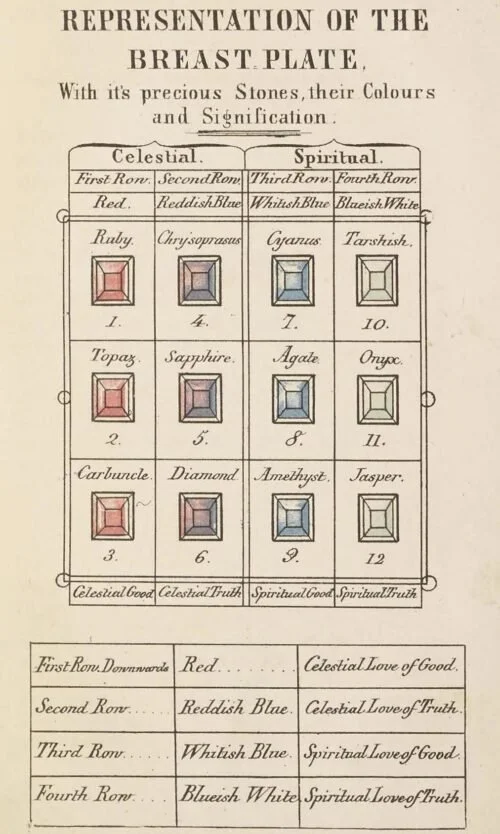
Image Credit Robert Hindmarsh
Let’s look at the stones that were assigned to each tribe in birth order:
Reuben - Ruby
Simeon - Prase
Levi - Carbuncle
Judah - Emerald
Issachar - Sapphire
Zebulun - Pearl
Dan - Leshem
Naphtali - Turquoise
Gad - Crystal
Asher - Chrysolite
Joseph - Onyx
Benjamin - Jasper
Pay close attention to stone #1, stone #12, and stone #4. Read Exodus 28:17-21. These stones are listed in birth order. Ruben was the first-born son of Jacob. His name means behold a son. Benjamin is the last-born son of Jacob. His name means son of my right hand.
Jesus is the Son of God and He is the Son who is sitting at the right hand of God. Jesus is the Lion from the tribe of Judah. So what John saw was the first and the last stone of this breastplate and he saw an emerald rainbow around the throne that corresponds with the tribe of Judah. This simply cannot be by chance, nothing in Scripture is ever just by chance. It is through these colors that John describes the rich background of the throne room in heaven.
The breastplate of the high priest was to be a memorial to God as he went before God on behalf of the nation of Israel. I believe that what we see on earth from the early priesthood in Exodus, Leviticus, and Numbers, came from the throne room of heaven and that Jesus has all of Israel, from the beginning (Reuben) to the end (Benjamin) engraved upon Himself. Is. 49:16, “See, I have engraved you on the palms of My hands.”
23.In Rev. 4:4, what was around the throne and how were they described?
The number 24 is only used one other time in Scripture. Read 1 Chron. 24:3. David divided up the Levitical priesthood into 24 different divisions or courses. There were thousands of Levitical priests and they needed to have some order so that there was no chaos in their service responsibilities. Remember, God is not the author of confusion.
24.Who are these 24 elders then?
We cannot say with complete certainty, but we can put together other information that might lead us to an educated guess. The first distinguishing characteristic of these 24 elders is that they are all sitting on thrones. The second distinguishing characteristic of the 24 elders is that they are wearing crowns.
25.What does Rev. 2:10 and Rev. 3:11 say about crowns?
26.The third distinguishing characteristic is that they will be wearing white robes. From our study of the 7 churches, who will be wearing white robes?
While we don’t know exactly who these 24 elders are, we might assume that they are 24 representatives of the Church. At least, this interpretation is consistent with what we have already read that was promised to the churches in chapters 2 and 3. I’ve heard these 24 elders described as many different groups from the 12 sons of Jacob/Israel, to the 12 apostles, to the prophets, to representatives of Israel, to angels and to the tribulation saints. But for various reasons that are too exhaustive to go into here, none of these groups fits the description as outlined in Rev. 4.
Every word matters and this is a clear case of why it matters! The first books of the Bible were written thousands of years before the New Testament and yet, they correspond perfectly with each other. This is the supernatural ability of a book that God has put His thumbprint on.
Each of these 24 elders wore a crown. In the New Testament (Greek) there are 2 different kinds of crowns:
Diadem - the crown of a ruler or sovereign that represents governmental authority
Stephanos - the crown of a victor
The word used here in Rev. 4:4 is stephanos. We can deduct from this translation that those 24 elders were wearing crowns because they had accomplished some kind of victory. Although the book of Revelation is not in complete chronological order, it is mostly in chronological order. Assuming that John saw this vision of the throne room and that it was prior to the beginning of the tribulation period (which we have not gotten into yet), then the 24 elders could not be angels because angels have not been judged yet. That comes much later.
27.What do you learn in 1 Cor. 6:2-3 about angels?
All angels will not be judged by saints. There are some who will be judged by God and we learn about this in 2 Pet. 2:4, Jude 1:6, and Rev. 20:10.
Therefore, we can mark off the 24 elders as being 24 angelic representatives. For the same reason, they cannot be representatives of Israel because it appears that they do not get judged until the end of the tribulation. Therefore, it would not fit correctly into our timeline. This really just leaves the Church (of which the apostles are part of). Since the Church is raptured after chapter 3 and before chapter 4, this would be my best guess. In the end, we cannot be dogmatic about who these 24 elders are, but as a means of elimination, I think we have a pretty good idea.
Read Rev. 4:5-11. There is incredible worship going on in the throne room of God. We have already read in 2 different places about the 7 spirits of God in Rev. 1:4 and Rev. 3:1. We will see this reference again when we get into chapter 5. Rather than viewing this as 7 different spirits, it is more closely related to the 7-fold Spirit of God which is the Holy Spirit.
28.What is spread out before the throne in Rev. 4:6?
John does not elaborate on this. In certain areas of this book, it appears that John expects the reader to understand and draw from other passages of Scripture and to understand the significance of certain things. The sea of glass may be one of those things. We have no idea if it is water as in a real sea, or if it is a clear crystal-like floor of some kind that is see-through. When we get over to chapter 15, we’re going to visit this sea again. John used the qualifiers “as it were” and “like crystal” to let us know that what he was seeing was not an actual sea of glass, but that is what it looked like to him.
29. If we are looking in Scripture for a pattern of this sea of crystal, we might look at 1 Kings 7:23-26 and 2 Chron. 4:2-5. What is described in these verses and how is it described?
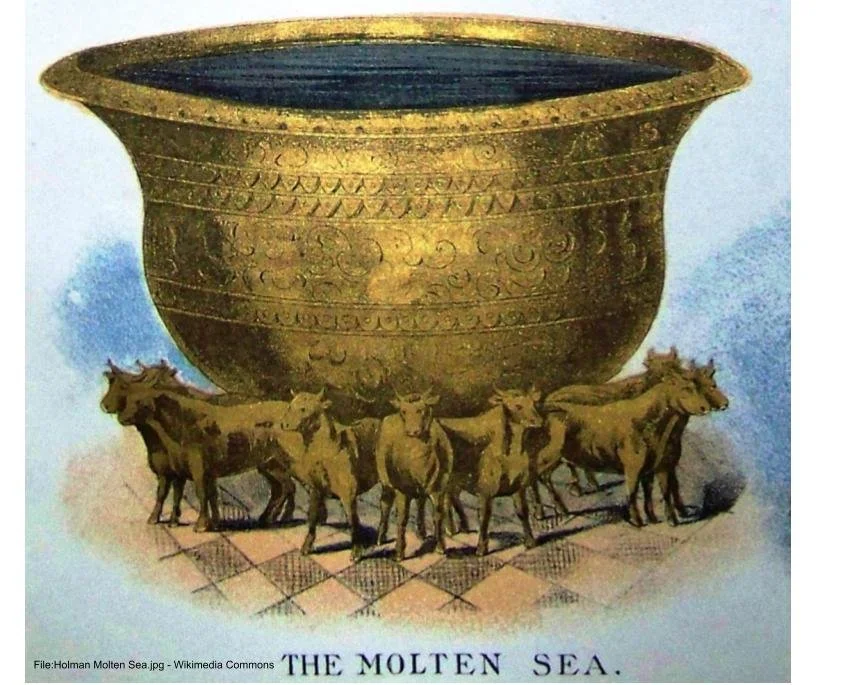
The molten or brazen sea was in Solomon’s temple. That would have been common knowledge to those Jews in the 1st century. Herod’s temple during the first century also had a molten sea, but it wasn’t nearly as big and elaborate as the one in Solomon’s temple.
The purpose of the molten sea or brazen sea was a receptacle of water that was used for ritualistic cleansing in the temple. The basin contained enough water for 150 ritual baths. The water was used for purity and the bronze container represented judgement. It was a big piece of furniture, almost 15 ft x 7 ½ ft. and was supported by 12 bronze oxen. You could not go before the Lord without being clean. You still cannot go before the Lord without being clean.
30.In Rev. 4:6-8, we are introduced to 4 very interesting creatures. Describe them.
31.Read Isaiah 6:1-3. What similarities do you find with the previous verses?
32.Read Ezekiel 10:14 and note how Ezekiel’s vision from God’s throne corresponds with what you’ve already read.
How can we make sense of these 4 beasts with what we already know from Scripture? Remember, prophecy for the Jews was a pattern. Let’s take a look back to the Old Testament again and examine how the 12 tribes of Israel encamped around the tabernacle. In Numbers 2, we read about the arrangement of the tribes around the tabernacle.
33.In Num. 2, we read about the arrangement of the tribes around the tabernacle. I want you to list the tribes for each of the encampment areas below. There will be 3 tribes camped to the North, 3 to the South, 3 to the East, and 3 to the West.
(North)
—------------------------------------------------------
(East) Tabernacle (West)
—------------------------------------------------------
(South)
Although there were 3 tribes on each side of the tabernacle, there was a primary tribe from each of the 3 that defined each of the geographic areas. Below are the 4 main tribes and the symbols that correspond to each:
East - Camp of Judah - lion
South - Camp of Ruben - man
West - Camp of Ephriam - ox
North - Camp of Dan - eagle
34.Now, go back to Rev. 4:7 and note what similarities you see in the creatures described here and the encampment of the 12 tribes.
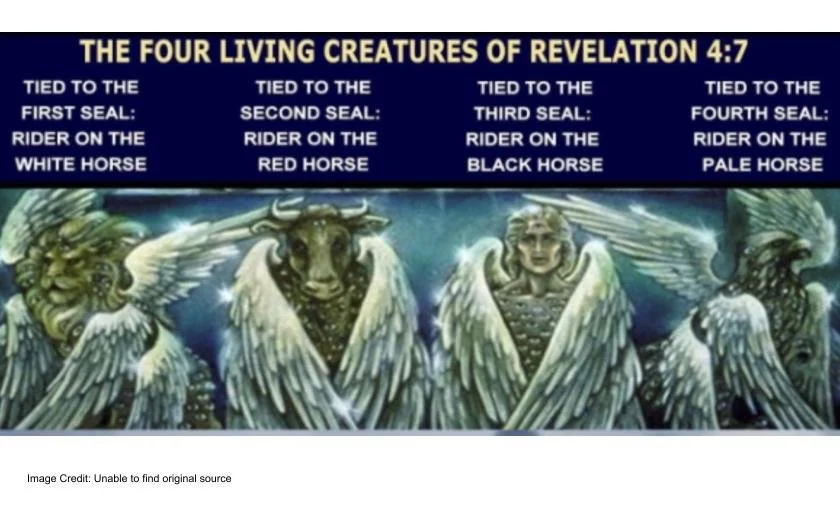
Can you believe this?!! All the way back when Israel was just in its infancy as a nation and they were traveling through the wilderness, God had them set up a tabernacle so that they could worship Him, and He gave them intrinsically specific instructions about how to camp around the structure, even giving each camp a “mascot”.
In each of the categories that these “mascots” are in, they are the superior one of each class. The lion is the king of the jungle! Lions always represent majesty and strength. The ox is the strongest of the domestic animals and is known for its endurance and hard work. Man is the greatest of all of God’s creation. We can reason with our minds and make rational decisions. Animals cannot do this. They live by their animalistic instinct. The eagle is considered the greatest of all birds. Perhaps that is why the U.S. chose it as a representation of our government. We will deal with the connection between the seal judgments and the 4 horses of the apocalypse when we get over to Chapter 6.
Comparison has also been made of the four living creatures to the four Gospels which present Christ in four major aspects of His person. As the lion, He is the Lion of the tribe of Judah, represented as the king of Matthew. As the calf or ox, He is the servant of Jehovah, the faithful one of Mark. As man, He is the human Jesus, presented in the Gospel of Luke, and as the eagle, He is the divine Son of God presented in the Gospel of John. (The Revelation of Jesus Christ, John F. Walvoord, p. 110.)
Who knew that the encampment around the tabernacle was somewhat of a picture of the throne room of God?!!! Nothing escapes the eye of God.
35.In Rev. 4:8, what word is repeated 3x?
36.The word holy is the only word in Scripture that is repeated 3x. Why do you think that is?
It could be that holy, holy, holy is seen in Scripture in triplicate because of the Trinity; the Father, the Son, and the Holy Spirit. However, that is just a guess on my part.
37.What does the word holy mean?
38.Read Rev. 4:9-11. What did the 24 elders and the 4 living beasts do before the throne of God?
Attaining a victor’s crown could only be possible because of the internal power of the Holy Spirit within the life of the believer. This reminds me of the Chris Tomlin song, “We Fall Down”.
We fall down, we lay our crowns
At the feet of Jesus
The greatness of mercy and love
At the feet of Jesus
And we cry, “Holy, Holy, Holy”
And we cry, “Holy, Holy, Holy”
And we cry, “Holy, Holy, Holy”
Is the Lamb.
By the time of the end, every knee will bow and every tongue will confess the name of Jesus, those in heaven, and on earth, and under the earth. (Phil. 2:9-11)
Why do we worship? Our worship is an expression of our love and focus on God and His worthiness of praise and adoration. Worship is a form of gratitude for who God is and for what He has done for us. It draws us closer into a personal relationship with our Creator. True worship transforms us as mere human beings to live lives that are empowered by God.
Just yesterday, I shared with a young friend who is going through a terrible trauma in her life. I told her that there are many things we think we cannot do and then when we find ourselves in the midst of that unthinkable situation, we learn what Phil. 4:13 really means. “I can do all things through Christ who gives me strength.” Friends, that is something worth falling on our knees and casting our crowns before the One who made us and sustains us forever and ever…..Amen!
© Cindy D. Ketron. All Rights Reserved
Thank you for prayerfully considering partnering with us.