Revelation Lesson 2
Video posted below after class is completed.Or, keep scrolling to read the lesson on this device
Download Questions Here

The Book of Revelation
Lesson 2, Chapter 1
By Cindy Ketron
On The Edge of Eternity
The book of Revelation is a message to the Church, not simply to a church. The non-believer could never understand this book because they weren’t meant to understand it. This book was written in apocalyptic language for believers only. There’s a lot of imagery in this book. John saw things far into the future and he explained them from his own point of reference, not fully knowing and understanding all that he saw. As a result of this, John uses the term “like” repeatedly to explain that he might not fully know what it was that he was witnessing, but it was “like” _______. This book is not the Revelation of John, but the Revelation of Jesus Christ.
In the Gospel of John (also written by John) he uses this same kind of language in describing the baptism of Jesus when he said in John 1:32, “and the Spirit came down like a dove (or as a dove).” That does not mean that the Holy Spirit took on the form of a dove. It means that there was something characteristic about a dove that reminded John of the manner in which the Holy Spirit came upon Jesus at the time of His baptism. Perhaps it describes a softness or gentleness. I don’t really know. In any event, we need to make certain that when he uses the word like or as, he is expressing to the best of his ability the scene and not claiming that what he is describing is an exact representation.
Read Rev. 1:1-8. Last week, we learned that the progression of how this book came to be in our hands was in a specific order; from God, to Jesus Christ, to His angel, to John, to the 7 churches, and finally to us.
1. Who is the intended recipient of this revelation?
2. In Rev. 1:1, when will the things written in this book come to pass?
The Greek word en tachei is used here and it doesn’t mean that it will happen in a little white. Instead it means that when it begins, what happens next will be sudden.
3. Who gets blessed in Rev. 3 and why do they get blessed?
This is the only book in the Bible that offers a specific blessing for reading, hearing, and keeping the words. In Lesson 1, I gave you a map of all of the 7 churches in Asia Minor who received these letters we will be looking at next week. Keep in mind that Asia Minor is not the Asia of today. It was Turkey.
4. In Rev. 4, how does John qualify who this book is from?
In this verse, John makes mention that the book is from “the 7 Spirits who are before the throne.” There’s a lot of speculation and disagreement as to what or who these 7 spirits are. We’ll do our best to try and connect the dots and make some sense of this. First of all, let’s see how this revelation was made possible to John.
5. Look at Rev. 1:10. What do you think John meant by the wording that he was “in the Spirit?”
It was the Holy Spirit who was John’s guide into these visions that took him on an interesting journey that no other human being has ever been privy to. These 7 Spirits mentioned in Rev. 4 are likely 7 manifestations of the Holy Spirit and not 7 distinct entities.
6. Note from the following verses what else you learn about these 7:
Rev. 3:1
Rev. 4:5
Rev. 5:6
The number 7 in Scripture is used over 800 times. It is often viewed as the number of perfection and completion. After 6 days of creation and 1 day of rest, we arrive at a 7 day week, which God said was, “very good.” The book of Revelation is all about 7’s….7 Spirits, 7 churches, 7 stars, 7 lamps, 7 angels, and 7 courses of seal, trumpet, and bowl judgments.
We just looked at the order in which John received this revelation. The Holy Spirit was who revealed this information to him. (Note - The Holy Spirit is a person, and not an it.)
7. In Isaiah 11:1-5 we find 6 qualifiers for the Spirit of God. What are they?
I love this illustration below. The temple menorah was symbolic of the work of the Holy Spirit. All 6 branches were lit from the middle branch….the “shoot of Jessee.”
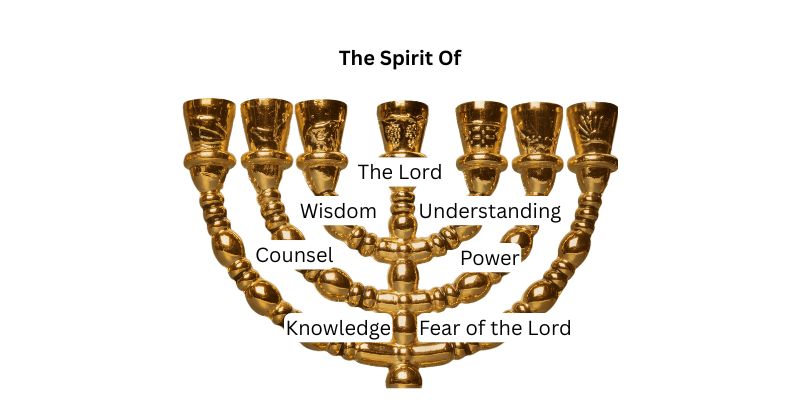
I don’t want to belabor this point, but of all the things mentioned in Rev. 1, this is probably the thing that puzzles people the most. Therefore, it could be this diagram is exactly what was meant regarding the 7 Spirits before the throne in Rev. 1:4 or it could be something totally different. There is no way to know.
When we get to chapters 2-3 next week and study about the 7 churches of Asia Minor that John sent letters to, we will discover that only 2 of the 7 did not receive any condemnation. Here is another interesting thing to note, when the temple menorah that was in the holy place was cleaned, there were always at least 2 prongs that were left burning. In the same sense, 2 of these 7 churches continued to burn the light of the gospel of Jesus Christ while being cleansed.
I have often heard it said that if you want to know where we are on the prophetic time clock, look at Jerusalem and see what is happening there. The nation of Israel is the focus of this book after we get past chapters 2-3. There are a lot of churches who believe in something called Replacement Theology. I believe this kind of theology is heretical because to follow it, you must ignore 27% of the Bible where Israel’s role in the last days is mentioned.
Replacement theology is the belief that the Church has replaced Israel in God’s economy. I hope you will be able to clearly see that by the end of this study, God still and always will hold a special place in His heart for the nation of Israel and for the land of Israel. The Catholic Church believes in replacement theology as do many evangelical denominations. This kind of theology ultimately leads to antisemitism.
Those who adhere to Replacement Theology generally see everything as symbolic and not literal. It is true that there are some strong symbols in this book, but if everything is symbolic, then nothing is real. This is a dangerous way to view Revelation.
In Rev. 1:5, Jesus is referred to as “the firstborn of the dead.” That basically means that He is the first of His kind (to be raised from the dead for eternity) and that there will be more to follow. We are the “more.” The handful of people in the Bible who died and were raised from the dead all had to die again. Jesus never had to die again, and when our bodies are raised to immortality, we will never have to die again either.
8. What 2 offices are spoken of in Rev. 1:6?
Never until the formation of the Church could an individual be a priest and royalty at the same time. Those who were in the royal line in Israel could never have served as a priest because priests were all from the tribe of Levi. But we are both royal and priestly, a unique characteristic of those within the Church.
9. Is Rev. 1:7 speaking of the 2nd coming or the rapture of the Church? Why?
You might want to go back to the first lesson and review what you learned about the rapture. The rapture of the Church and the 2nd Coming of Christ are 2 different events.
Let’s look at some fundamental differences in the 2:
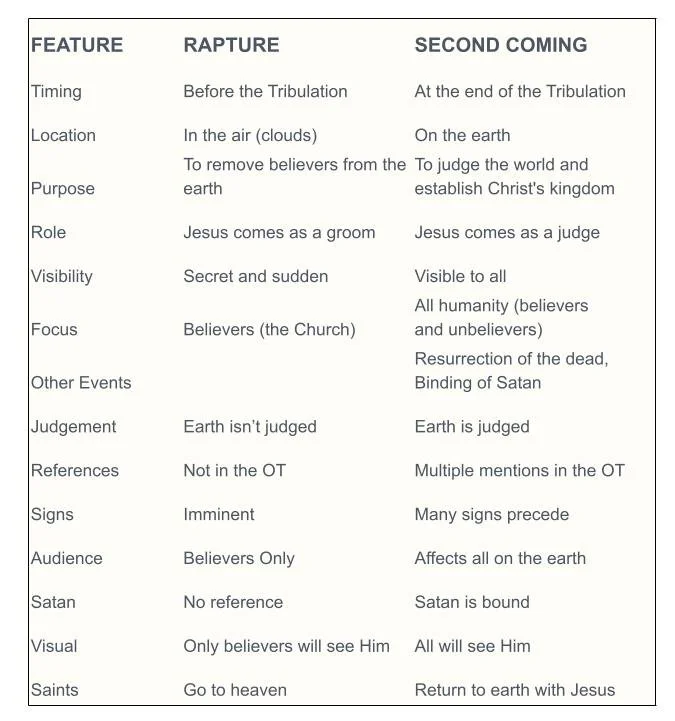
There are those who will say that there is no difference between the rapture of the Church and the 2nd coming of Christ. However, Scripture is very clear in that there is. We will get to the 2nd coming of Christ when we near the end of this book.
Read Rev. 1:9-20. In these verses, John relates to us as believers in 3 ways. Here are the ways that he is connected to us:
Perseverance - the attitude
Tribulation - the battle
Kingdom - the prize
I remember when my man-child, Colton, was playing high school football. Right before school started back during the hot month of July, the players would have what was called "2-a-days". That means that they would have 2 practices per day. It was grueling! On many of those days, he would walk through the door after the second practice barely able to walk because he was so tired and his muscles so overworked, but he kept going (the attitude). Here’s the thing, he knew that in another week or two, he’d be playing a football game (the battle). The reason he pushed himself was that hopefully at the end of the rainbow (the end zone), his team would win (the prize).
Let’s transfer that over to our situation as believers. We need to cultivate the attitude that regardless of the circumstances of our lives (illness, job loss, death of a loved one, divorce, persecution, etc.) we WILL hold onto the Truth! The truth is that Jesus has already made the touchdown and won the victory! We need only to persevere to the end of the battle (the tribulation of life on earth and not the 7-year tribulation). Our prize is eternity in heaven with Jesus.
If you’re reading this and wondering if you can or will persevere, do not worry! It is because you are a believer that you will persevere and you will join John in heaven. This is the message he is conveying to us.
10. Read 1 John 5:5 -12. Record everything you learn about being an overcomer.
The Greek word most often translated “overcomer” stems from the word nike which means “to carry off to victory” (Strong’s Concordance). This word carries the implication that a battle is occurring all the time in some form or fashion. Do you ever feel like the moment you step out in faith to do something for the kingdom of God, that darts are thrown your way to impede your journey? That is actually part of the journey. We are in a daily battle. That battle is only going to get increasingly more intense as we move deeper into the last days.
In my 30+ years as a counselor, I have walked through the grief process with more men, women, boys, and girls than I could count. Here’s something I learned years ago; you can get through the death of someone you love deeply, but you never get over the loss in the sense of forgetting about the pain so that it no longer hurts. That is not really what the over means in overcomer. The word over means to rise above. As overcomers, God gives us the capacity to rise above and move beyond our pain and to know that even in our darkest hours and deepest waters, He will give us the capacity to rise above and move beyond our pain.
So, what is the difference between our problems as believers and the problems that unbelievers experience? Nothing! Trials and tribulations are an occupational hazard of breathing! The problems that all human beings face are similar. But, only the believer in Christ gets to have hope that their worst nightmare will one day evaporate after one breath in heaven. Yes, we certainly will rise up, up and over!
11. In Rev. 1:10, what do you think John meant by the statement that he was “in the Spirit”?
He uses this terminology 4x in the book of Revelation. (1:10, 4:2, 17:3, 21:10). Each time it is used, it seems to denote a different vision. Did his mind go somewhere but leave his body behind? We don’t really know from Rev. 1:10.
12. Something similar happened to the prophet Ezekiel in Ez. 8:2-3. Read these verses and record the situation.
I’m not entirely sure that it matters whether or not this vision was placed on John’s mind or whether he physically experienced it. What we do know is that his experience was beyond the norm of human experience. Whatever it was, this would not change the content of the message.
13. What day did John have this initial vision?
14. John says that he was “in the Spirit on the Lord’s day. Is there a difference between the Day of the Lord and the Lord’s day? Keep in mind when answering this question what terminology is used in the following verses before answering; Acts 20:7, 2 Pet. 3:10, 1 Cor. 16:2, John 20:1, Joel 1:15, Jer. 46:10, and Isaiah 13:9.
Many people, theologians included, have assumed that the Lord’s day is speaking of the first day of the week. I have been one of those people because in modern culture, we use this terminology to mean Sunday. But the first day of the week is never referred to in the New Testament as the Lord’s day. Even the day of Christ’s resurrection is referred to as “the first day of the week”. Therefore, there is no concrete evidence that the Lord’s day as it is mentioned here in Rev. 1:10 is a reference to Sunday as most of us, I’m sure, have thought. (I have even written about this in other studies as being different. Now, I need to go back and correct myself!) Instead, it is more likely that it is a reference to the day of the Lord that we find in the Old Testament. Interesting to note here is that in the Old Testament Hebrew language, there was no adjective form for “the Lord”, therefore, the noun form had to be used. In the New Testament Greek language, there is an adjective form, the Lord’s day. It is more than likely that this term is related to the Old Testament meaning of the day of the Lord which indicated an extended period of time in which God deals in judgement against those on the earth.
We have already looked at the importance of the number 7 in this book. There will be a lot of 7’s in this book.
15. In Rev. 1:12, John sees 7 golden lampstands. What is the purpose of a lamp or a candlestick?
A lamp illuminates the darkness.
16. What is Jesus’ message to the Church in Matthew 5:14-16?
There is a strong warning to the church of Ephesus in Rev. 2:5 regarding their lampstand. We’ll get to that momentarily.
17. Does a candle or lampstand have the ability to bring light on its own?
18. What does it need?
The lampstand is not the light. It is the bearer of the light. We are the bearers of that light as His children.
19. What does John 8:12 tell us about light?
In the temple, there was a menorah which is a 7-pronged lampstand.
20. Instead of having one 7-pronged lampstand, there appears to be 7 different lampstands here in Rev. 1, and in the middle of them, John sees an individual who looks like a son of man. Describe this individual.
21. Who do you think this is?
22. Where was the golden sash?
23. Describe Aaron’s priestly garments as they are described in Exodus 28:2, 4, 31.
Jesus began His role as our High Priest when He ascended to heaven and this was made evident to us as believers on the Day of Pentecost in Acts 2. A priest is one who goes before God on behalf of himself or someone else. In the Old Testament, only men from the tribe of Levi could be priests. As we’ve already learned, a man could not be a priest and also of the royal order. A woman could never be a priest. Therefore, no man could be a priest and a king. If we look back to Gen. 14:18-20, a curious fella named Melchizedek shows up seemingly out of nowhere and is described as the King of Salem and a priest of God Most High. This was atypical, and nowhere else in Scripture is a man described as both a priest and a king until Jesus came to earth. Jesus is said to be of the order of Melchizedek. (Ps. 110:4, Hebrews 7:17)
When Jesus came to earth the first time, He came to save. At His 2nd coming, His role will be different. The placement of the golden sash is our first clue as to why He is coming again. Priests wore their sashes around their waists. Judges and magistrates wore their sashes around their chests.
24. If this is the case (and it is) then what can we say will be the reason for His 2nd coming? (Rev. 1:13)
What is really mind-blowing in this wording is that one tiny word can convey and give so much insight. That’s why EVERY word matters! Two things begin in the house of God, revival and judgement and if the 1st doesn’t happen, the 2nd will. Oh, that we’d all pray for revival in our hearts and across our country, because judgement is undoubtedly coming to this world.
25. Describe His feet in Rev. 1:15.
In the Old Testament, brass, or more properly, bronze, was the metal that was used for the bronze altar, a temple element that was used in the sacrifices for sin. Here, we can assume that the reference to “feet of bronze” has to do with the righteous judgement of Christ.
Let’s review what we know so far. We know that John was in the Spirit on the Lord’s day and he hears a loud voice. That voice told him that he was to write 7 letters to 7 churches in Asia Minor. When he turned to see who was speaking, he described someone as “like the Son of man,” and he was clothed like a priest with the exception that he had on a sash across his chest indicating that he was coming as a judge.. This person was undoubtedly Jesus Christ.
26. Compare Rev. 1:10 and Rev. 1:15.
Both of these verses refer to Jesus’ voice. Anyone here ever been to Niagara Falls? Did you find it difficult to communicate to the person/persons who were with you because of the noise created by the rushing falls? When I read these 2 verses, I think that it would have been difficult to hear anything else except the voice of Jesus. His voice alone, drowns out every other noise. Friends, there are many noises in our lives these days. I want His voice to be the one that drowns out all the others.
27. Compare Rev. 1:16 to Rev. 1:20. What/who are the 7 stars and the 7 lampstands?
The Greek word for angel in these verses is aggelos, which means pastor or messenger. So, these letters were going to the pastors at each of the 7 churches. This makes sense since they would have been the ones shepherding those flocks.
I told you earlier that you would see the number 7 a lot in this book! There is a heptadic (means organized into repeating cycles of 7) structure to the book of Revelation. You might remember that word from high school geometry. Let’s take a preliminary look into the other 7’s in this book.
28. Record what you learn.
Rev. 5:1
Rev. 5:6
Rev. 8:2
Rev. 10:3
Rev. 12:3
Rev. 13:1
Rev. 15:1
Rev. 15:7
Rev. 17:9
Rev. 21:9
Any word or idea mentioned this many times in 1 book must have intrinsic importance.
29. Read Gen. 29:18-30. What was the significance of 7 in these verses?
30. Record the significance of 7 in Gen. 41:25-27 where Joseph interprets Pharaoh's dream.
31. In the Feast of Unleavened Bread, what are God’s people told to do? (Exodus 12:15)
32. When Jesus fed a multitude of people, how did He accomplish this? (Matthew 15:34-36)
33. In Matthew 18:21-22, how many times are we told to forgive others?
I think you get the point! There are hundreds of references to this number in Scripture. But the books of Genesis and Revelation contain more references to the number 7 than any of the other books in Scripture. We have addressed the fact that if Satan could destroy and make irrelevant any 2 books in the Bible, they would be Genesis and Revelation. Hummmmmmm……makes me wonder if the number 7 has anything to do with Satan’s hatred of these books. We’ll unfold this as we move through the book of Revelation. Between these 2 books, there are well over 100 references to the number 7. (I have counted them!)
34. In Rev. 1:16, what came out of Jesus’ mouth?
A two-edged sword cuts both ways if it can be wielded by an accomplished swordsman.
35. Read Hebrews 4:12. What is likened to a two-edged sword?
The Greek word for sword used here in Rev. 1:16 is romphaia as opposed to macharia used in Hebrews 4:12. In the Hebrews text, the sword is an instrument (could be a knife, dagger, or short sword) used to uncover unbelief. In the Revelation text, the sword is an instrument (long and heavy) used for devastating judgement.
In the context of the Hebrews verse, Scripture is the weapon. In the context of the Revelation verse, Jesus is the weapon.
I want you to know that Scripture is not magical. In other words, it’s not trickery. We can’t use it in the sense that we’re casting a spell on someone. However, all Scripture is supernatural. It is beyond our understanding of what is natural. When we read God’s Word and meditate on it and obey it, then in the heat of our spiritual battles, God brings those verses back to the front of our minds, which will give us strength and help us to discern truth from a lie.
Read Eph. 6:17. The sword of the Spirit is the only offensive weapon that the believer in Christ is instructed to carry into battle. Think back on your life when you experienced a dark time and God’s Word brought you peace. Think back on your life when God’s Word helped you discern the truth from a lie. Remembering is one way of strengthening and sharpening.
36. Rev. 1:17, when John saw Jesus amongst the lampstands with the 2-edged sword coming out of His mouth, what was his reaction?
I wonder what my reaction would be. The reaction of others to God (in any form) and even to angels, is most frequently one of fear. I promise you that regardless of who you are, if you were confronted with the majesty of God like. Isaiah was in the temple, and like Moses was with the burning bush and on Mt. Sinai, then you would know absolutely that you are not in charge! I could never count the number of times that I said to my children as they were growing up, “You are not in charge! Mommy and Daddy are in charge and if you do not follow our rules, there will be problems!”
Fear is not a bad thing and neither is submission to a higher authority. Our culture would have each and every person believe that they are completely in charge of their lives, but as believers in Christ, we know differently.
Jesus’ response to John was 2-fold.
37. How did He respond to John’s fear?
Jesus touched John and then He told him not to be afraid. Can you even imagine the touch of Jesus? There were many times throughout the New Testament when He healed people by a touch when He could have healed them with a look or just a thought.
38. Read Matthew 19:13-15 and Luke 18:15-17. These are different accounts of the same story. Describe who Jesus touched.
A gentle touch is calming and sometimes even healing to the individual who is receiving it. Touch is critically important to us as human beings. In fact, we need it for our very survival. When infants are not touched by their primary caregivers, they can suffer from something called failure to thrive syndrome. Those infants don’t eat well or respond mentally and emotionally in a normal way as they grow up. We serve a God who wants us to thrive! He loves us and touches us in our fear to move us out of the darkness and into the light. Imagine His touch, how soft and gentle, yet how strong and reassuring. That was the kind of touch John received on that day as he was surviving on the Isle of Patmos, a touch that said, “Don’t be afraid, you will thrive through Me.”
39. Read Rev. 1:17-18. What did Jesus say to John after He touched him with His right hand?
Note - There is a significance in the Bible regarding the right side being the side of strength and honor. “The keys of death and Hades” is an interesting use of words.
40. Is He saying that death has an actual key? Is He saying that Hades has an actual key?
In the first lesson, we looked at the fact that there are those who look at everything in this book as being symbolic. I’m not one of those. I believe this book contains both the symbolic and the literal.
41. Read Matthew 16:18-19. What did Jesus tell Peter?
When Jesus said this to Peter, the Church had not yet been established. In ancient days, cities had walls and gates for protection. The nation of Israel had high walls and watchmen posted on those walls. Gates kept those in the city safe from harm and they kept those who might mean them harm, outside the city gate. If the gates to the city were not strong enough, the city could easily be invaded. Therefore, gates as a metaphor represent strength and power. If they are weak, they are useless.
42. In reference to Matthew 16:18, what do you think this means?
In the New Testament, Hades is referred to as the realm of the dead. It was believed that upon the moment of death, everyone would go immediately to the place in the underworld referred to as Hades. Luke 16 gives us a birds-eye view into this with the story of the rich man and Lazarus. In many regards, death and Hades seem almost interchangeable.
43. Was Peter saying in Matthew 16 that believers would not experience death?
Obviously, death is appointed to everyone. But the deaths of a generation of believers did not mean that the Church would die out when that generation died out. The Church will continue on from generation to generation until the Lord takes us up in the rapture. The power of death could not keep Jesus in the grave and it will never destroy the Church!
44. Read Romans 8:1-2. What is the difference between the law of the Spirit of life and the law of sin and death?
45. Read Acts 2:24-28. List everything you learn in these verses about the death of Jesus Christ.
46. Read Romans 6:4-10. What an amazing set of verses! How do we benefit from Christ’s death and resurrection?
(John 16:19b) “A little while and you will not see Me, and again a little while, and you will see Me again? (v. 22) Therefore you too have grief now; but I will see you again, and your heart will rejoice, and no one will take your joy away from you.
These 3 categories from Rev. 1:19 that John was supposed to write about covered the full spectrum of John’s human experience.
“Things that you have seen”: Things that have happened in the past from John’s experience.
“Things that are”: John’s present and current reality.
“Things that are to come”: The future, the unknown.
Dr. W.A. Crisswell, former pastor at 1st Baptist Church in Dallas, explained in his teaching on this book and in particular, this 3-fold outline of the book of Revelation says this:
Is there a key to this book from God? Does God have an analysis of it? Does God have an interpretation? Is there something from heaven by which we can study the meaning of these visions? Yes, there is. When I was a student in school, I remember some lecturers saying that there was a key to the interpretation and the meaning of the Revelation, possessed in ancient times, but that key has been lost and we do not possess it today. Therefore, those lecturers concluded, the book is an enigma to us. I have learned just the opposite of that as I have studied the book. The same key that those first and primitive Christians had in the Roman province of Asia to whom the letters were addressed, we have today; because the key is written here in the first chapter of the book itself. This is the grand foundation. This is the great starting point. This is the key to the meaning of this vast outline of God’s future. W.A. Criswell, Expository Sermons on Revelation, p. 177
Chapter 1 fulfills the first major division of this book, “the things which you have seen,” Next week will begin the 2nd major division, “the things that are.”
Are you ready to find out what was going on in these 7 churches in Asia Minor? We will look at that in next week’s lesson!
© Cindy D. Ketron. All Rights Reserved
Lesson 2
Thank you for prayerfully considering partnering with us.