Revelation Lesson 1
Video posted below after class has completed.Or, keep scrolling to read the lesson on this device
Download Questions Here
The Book of Revelation
Lesson 1, Introduction
By Cindy Ketron
On The Edge of Eternity
Welcome to the book of Revelation! This is the only book that promises a special blessing if you read it, hear the words, and keep those things written in this book. We know that every book of the Bible offers us a blessing, but there is something unique about the book of Revelation. And by the way, it is Revelation and not Revelations, as some refer to it. This is the 3rd time I’ve taught through this book. The last time I taught through it was 6 years ago. Soooooooo much has happened in the world since that time and during this study, we will address some of those things as they are pertinent to prophecy. Many people believe that Revelation is the most difficult book in the entire Bible to understand. It certainly is challenging. Remember this, all books of the Bible were written for all believers. If God wanted all believers to read all books and understand them, then, of course He’s going to guide us all through this with His Spirit.
I have often heard pastors say that if Satan can cause a person to doubt the validity and literalness of the book of Genesis and the book of Revelation, then everything in between those 2 bookends of the Bible will fall into the category of doubt as well. I understand why Satan would hate these 2 books. One prophesies the future doom of Satan and the other tells us how that doom will occur. In the end, Satan will end up in the lake of fire along with everyone else who does not accept Jesus Christ as personal Savior.
The Apostle John authored 5 books in the New Testament; the Gospel of John, 1, 2, and 3, John, and Revelation. The book of Revelation, as the final book of the Bible is also God’s final message about human history and a primer into the future of when eternity begins. There are parts of this book that can scare the begeebees out of us! But, as believers in Christ, we need not be afraid for we will not be here to experience the wrath of God raining down upon the earth. The words of this book were not meant to scare us, but to prepare us and to encourage us to share Christ with a lost and dying world before those last 7 years on earth take place.
The coordination of Scripture from the Old Testament to the New has been something that has caused even the greatest of biblical critics to take note. Of the 404 verses in Revelation, 278 of them refer back to the Old Testament.
1. Read John 1 and John 2:1-11. How do these verses begin and how do they end?
2. Read Is. 25:1-9. In Is. 6, what will God do for the peoples of the earth who know Him?
John echoes the event mentioned in Is. 25 in Rev. 19:5-9. John began his gospel with “in the beginning” (of creation) and then came Jesus’s first miracle at the wedding feast in Cana (Jn. 2:11). He ended the book of Revelation with a wedding feast which will be a new beginning. That new beginning will be the beginning of eternity. Oh friends, this is the most incredible narrative to hold in our hearts, especially when our hearts fail us with all that is happening around us. Much of the book of Revelation is brutal and that brutality can’t even be fully imagined by us and thank God, we won’t have to fully imagine it.
There’s been so much speculation since the New Testament was written as to what different events mentioned there might mean and how those events correspond with present day news, especially in regard to the geopolitical atmosphere of the day. Since Christ ascended to the right hand of the Father in the first century, believers have anticipated His return. A man named Edgar C. Whisenant, who was a NASA engineer and Bible student, predicted that the rapture of the Church would occur between Sept. 11-13, 1988. He even wrote a book entitled, 88 Reasons why the Rapture Will be in 1988. When the rapture didn’t happen in 1988, he revamped his theory and predicted that it would occur in 1989 and released another book entitled, The Final Shout. When that didn’t happen, he predicted it would be 1993. The first book sold 300,000 copies. The more he wrote and made false predictions, the less books he sold. We will not be making any predictions in this study as to when the rapture or the 2nd coming of Christ will be. Suffice to say that we are one day closer today than we were yesterday. Whisenant also believed that the rapture of the Church would take place during the fall feasts during Rosh Hashanah. I think we could make a case for the rapture occurring during the fall feasts, but we can’t know for sure on this side of heaven. The very reason that we can’t be dogmatic about this is that we don’t know the date. We can’t be complacent about it either, because we simply do not know the day and the time. Therefore, we need to conduct our lives as if Jesus could take us out of here tomorrow, because He absolutely could.
As we go through this book, I will address some of the current geopolitical happenings that were not present when I taught through this book in 2019. From time to time, I will see a Bible passage that has been interpreted one way for years, and then with the happenings of the current day, that same passage may be re-explained in a different way because of how the words in Scripture and the current events have coordinated or not coordinated. I heard a pastor say of this recently, “You’re seeing it right, but reading it wrong.” This means that a person may be perceiving something correctly, but they are misinterpreting it or misreading it in a way that doesn’t align with the true meaning or purpose of the information. What we want to do in this study is to align the information in the Bible with what we are witnessing currently and what has happened in the world historically. In other words, we want to read it right and see it right.
Somehow, some way, we must be able to coordinate what we see with what we read, and we must be able to say that there are verses that may be so difficult to understand that we could be wrong in our interpretation of them. Sooner or later, science and history catch up with the prophecies of Scripture. We will do our best to be as accurate as possible, but where there are multiple interpretations of the same Scripture, we will not be emphatic regarding one particular point of view or the other.
One of the most heated points of contention regarding the last days has to do with when the rapture will occur or even if the rapture will occur. There’s a lot of viewpoints on that. I know where I fall on that topic. I will be taking a pre-tribulation point of view as I teach. There is information at the end of this lesson that lists the 5 major views of endtime events. I encourage you not to take my word for anything, but to look over these terms, pray and seek the Lord’s guidance and decide what you believe as you study.
Where do we start with this very important and very difficult book? Let’s start in the beginning. So, why does Satan especially hate the book of Genesis? Let’s look at some reasons why.
3. Read Gen. 1:31. What did God think about His creation?
4. Now, turn over a couple of pages to Gen. 3:1-5. What in the world happened between Genesis 1 and Genesis 3?
5. Read Gen. 3:14-15. In Gen. 15, we read about the very first prophecy in Scripture of the birth of Christ. What does this verse say about the first coming of Jesus?
The word seed in Scripture refers to being able to reproduce after one’s own kind. If you plant an orange seed, you get an orange tree. If you plant a tulip bulb, you get a tulip. But seed is also used to refer to the reproduction of a human child and it is always a masculine reference. It is the man who carries the seed, not the woman.
6. Then how could we possibly explain the fact that this verse says “her seed?”
Remember what we just learned about the term seed always being a reference to the masculine. Women do not have seeds. In Scripture, especially in the Old Testament, many things are personified as female. In the book of Proverbs, wisdom is personified as female. In Genesis 3, the nation of Israel is personified as the woman, even though the nation of Israel did not yet exist. We will see more of this personification of the nation Israel as we go through the book of Revelation. Therefore, rereading this passage in Gen. 3:15, we learn that God will put hostility (enmity) between Satan and mankind and ultimately between Satan’s offspring, the Antichrist, and Israel’s offspring, God-incarnate, Jesus Christ.
Satan’s seed - a man (aka, the Antichrist)
And
God’s seed - a man (aka, Jesus Christ, God incarnate)
The hostility that Satan has for Jesus is not exclusively with Him, it is extended to all of His believers. If you don’t believe this, step out in faith to do something in the name of God and see the obstacles that are thrown in your path! The moment you say “yes” to a relationship with Jesus, all hell breaks out to stop you! Calm down, Jesus has an answer for that as well.
7. What does John 16:33 say?
So, going back to the Gen. 3:15 verse, He (Jesus) shall bruise you (the Antichrist) on the head (it will be a mortal head wound), and you (Satan) will bruise Him (Jesus) on the heel. There is a lot of information packed into this one little verse. 7. What does Rev. 13:2-3 say about a mortal head wound?
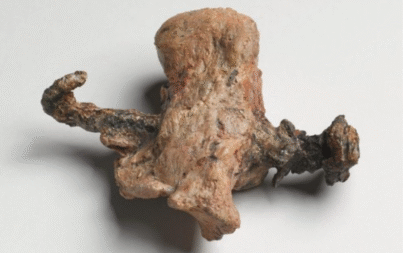
The Jewish historian, Josephus referred to crucifixion as “the most wretched of deaths.” Below is one of the few pictures that gives us a glance at the bruising of the heel through crucifixion. In fact, crucifixion is the only known means of execution that harms the heel.
8. What do you discover about the identity of Satan in the following verses?
Rev. 12:9
John 8:44
2 Cor. 4:4
1 Pet. 5:8
The same Satan that we meet in the book of Genesis is still the same Satan we meet in the book of Revelation. Satan knows the end of the story, just as we do. He knew that Jesus Christ would come to the world in human form to thwart and destroy everything that he sought to build and gain. Therefore, from the beginning of time, Satan has been hell-bent on destroying the lineage of Jesus. He tried to do this when he had Pharaoh kill all the Jewish baby boys under the age of 2 after Moses was born. He tried to do this when he had Herod do the exact same thing after Jesus was born. If he could have accomplished this, then there wouldn’t have been a Jesus in human form. This is one reason that Satan hates the Jews. Jesus was born Jewish. Jesus is Jewish. The Bible is a Jewish book. We have a Jewish Savior. From Rev. 4-19, the focus is on the Jewish people. Satan is anti-semitic and so is a large part of the world we live in. This is unfortunately true even in many of our churches.
Satan is a formidable foe for us. We could never defeat him on our own.
9. How is Satan referred to in Eph. 2:1-2?
The book of John repeatedly refers to Satan as the prince of this world. (John 12:31, 14:30, 16:11) So, as a prince, he has a certain degree of power.
10. What kind of power does he have? (1 John 5:19)
11. How does following Satan affect those who follow him? (Acts 26:18, 2 Cor. 4:4)
Satan has only a limited amount of power and he is always under the sovereign control of God. Satan is older than this world. He was around when the earth and the heavens were created. We have to understand his role in the world to grasp the content of the book of Revelation.
12. What did God do for Adam and Eve in Gen. 3:21?
The first shedding of blood took place when God killed animals to make garments for Adam and Eve to hide their nakedness. This is also the very first picture in Scripture of the eternal covenant that God would later make with Abraham.
My favorite definition of covenant comes from Kay Arthur, “a solemn binding agreement made by passing through pieces of flesh". There are numerous covenants in the Bible and we’re not going to do an exhaustive study of them here. What we need to note here is that covenant is God’s method of binding us to Himself. As believers in Christ, we are bound to God through the covenant of blood that Christ ratified for us on the cross. (If you want to understand the different covenants in Scripture, look under the “articles” section on this website and find the article entitled, “What is Replacement Theology”.)
When my boys were growing up, they would often ask me why Christ had to suffer and die in such a horrific way. I’m not sure I was ever able to adequately answer that question for them, other than to explain that it was God’s way. There had to be the shedding of blood for the remission of sins. Therefore, Jesus had to come to earth in human form so that He could bleed actual human blood for us. Had He come in a spiritual form, the shedding of blood would not have been possible. Covenant is about blood. As we go through this study, keep in mind that we are in a covenant relationship with God through the blood of Jesus Christ. It is His blood that saves us from sin and death. It is His blood alone that has any power to save. The blood of goats and bulls and sheep could never save us from our sins. That blood could only postpone our sins until Jesus came and died. It is His blood and only His blood that has the power to save.
Satan wanted to destroy the bloodline of Christ from the beginning. But His death, burial, and resurrection gave way to victory! Hallelujah!!!!
In the Ernest Hemingway novel, The Sun Also Rises, the character, Mike, was asked how he went bankrupt. He said, “Gradually and then suddenly!” This is the case with the countdown to the rapture. It is going to happen gradually, and then suddenly. Matthew 24 gives the analogy of childbirth to explain the end of days scenario. For those of us who have given birth, the 9 months of pregnancy seems to be a lifetime, and then suddenly, the child is here. For over 2000 years, the prophesied events of Scripture have been ever so slowly transpiring. But in the last few years, there seems to be a sudden acceleration. Friends, Jesus is coming soon!
When we hear the word “prophecy”, we think of something that is foretold that will happen in the future. The Jewish mindset is similar, but not exactly like that. The Jews look at prophecy as something that has happened in the past and will be repeated in the future. In other words, prophecy is a circular biblical pattern. We can make a good argument for this with the fulfilled prophesies that have already occurred.
13. Let's look at the first Antichrist-type figure in Scripture. Read Gen. 10:8-10. Who was it that became a mighty hunter before the Lord?
There are a couple of words in these verses that are very important. The first word is became. In Hebrew, that word is hayah, which means to come to pass. In other words, Nimrod did not start out being a mighty hunter before the Lord, but at some point, he became one.
Now read Gen. 6:1-5. In these verses as in the Gen. 10 verses, the word mighty is used. The Hebrew word for mighty is gibbor which means giant man or valiant man.
14. Look back to Gen. 6:4. What (or who) was on the earth in the days of Noah and afterward?
The word Nephilim means fallen ones. There was a specific group of angels who came down from heaven and mated with the daughters of men (who were human women). The result of this union was the Nephilim, a ½ breed of race of ½ human, ½ angelic beings. Now, go back again to Gen. 10. 15. What exactly did Nimrod begin to be?
This is what happens when God’s creation is messed with! Ridding the world of these ½ breeds was in part the reason for the flood of Noah’s time. Reread Gen. 6:4.
16. Were the Nephilim completely wiped out in the flood?
17. How could this be?
We don’t know for sure. We can guess. If Noah was pure (undefiled by Nephilim blood) and his wife was pure, then their 3 sons would have been pure as well. But, there were 3 other people on that ark….the wives of Noah’s 3 sons. It would be my guess that at least 1 of those women had Nephilim blood. This is one theory. Another theory is that there was another incursion of angels mating with human women. We are not told in Scripture how the Nephilim managed to be in the world after the flood.
18. Read Gen. 10:8-10 and 11:1-9. Who built the city of Babel?
19. Why did he build it?
20. Was he successful in his quest? Why or why not?
When we get to Rev. 17, we will again look at this man named Nimrod. You will need to refer back to this information when we get there.
The term antichrist means against Christ. John, the writer of Revelation, coined this term in 1 John 2:18, 1 John 2:22, 1 John 4:3 and 2 John 1:7.
21. What else do you learn from this term in these verses?
There are many antichrists or many who will emerge in the last days who are against Christ. However, there will only be 1 Antichrist who is also referred to as the Beast in the book of Revelation. From almost the beginning of time, there have been individuals who have been against Christ. There are people today who are against Christ. But the Antichrist of the last days will be different, worse, more powerful, and will seek to have world domination. He will make it his goal to destroy believers and to destroy the nation of Israel. There are other biblical texts that give us some understanding into who this man is and what he will be about.
22. What do you learn about him from the following verses?
Daniel 7:25
Daniel 9:27
Mark 13:14
2 Thess. 2:1-12
When we get to Revelation 6, we will start to learn a little bit more about the guy we refer to as the Antichrist, but we’ll save that information until we get to that part of our study.
The account of the Tower of Babel in Gen. 11 indicates that everyone in the world who was alive at that time was collected on the plains of Shinar and they all spoke the same language. If you go back one chapter to Gen. 10, you will see the result of what happened in chapter 11. God intended for the people to scatter across the earth, but in defiance of Him and with 1 language, they stayed in 1 place.
What was going on in Babel (later called Babylon in Iraq) during Nimrod’s day was something we refer to today as globalism. Globalism is the theory that the people of the world would be better served if there was 1 global currency, 1 foreign policy that involves open borders for every single country on earth, and 1 religion (or no religion) and free trade. 23. According to Gen. 11:4, what do you think God thinks of globalism?
Globalism should scare everyone because God obviously vehemently opposes it. God said in Gen. 11:6, “and now nothing which they purpose to do will be impossible for them.” Keep in mind that the people during Nimrod’s day on the plains of Shinar had the benefit of having fallen angels and Nephilim amongst them. These beings had knowledge of things that ordinary human beings didn’t have. They knew stuff! They had supernatural abilities and preternatural (beyond what is normal or natural) knowledge.
If you go to the internet, you will find that most leaders in our world today are globalists and are pushing a globalist agenda and the world is undoubtedly heading in that direction.
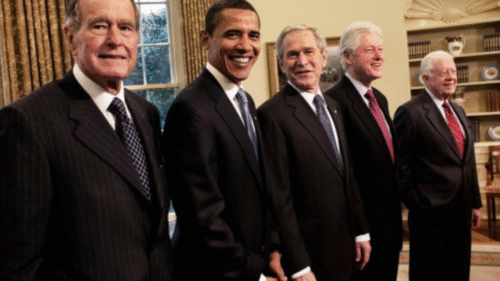
The picture below is a representation of U.S. presidents who sought to have a globalist agenda. It doesn’t matter if a president is a Democrat or Republican. George H.W. Bush pushed for free trade between Canada, Mexico, and the U.S. His vision was not realized in his own administration, but it was in the one that followed. Bill Clinton ushered in NAFTA (North Atlantic Free Trade Agreement). In the last 62 years, there have only been 3 U.S. presidents who were not globalists; John F. Kennedy, Ronald Regan, and Donald Trump and with all 3 of them, there were assassination attempts with one of those attempts being deadly for JFK. Satan does not like nationalists, he likes globalists.
The United Nations is the biggest globalist organization on the face of the earth. The UN is an intergovernmental organization with 193 member states. They aim at facilitating cooperation among nations on issues of international law, security, economic development, and social equity. Those are just words (which mean nothing) when it comes to the nation of Israel. The UN stands as the most antisemitic organization in the world. The UN believes that there are global challenges that transcend national borders and cannot be solved by individual countries alone.
The European Union (EU) is a globalist organization. The World Economic Forum (WEF) is a globalist organization. The World Trade Organization (WTO) is a globalist organization. There are a host of other globalist organizations that exist to protect the environment. Regardless of what we do or how hard President Trump works to solidify the sovereignty of the United States, God has a timetable and that timetable will not be thwarted.
There will be a time during those last 7 years on earth, when there will be a global government. That much concentrated power in the hands of 1 person is dangerous unless that power is in the hands of Jesus Christ.
There are some themes in the book of Revelation. Some of these we’ve already alluded to:
Patterns that repeat from the Old Testament. Those patterns are evident from Genesis to Revelation.
2 cities are highlighted, Jerusalem and Babel (Babylon)
God’s covenant with Israel will emerge early in the book.
We will see Nimrod again in this book. (but not by name)
Revelation is a bloody book. Blood is one of the consistent themes from the Old Testament through the New Testament.
The book of Revelation is unique in that it has its own outline.
24. Read Rev. 1:19 and write out this simple outline below:
Rev. 1:1-2 gives us a clear flow of how this book arrived to John and ultimately to us.
25. Can you make a flow chart that describes how we eventually received the book of Revelation?
___________>___________>__________>_________>__________>Us
The book of Revelation was written at a time of intense persecution in the early Church.
26. Who wrote the book?
27. What exactly is the book of Revelation? (Rev. 1:1a)
The book of Revelation is believed by most biblical scholars to have been written around A.D. 96.
28. Why was the book written? (Rev. 22:16-21)
29. How was the book written? (Rev. 1:11)
30. Where was the book written? (Rev. 1:9)
Early church fathers such as Eusebius, Irenaeus, and Clement of Alexandria wrote that John had been exiled to Patmos by Emperor Domitian. This cruel Roman ruler exiled John due to his preaching of the Gospel and his opposition to imperial cults within the Roman Empire. Plainly put, Domitian was threatened by John’s message. Like other Roman emperors, Domitian demanded to be worshipped like a god. The early Church was a suffering church, and this was especially true during Domitian’s reign of terror. He reigned from AD 81-96, so this book had to be written within that time frame and most likely towards the end of his reign.
The Isle of Patmos was a penal colony for political and religious dissidents. According to ancient historian Victorinus, John, who was aged at the time of his exile, was forced to do hard labor in the mines at Patmos. He had a lot of solitude there and this is one reason that it was a blessing for him to be there instead of in Ephesus or somewhere else. We do know that according to 1st century historians, John was a leader of the church in Ephesus both before his exile to the Isle of Patmos and then afterward.
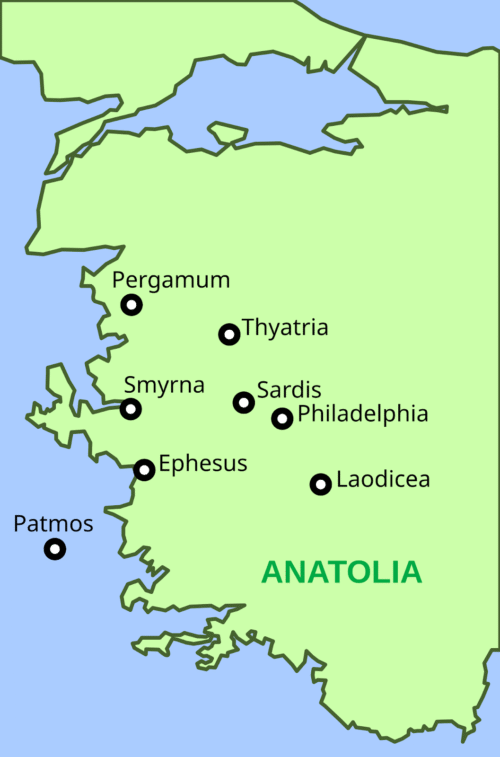
Patmos was a small, rocky island about 10 miles long and 6 miles wide in the Aegean Sea. It was southwest of Ephesus. The terrain was rugged and the living conditions were poor. After Domitian's reign, Emperor Nerva released many prisoners who were at Patmos, John being one of them and he returned to Ephesus. Below is a modern-day picture of Patmos.

31. Who exactly was John? Read the following verses and record what you discover:
Luke 5:10
Mark 3:17
Matthew 27:55-56
Mark 15:40-41
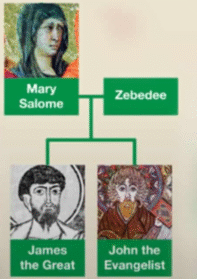
This is John’s family tree. John was one of the 12 apostles. He was a business partner with Peter, James and Andrew in the fishing business. The apostle James was his brother. He was part of Jesus’s inner circle. After Jesus ascended back to heaven, John stayed in Jerusalem for many years and helped to establish the 1st century church there. He was the last survivor of the apostles and the only one who did not die a martyr’s death although apocryphal stories suggest that Domitian tried to boil him in oil on one occasion and forced him to drink poison on another. These sources outside of Scripture claim that he would not die, just like Daniel did not die in the lion’s den and Shadrach, Meshack, and Abednego did not die in the fiery furnace. However, since these stories are not in the Bible, we cannot claim them to be true.
Domitian assumed that he would shut up John when he exiled him, but instead, that exile turned into a great blessing. It was on this island that John was given a divine glimpse into the future of mankind. He was also granted a glimpse into the throne room of heaven.
We can learn a lot from John’s life. God does not always prevent the plottings of wicked and evil people from affecting our lives as believers. But, He does cause these devices to work for our good and for His glory. Rest assured that God has a purpose and a plan for any pain a believer experiences.
Below, the 7 churches that John wrote to and where they were in connection to the Isle of Patmos are seen on the map of that part of Asia Minor.
The Rapture of the Church
For those who have never studied the book of Revelation before, you might assume that the rapture or the “catching away” of believers prior to the 7-year tribulation is covered in this book. It is not. Well, at least it is not in an overt way. It is there and we will address it when we get there. It is discussed in other places in the Bible.
Before we begin covering chapter 1, I wanted us to know and understand what is meant by “the rapture of the Church” and what different points of view readers of the text might have. The rapture of the Church was a direct revelation given to the Apostle Paul. Prior to the time that God revealed it to Paul, it was unknown to believers. 32. What did Paul tell the church at Corinth in 1 Cor. 15:51?
What is the rapture? The rapture of the Church is a time in the future when true believers in Christ who are alive on the earth will be caught up in the air to meet Jesus Christ and their mortal bodies will become incorruptible. Preceding the catching up of Christians who are alive will be the rapture of those who have already died in Christ. Their bodies will emerge from their graves and will be changed into incorruptible bodies. And thus, we all will always be with the Lord. This is the blessed hope.
WARNING! There is a LOT of disagreement regarding the rapture of the Church; when it will happen and even if it will happen. I want to state this here and now, the rapture of the Church is not a major doctrinal issue and it is certainly not one to fall out of fellowship with others over. As long as you believe in grace alone, by faith alone, in Christ alone, you are saved. That is the important doctrinal issue of Scripture.
Rapture and translation are 2 words that are used to refer to the same event. In the rapture, we meet Jesus in the air and He doesn’t come all the way to the earth. The word translation refers to the changing of one’s body from corruptible to incorruptible.
The 2nd coming of Christ is different from the rapture. This term is used to describe a time when Jesus Christ will return to the earth with believers to establish His kingdom on earth in what we refer to as the millennial reign of Christ.
We get the term rapture from the Latin Vulgate translation of the New Testament. In Latin, the word for rapture is rapere. This word is a translation of the Greek word, harpadzo, (also spelled harpazzo) which means “being caught up.” It is a verb. We use it like a noun, but it is an action word.
We just studied the books of 1 and 2 Corinthians in the fall of 2024 and the spring of 2025. The Apostle Paul gives us some insight into the rapture in 1 Cor. 15:50-52.
33. Read these verses and write down in order everything that will occur.
34. What is sleep referring to in these verses?
Paul echoed this idea to the church at Thessalonica.
35. What do you learn in 1 Thess. 4:16-17 that you did not know from the verses in 1 Cor. 15?
Jesus also spoke of this Himself when He was here on earth.
36. What do you learn in John 14:1-3?
37. What is the chronological order of events in 1 Thess. 4:16?
Here is what we learn from this verse:
The Lord Himself will descend from heaven.
There will be a loud shout and a command.
There are 2 times in Jesus’s ministry when He shouted and His voice had an effect on those who were already dead:
At the tomb of Lazarus.
His last words on the cross in Matt. 27:50-53 when the tombs of the righteous dead were opened and they came back to life.
The trumpet of God will sound.
Those who have died in Christ will be raised up to meet the Lord in the air and they will have new bodies.
Those believers who are still alive will be raised up to meet the Lord in the air and they will have new bodies.
We will be with the Lord forever.
This truth will bring comfort to us.
When we address the 70th week of Daniel, we’ll look at where we can place the rapture on our timeline. Everyone is concerned about the timeline. I’m not going to get into the whole debate about dispensationalism in this study. Dispensationalism is a theological system that interprets the Bible as revealing 7 distinct “dispensations” or eras of time in which God related to humanity in different ways. The reason I’m not going to get into this too deep is because this is not a theoretical framework that is obvious in Scripture. I’m not saying that it is not there. I’m just saying that there are far more important things we have to study without superimposing something on top of Scripture. Most dispensationalists believe in a pretribulation rapture of the Church.
There are various schools of thought about the rapture of the Church and I want you to study for yourself and decide which school of thought you follow. Because I hold to a pre-tribulation rapture, that is what I will be presenting in this study. The different views of the rapture are:
That there is no rapture at all.
The pretribulation rapture which is that all believers will be taken up to heaven prior to the beginning of the tribulation.
The mid-tribulation rapture which is that the rapture will take place in the middle of the 7 year tribulation.
The pre-wrath rapture which is that believers will be raptured about ¾ of the way through the 7 year tribulation when the wrath of God is poured out upon the earth.
The post-tribulation rapture which is that believers will be taken to heaven after the 7 year tribulation.
Friends, regardless of which one of these views you take, God does not want you to be uninformed about the rapture. 1 Thess. 4:13 tells us that God wants us to have peace about this. That is why He wants us to be informed.
The geographical focus of everything in the book of Revelation is in the Middle East, with Jerusalem being the bullseye. 38. This book was written in the first century AD, so how do we make sense of the last few words in Rev. 1:3, “for the time is near”?
That was over 2000 years ago! Somehow, that doesn’t seem “near” to me! Time in a measurable way began in Genesis when God said, “Let there be light.” With the speed of light, night and day were separated and time as we know it could be measured. Never think that God is confined to our time and space. He is outside and above all of that. Our minds cannot comprehend the concept of that right now.
So, with the passage of 2000 years, believers have been looking for and anticipating the 2nd coming of Jesus Christ. 39. Read Gen. 11 about the Tower of Babel. What important elements are in this chapter?
Now, read Acts 1:8. This is the record of Jesus sending a Helper, and a Comforter to us in the person of the Holy Spirit. From Pentecost til now, we have been living in the last days. In Gen. 11 at the Tower of Babel, the Trinity came down and confused their language and separated the people into 70 different people groups who spoke 70 different languages. We learn the names of 70 of Noah’s descendants in Gen. 10. In today’s vernacular, we use the word babel to describe someone who is not speaking coherently. Confusing their language was a part of God’s judgment against them.
40. How is what happened at the Tower of Babel different from what happened at Pentecost in regards to the language issue?
Pentecost is a reversal of Babel. At Babel, the people could not understand one another and separated and spread across the known world. At Pentecost, all languages were understood and the people united as believers in Christ.
Read Joel 2:28-32. In Acts 2:14-41, Peter is quoting from these Old Testament verses in his sermon on the Day of Pentecost.
41. What do you think the reference from Joel 2:29 “in those days” means?
Joel anticipated these events in his day and time, but they were far away by human terms.
42. How was the work of God’s Spirit different on the Day of Pentecost from the Old Testament days?
Think about the absolute, mind-blowing awesomeness of this! The God who dwelt among Adam and Eve in the Garden of Eden, and who dwelt between the cherubim above the mercy seat on the ark of the covenant, and who dwelt with Jesus Christ in eternity past, now dwells within us by His Spirit! This fact brings me to my knees in tears!
Read Acts 1:8 and Matthew 28:19. In these verses, we have the commission from God that we are to go out and do kingdom work. Kingdom work must be empowered by the Spirit of God. Now, go back and read all of Acts 2 again and close your eyes and envision what that event was like. I’ve often said to my clients, “You can’t go back and have a new beginning, but you can start from here and have a new ending.” With God, we can actually have a new beginning! He reversed Babel on the Day of Pentecost. He gave mankind (all who would trust Him) a new beginning on that day.
That new beginning kicked off the last days that we will address as we go through our study of the book of Revelation. As we live in these last days, we need always to be watchful and faithful to the Lord and to share the truth of His Word, especially with those who do not know Him yet. I promise you this, if you read and study this book, God will bless you in ways that you cannot imagine! Buckle up! This is going to be an exciting ride!
The 5 Major Views of End-Times
Amillennialism
*Sees the 2nd coming of Christ and the Rapture as the same event that ushers in the eternal state.
*There will be a general resurrection of believers and unbelievers at the 2nd coming.
*There will be a general judgment of all people, saved and unsaved.
*The tribulation is currently being experienced.
*There is no literal millennium on earth after the 2nd coming of Christ. The kingdom of Christ is now in this Church Age.
*The Church is the new Israel and there is no distinction between the 2.
Postmillennialism
*The Church will go through the tribulation.
*Sees the 2nd coming of Christ and the Rapture as the same event. Christ doesn’t return until the end of the millennium.
*There will be a general resurrection of believers and unbelievers at the 2nd coming.
*There will be a general judgment of all people, saved and unsaved.
*We are currently experiencing the tribulation right now.
*The present age will flow right into the millennial period.
*The Church is the new Israel and there is no distinction between the 2.
Historic Premillennialism
*The rapture and the 2nd coming of Christ happen at the same time. Christ stays on earth to reign after this.
*Dead believers will be resurrected at the beginning of the millennium and unbelievers will be resurrected at the end of the millennium.
*There will be a judgment at the 2nd coming and a judgment at the end of the tribulation.
*The millennium is both now and in the future and the millennium is not necessarily 1000 years. Christ will be reigning from heaven.
*There is a distinction between Israel and the Church. However, they view the Church as spiritual Israel.
Dispensational Premillennialism
*The rapture of the Church happens prior to the 7-year tribulation. The 2nd coming of Christ happens at the end of the tribulation.
*There are different resurrections: 1. Those in the Church who have died will be raised first and then those who are alive will join them in the air at the Rapture of the Church. 2. The Old Testament and tribulation saints will be resurrected at the 2nd coming. 3. Unbelievers will be resurrected at the end of the millennium.
*The Church will not have to go through the tribulation.
*The 2nd Coming of Christ will usher in the literal millennial reign of Christ on earth.
*There is a clear distinction between Israel and the Church and God has a different plan for each. That plan includes both finding salvation.
Preterism
*All prophecy is really history and it has all already occurred. The events of the book of Revelation have already happened in the 1st century.
*There will be no rapture.
*There will be no 2nd coming.
*There will be no tribulation period. That already happened in 70 AD.
*There will be no future resurrection of the dead and no future final judgment. We are currently in the midst of the final judgment right now.
*God’s covenant with Israel ended in 70 AD.
*The Church has replaced Israel.
*The kingdom of Christ is what we are living in now which means that we are currently living in the millennium.
Note: There is a danger in the belief that the Church has replaced Israel leading to anti-semitism. To learn more about this, go to the “Articles” section of the website and find the articles: “What is Replacement Theology” and “Differences Between Israel and the Church”.
For purposes of this study, we will be taking a pretribulation, premillennial viewpoint. If you follow dispensationalism to all of its conclusions, then everything has to fit in 7 different boxes. The very reason I don’t want to focus on this aspect is because I don’t want to put God in a box. So, while I do believe this view is the correct view, God can do whatever He wants, whenever He wants, and in the manner that He chooses.
A case can be made for each of these viewpoints with the exception of the Preterist view. There is absolutely no way to make a case for this viewpoint unless you do some extraordinary Scriptural gymnastics. Following this view could actually be seen as heretical as it is not biblically based.
© Cindy D. Ketron. All Rights Reserved
Thank you for prayerfully considering partnering with us.