Judges Lesson 6 - Chapters 10-12
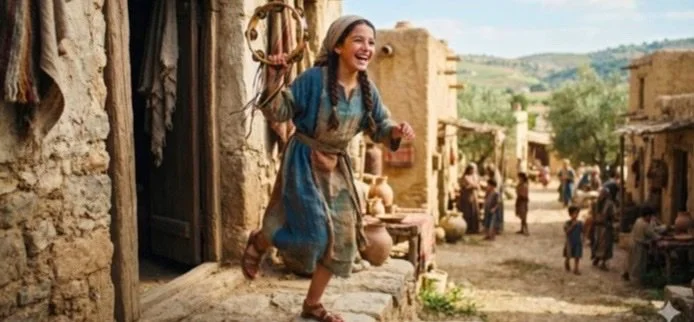
This week’s lesson is a hard one. Our minds do not want to go to the places that this week’s lesson will end up taking us and yet, it is in the Bible and is therefore beneficial for our instruction.
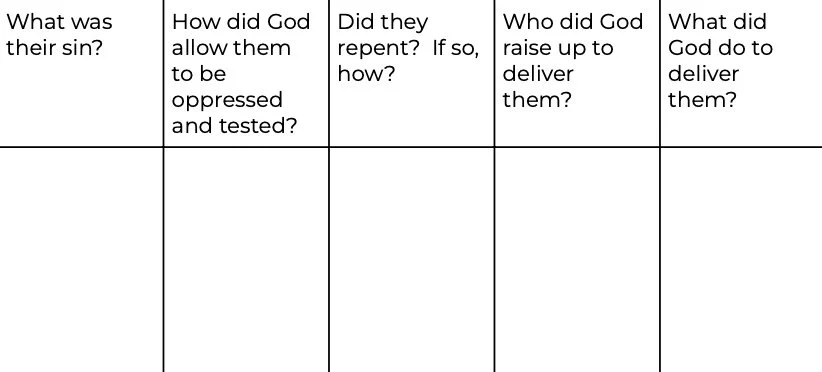
Last week, we ended up with good ole Abimelech reaping all that he had sown and then some! This week, we will look at the 5th cycle of sin in this book. Go ahead and read Judges 10. Fill in the chart below:
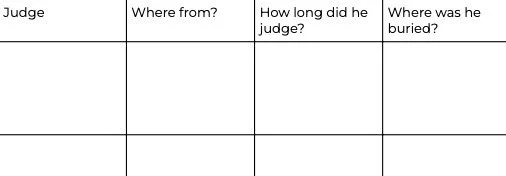
Friends, please don’t name your kids Puah or Dodo! We don’t know a lot about Tola and Jair. We know what tribe Tola was from. We know where he lived. We know how long he lived and where he was buried. Other than that, we don’t know a whole lot. We don’t learn of any great military victories that he led. That leads some scholars to think that perhaps he actually adjudicated like a regular judge, kind of like Deborah did at times. But we really have no idea.
After Tola judged for 23 years came Jair who judged for 22 years. He ruled northeast of the Jordan River where the 2 1⁄2 tribes settled (Reuben, Gad, and the 1⁄2 tribe of Manasseh). We don’t know a whole lot more about him than we do about Tola, but we do know that he had 30 sons who rode 30 donkeys who settled in 30 cities. I think that is so funny! I also think we can assume that Jair was a polygamist. I hope he was a polygamist because if he wasn’t, some poor woman bore 30 sons! They often didn’t even mention the daughters they had, so the possibility that there were many more children is there. Jair must have been wealthy. Having a donkey in those days meant that you had $$$$. Donkeys were considered to be a primary luxury item. Patriarchs like Abraham and Job measured their fortunes in part by how many donkeys they owned. Leaders, judges, and kings rode donkeys during times of peace. And if you bought each of your sons a donkey, then it would have been like buying 30 sons today each a Ferrari.
So, what else did Jair do? We have no idea. We know that he had a whole lot of affluence. That’s all we know.
As we head into this week’s lesson, I’m reflecting on so many stories I’ve heard from heartbroken parents who have tried their best to instill godly values into their children’s lives only to have them continuously refuse to obey and live right. Too many times, these kids refuse to listen to wise counsel, but even worse than that, they resent it. It is a hard pill for many parents to swallow when they feel like they’ve done all they can do. When I end up getting involved, I’m a big believer in allowing the sowing and reaping process to play out. That means that sometimes a parent has to remove himself or herself from the situation and allow the child to reap what he/she has sown regardless of what that is. What if these parents finally say, “You want it, you got it!? You want to drink and hang out with bad actors, then do it somewhere else. You will not be living that way under my roof and I will not be financing it.” That is basically what God did with His children when they flat refused to listen to Him and to obey His Word. This is why they ended up going into exile, because God would not allow them to live in His land (under His roof) as long as they were living like the pagans around them.
The utter absurdity of what the people of Israel fell into is staggering. The utter absurdity of chasing after gods made of wood and stone who had no power to do anything is staggering. The utter absurdity of leaving an all-powerful, all-loving, all-seeing God is staggering. And at some point, to teach them a lesson, God basically said, “You want it, you got it!”. Perhaps the most frightening words in all of Scripture is “And God gave them over”. I am convinced that God never wants to turn anyone over, but sometimes He does. It is a sad, sad situation when that happens.
Why do we weigh things in Scripture differently? Why do we think some things are lightweight sins and others are horrific sins? Friends, all sin comes with a capital punishment because we have sinned against a holy God. Scripture should challenge all of us to seek holy living. The people of Israel didn’t weigh their sin in the manner that God weighed their sin.
1.What does God say in Exodus 20:1-3?
The very first commandment is the most important commandment. We are to worship God and only God. Somewhere along the line, Israel forgot this one. Today, they have, for the most part, still forgotten the God who loved them and called them to be a people of His own choosing and placed them in a land flowing with milk and honey. Remember, the book of Judges chronicles a very dark time in the life of the nation of Israel.
2.Go back to Deut. 8:1-4. What did God do for the people in the wilderness?
3.Why did He do this? (Deut. 8:5)
4.What is the warning He gave the people in Deut. 8:11-20?
5.Turn over a few chapters later to Deut. 28:1-14. What kinds of blessings (in general) did God promise to the nation of Israel for obedience?
6.In Deut. 28:15-44, God lays out all the curses that will occur if Israel fails to be obedient to Him. Ultimately, what does God say will happen to them in Deut. 28:45 if they make the choice to be disobedient?
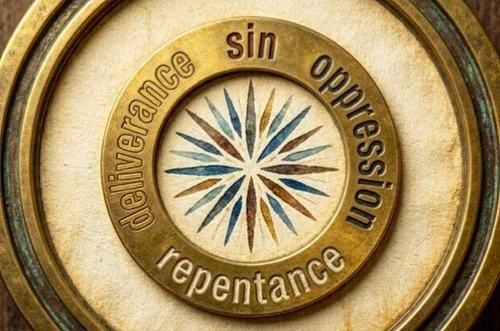
We initially addressed the sin cycle in our 2nd lesson. Because Israel consistently and continually chose to disobey God, that old sin cycle kept going around and around like a hamster on a wheel who could simply not get off the wheel. Let’s revisit that hamster wheel again. There can never be any kind of effective government where no value is placed on God as the Supreme Being. And that is what we are faced with today in our own country..
We all have different styles of parenting, but when you boil down parenting styles, you get 3 primary styles:

Autocratic - All rules without any freedom. You’re basically in prison. Permissive - No rules and only freedom. You’re running wild.
Democratic - Freedom within a set of rules. There’s security here.
7.Which one of these do you think God employed with the ancient Israelites and which one do you think He uses today?
God always allowed His people freedom, but that freedom must exist within a set of boundaries. If you are a good parent, that is the way you parent. The Israelites wanted only permissive parenting. They didn’t want to have to answer to anyone. But the irony of what they did was they ended up placing themselves in a self-induced autocracy by imagining that they were bound to certain pagan laws and traditions. Oh how chaotic!
If you will notice from our reading, the more the cycle goes around, the worse the situation gets with the people of Israel. The sin becomes more widespread and intense the longer it goes unchecked.
British historian Arnold Toynbee wrote a massive 12-volume magnum opus called, A Study of History. In it, he chronicles 22 major civilizations. His conclusion was that 19 of the 22 died out, not from murder, but from suicide. He describes how these civilizations collapsed internally from moral decay. We are witness from Scripture to the rot that Israel had going on. It is sad and it causes us to reflect on our own country and the rot that is going on from within it. If you are like me, anytime I go to a funeral, I begin to reflect on my own mortality. The ancient Israelites, just like the contemporary Americans watched other civilizations snuffed out and die from within and yet, they never seemed to learn any kind of lesson from watching other countries.
They were witness to the funeral services of many civilizations and yet, they never had the insight to reflect on their own mortality as a nation.
8.Read Judges 10:6-9. What happened after Jair died?
9.Well, here we go again folks! How long were the people oppressed this time?
10.Start filling in the 5th sin cycle as we go throughout this lesson.
5th Sin Cycle
The ancient peoples of Moab, Sidon, Aram, and the Philistines all worshiped in a similar manner, but they each had distinct patron gods and nature deities.
11.What was God’s response to this slide back into the worship of pagan gods?
The gods of the Moabites - Chemosh, Ashtar-Chemosh
The gods of the Syria (Aramaeans) - Hadad, Atargatis, Sahar
The gods of the Phoenicians - El, Baal, Astarte, Melqart, Eshmun, Dagon The god of Ammon - Molech
The gods of the Philistines - Dagon, Baal-Zebub, Ashtoreth
There were lots of gods and these gods were often territorial. And some of them were thought to have morphed from one deity into another. It can get very confusing. Ammon is spoken of in these verses and it is east of the Jordan River in what is now modern-day Jordan.
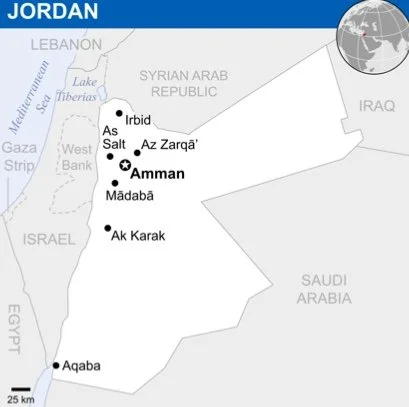
The capital of Jordan today is Amman (same as Ammon in our text). The Ammonites that we read about in Scripture are those people from this area of Ammon/Amman. What we see in Judges 10 is that these 2 1⁄2 tribes who lived east of the Jordan River were living in Amorite territory and the Ammonites (not the Amorites) were persecuting them. When we start looking at all the “ites”, it can get pretty confusing. Let me break down the ones we’re looking at here:
Ammonites - descended from Ben-Ammi, the son of Lot (Abraham’s nephew), making them kin to the Moabites. These people settled east of the Jordan River in the region around modern-day Amman, Jordan. They also established a long-lasting distinct kingdom (Ammom) that was in frequent military conflicts with Israel. They had wicked religious practices that included child sacrifice.
Amorites - descended from Canaan, the grandson of Noah. These people occupied a much broader geographic area, including parts of Mesopotamia, Syria, and the hill country and lowlands of Canaan (east and west of the Jordan River). They formed powerful early urban civilizations and major kingdoms in the ancient Near East. They also had wicked religious practices that included child sacrifice.
One of the earliest conquests of the children of Israel after they escaped Egypt was that they conquered the Amorites. Over time, the remaining Amorites who did not die were absorbed into the population of Israel. God told the children of Israel to wipe them completely out. They killed most of them but not all of them and here we are in our story with the obvious influence they had spread to the people of Israel, influence that spreads like a poison.
12.Read Judges 10:10-18. When the sons of Israel cried out to the Lord, what did He remind them of?
I love v. 14. He is basically telling them to go and whine to their gods and to see if their gods could deliver them. Israel is finding that they are in a pickle! For those of you reading this who aren’t from the South, that means they’re in a big, hot mess! The Ammonites were encamped around them and they were threatened and then they started panicking because they had no leader. This is really where our story this week begins.
13.Which part of the sin cycle are verses 15-16 talking about?
Mankind has to worship something. It’s in our DNA. Just because the people forsook God for a while does not mean that nothing moved in to take God’s place. They always replaced God with something or someone else. That is human nature. Nature abhors a vacuum.
14.What is the difference in what the sons of Israel did in Judges 10:10 and what they did in Judges 10:15-16?
It is never enough to just say what we did to sin, we must do something about it. One reason that AA (Alcoholics Anonymous) has even a degree of success is because for all those the addict has wronged, they must at least try to make things right. This is biblical. It’s not simply turning to something. It’s also turning away from something else. It is making right all the wrongs that have been done to the degree that it can be done.
15.What was going on in vs. 17-18?
16.Who was the leader at that time?
17.Sounds like the people are getting desperate. Read Judges 11:1-11. Who is Jephthah and where is he from?
A Gileadite is a person from the region of Gilead which is a region just beyond the Jordan River. Gilead was a the grandson of Manasseh and his great grandfather was Joseph from the book of Genesis. As we’ve already learned in this lesson, the tribes of Gad, Reuben, and the 1⁄2 tribe of Manasseh settled east of the Jordan River. This area became famous for a healing herbal extract called the “balm of Gilead”. A lot of physicians settled in that area because of the easy access to medicinal ingredients. When we get over to the book of Jeremiah, the prophet makes an interesting connection between the spiritual and the medicinal.
18.What does he say in Jeremiah 8:22?
19.What is ironic about this?
North of Gilead was Bashan, and to the south were the lands of Moab and Ammon. (Note that back in Judges 5:17, the terms Gilead and Gad are used interchangeably.) Jephthah was a mighty man of valor.
20.What other judge do you recall was referred to as a mighty man of valor?
When God called Gideon, he was a scaredy cat, but God turned him into a man of valor. Jephthah was different. He was already a brute. The cowardly lion in The Wizard of Oz said famously, “Put up yer dukes, I ain’t afraid a-nothin!”, but in reality, he was scared to death of everything, kinda like Gideon. This Jephthah fella really wasn’t afraid a-nothin!
Being the son of a harlot meant that Jephthah was an outcast. It was not out of the ordinary for people born of harlots in those days to be considered less than. The Jewish historian, Flavious Josephus said in his books that the wife of Gilead was a Gentile, which would have made a bad situation even worse. In all likelihood, she was a Canaanite.
21.What did his half-brothers do to him?
22.Who did Jephthah end up attaching himself to?
The Hebrew word, riqim, that is used here in v. 3 refers to outcasts, societal rejects, and desperate men with no property, status, or steady employment. They had joined ranks with Jephthah and formed their own little mob who went out raiding others. Their survival depended on what they took from others. They were neither nice nor were they upstanding citizens. Once again we see that God has chosen an unconventional and rejected individual to be the leader of His people.
What happens today to young people who grow up not fitting in and who have no real upbringing and are poor? Far too often, these young people grow up breaking the law, being on welfare perpetually, and never having any aspirations other than what I just listed. They are unmotivated and have too much time on their hands to get themselves in trouble. I imagine that Jephthah was very much like this. It was the perfect storm.
Jephthah wasn’t the only leader in Scripture who had a gang of thugs fighting for him.
23.Read 1 Sam. 22:1-2. Who else had a band of rejects fighting for him?
These roughnecks ended up being loyal to their king and needless to say, they were tough military men. No doubt they were used to being resourceful. The International Standard Version of the Bible refers to them as David’s special forces but other texts refer to them simply as David’s mighty men. This group that began with 37 men grew into 400 warriors. One of these men alone was responsible for the deaths of 800 men at one time! So before we get all bent out of shape regarding the delinquent nature of these fellas with Jephthah, just remember that our ways are not God’s ways and if He raises up a man or woman (regardless of their circumstances), He will equip them for the job.
24.What do you learn about our Lord in the following verses: Hebrews 13:12
Isaiah 53:3
Psalm 69:8
John 1:11
Psalm 22:6
Although Jesus wasn’t a delinquent like Jephthah was, He was an outcast in the society He lived in. And furthermore, He chose outcasts as His disciples. These were ordinary, unpolished, marginalized men rather than the upper crust who were well-educated. They were often associated with sinners and didn’t follow the strict purity laws set forth by the Pharisees, Sadducees, and Scribes. One of the very reasons that Jesus was so hated in His time was that He turned the conventional societal hierarchies on their heads by giving a voice to the ordinary guy (and girl).
“God has chosen the foolish things of the world to put to shame the wise.” (1 Cor. 1:27) As we look at the story of Jephthah, we must keep this in mind.
25.What did the elders of Gilead do?
Jephthah apparently had a reputation that preceded him. This was a different kind of calling than Gideon had straight from God.
26.What was Jephthah’s response to the men of Gilead?
27.And what was the response of the men of Gilead to Jephthah?
These words sound vaguely familiar and the ironic thing is that similar words were spoken 700-800 years earlier in the same place, Mizpah. Read Gen. 31:45-49. Although there are 2 Mizpah’s mentioned in the Bible, the one in these verses is the same one we’re reading about in Judges 11. Mizpah in Hebrew means watchtower or lookout.
28.What happened in these Gen. 31 verses?
This region was located in a very mountainous region east of the Jordan River. Jacob had snuck away from his father-in-law, Laban and Laban caught up with Jacob here at Mizpah. The wording in the covenant made between Jacob and Laban is beautiful and is often used on necklaces between friends or lovers. And although I’m sure that Jacob respected Laban because he was his father-in-law, he didn’t like him or trust him and with good reason.
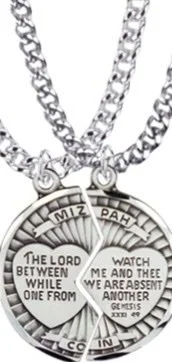
Here is a Mizpah necklace. The idea is that each person wears 1⁄2 of the necklace coin. When most people purchase these necklaces as a symbol of unity with someone, they have no idea that these were the words spoken between Jacob and his cheating, no good father-in-law, Laban.
29.Read Judges 11:12-28. What was the beef that the king and the sons of Ammon had with Israel?
Ya gotta hand it to the king of Ammon and Jephthah, they knew their history....well at least one side knew the real history. The other side had been given a whole different set of facts. Remember, there’s only 1 truth. You can’t have your truth and me have my truth.
30.Before Jephthah just jumps right into war, what does he do?
Jephthah might have been rough around the edges, but he was a very good historian and I can appreciate that he wants to handle this diplomatically first if that can indeed happen. But as you will read shortly, his diplomacy was very short-lived.
31.Read Num. 20:14-21. Is what you just read in Judges 11 consistent with the narrative from Numbers 20?
32.What kind of an edict does God hand down to the Ammonites in Deut. 23:3-4 because of their actions while the children of Israel were wandering in the wilderness?
These foreign peoples who were oppressing Israel had some pretty sick beginnings.
33.Read Gen. 19:30-38. What were the ancestral beginnings of the Moabites and the Ammonites?
These 2 people groups were constant adversaries of Israel and God’s decision to exclude them from gaining access to the assembly of the Lord went all the way back to the wilderness wandering days. But these people were cursed from the beginning for their incestuous start. The Ammonites did 2 things that caused them to be cursed by God:
1. They were inhospitable to the children of Israel as they were journeying on their exodus from Egypt.
2. They hired Balaam to curse Israel. God thwarted that, but their intent was that Israel would be eliminated.
This whole story really underscores the importance of God’s eternal covenant with Israel. Our replacement theology friends who believe that the Church has replaced Israel need to read the story of Balaam. It is because of God’s covenant with Israel that He cursed the Ammonites for their actions. And for all of those people who say that the covenant God made was just between God and Abraham, we see here that Abraham’s offspring was so loved by God that He would not allow anyone to curse them as a people group. That people group belonged to and were chosen by God.
34.In Judges 11: 28, what did the king and sons of Ammon do with the information Jephthah sent to them?
I’ll just go ahead and tell you that I hate the next part of this story! It is one of the stories in Scripture that makes me sick to my stomach. Go ahead and read Judges 11:29-33.
35.What kind of a vow did Jephthah make with God?
Jephthah tried to negotiate with God. He promised God something if God would do something for him and for Israel. Victory was already a done deal because God said it was. There is never any need to negotiate with God. Sometimes Scripture makes us feel intentionally uncomfortable. Judges 11 makes me terribly uncomfortable. Let me tell you why trying to negotiate with God is ridiculous:
God is the Creator and He is sovereign. He gets to set the terms and not the other way around. There should never be a time when we tell God, “If You will do this, then I’ll do that”.
Grace is a free gift. We cannot earn divine favor just because we have negotiated with God with a promise of good behavior.
Trying to force a bargain with God is our human attempt to control a situation instead of having faith in God’s sovereignty and His plan.
Victory never needs to be purchased with our promises. God only requires us to trust Him and to be obedient to His precepts. Jephthah had the Spirit of God upon him already. You have the Spirit of God within you already if you are His child. Never trade your devotion to God with negotiation for your intended outcome!
36.Read Judges 11:34-40. Who came dancing out of his house when he returned from this battle?
Remember that Jephthah had a Gentile, pagan, Canaanite mother and here he is acting like a pagan! Pagans would vow to offer human sacrifices to their gods if they had a good crop or won a big battle. But God forbade human sacrifice in the law. Jephthah has basically lowered God to the ranks of the Canaanite gods. Although he knows Israelite history pretty well, he doesn’t know the God of Israel very well.
If Jephthah only had 1 child, who else would have come out of his house? Perhaps his wife?
37.What was Jephthah’s reaction when he saw his only child come out of his house?
38.What was his daughter’s reaction? 39.What did she ask of him?
I need to tell you that there is A LOT of debate about these verses. Did Jephthah have his own daughter killed? Did he simply not allow her to marry and to remain a virgin for the rest of her life? First of all, we must admit that he had a commanding memory of Scripture. He knew what was there. If he knew Scripture, then he had to know that God absolutely forbade the killing of humans, especially a child. So if he did kill her, he was acting in defiance of the Law of God.
40.What do you learn from the following verses: Lev. 18:21
Lev. 20:3
Deut. 12:31
Deut. 18:10
Another interesting fact from Judges 11:31 is that the Hebrew word for “and” (Vav) is sometimes translated “or, together with, but, so, then”. The one letter can mean many different conjunctions joining 2 parts of speech. In our English language, we have different words that function as conjunctions. This is not the case in Hebrew. I’ve read a lot of commentaries that have translated this word as “or”. If that is the case, then here is the way that verse would read:
“Whatever comes out of the doors of my house to meet me when I return in peace from the sons of Ammon, it shall be the Lord’s OR I will offer it up as a burnt offering.” In other words, if the first thing that emerged from his house was appropriate as a burnt offering, then Jephthah would offer it as a burnt offering. But if it wasn’t an appropriate burnt offering, then it would be the Lord’s, meaning that whoever emerged would be dedicated to the service of God. If, indeed he offered her to the service of the Lord, she might have been like Samuel when his mother, Hannah, offered him to the service of the Lord at the temple. The fact that Japhthah’s daughter grieved her virginity is a compelling fact that she possibly got to live, but was never able to marry and have children and therefore, Jephthah never had the joy of grandchildren, which in those days would have been a terrible tribulation. And his name was never passed on.
It is also completely possible that he did offer her up as a burnt offering because he was sooooo grieved! You can’t mix in a little pagan and a little Scripture and think you’re serving God. I’m going to throw another potential wrench in this whole thing.
41.What does Numbers 30:2 say about vows?
Jephthah knew the law and he raised his daughter to know it too because of the way she responded to him when she discovered his vow. If his daughter knew she was going to be a burnt offering, then why did she go away and mourn her virginity for 2 months? Why not go away and mourn her impending death?!
42.Go to Lev. 27:1-8. In those days, once a vow was spoken, it became a binding and serious obligation. How were human valuations made?
The actual Law ended in Lev. 26. Making a vow to God was not required by the Law. A vow was seen as a little something extra that was offered to God. Leviticus 27 speaks of vows concerning people, animals, houses, and land.
43.What was Hannah’s vow in 1 Sam. 27-28?
When both of my boys were babies, I had both of them dedicated in a special ceremony at church. It was mine and Todd’s way of promising God, in the presence of other believers that we were going to raise our children in His nurture and admonition. We didn’t bargain or negotiate with God the way Jephthah did. We simply said, this is what we are committing ourselves to doing. Here’s the difference in what we did by dedicating our children to the Lord and what we see here in Lev. 27, the pastor didn’t place a price on the heads of our children and say, “Ok, this one is worth $20.55 and the other one is worth $26.55 because he’s a little older”. That seems nuts to us! And yet, the writer of Leviticus puts a value of 50 shekels on a man between the ages of 20-60. The reason for assigning a monetary value to the vow is because once that vow leaves the lips, it is binding. The only way out or the only way to redeem the vow is by giving the specified amount of money listed in each category. Redeeming a vow with an offering is an acknowledgement that circumstances can certainly change. People commit to things all the time that they can’t follow through on for one reason or the other. To redeem in these circumstances means that the person had to substitute something else in exchange.
So, could this have been the case with the daughter of Jephthah? Perhaps. Following Levitical Law, Jephthah could have been released from this vow for a price. I want to believe this is what happened.
44.In the years following this, what happened yearly as a result of Jephthah’s daughter in Judges 11:40?
45.Read Judges 12:1. What kind of beef do the men of Ephraim have with Jephthah?
I don’t know why the men of Ephraim always had their panties in a wad, but they apparently were constantly looking for a good fight.
46.Go back a few pages to Judges 8:1. What was going on here?
Years had passed between Judges 8 and Judges 12, but one thing is consistent, these men of Ephraim were itching to fight. The big, bad wolves of Ephraim threatened to huff and puff and blow down the house of Jephthah.
47.Read Judges 12:2-7. How did Jephthah respond to the men of Ephraim?
48.Is this different from how Gideon responded to them and if so, how?
49.There was a little test that Jephthah and his men used to distinguish whether or not a man was from Gilead or Ephriam. What was it?
I think this is so clever! We know that people in different parts of our own country pronounce things differently. The Ephraimite dialect lacked the ability to pronounce the “sh” sound. It was a dead give away and by dead, I mean that literally! Today, the word shibboleth is used to mean “any word, phrase, custom, or manner of speaking that identifies a person as a member of a particular group, or conversely, exposes them as an outsider,” According to American biblical scholar Herbert Wolf, he said that during the WWII, the German soldiers sometimes identified Russian Jews by the way they pronounced the word for corn. Their distinctive pronunciation unfortunately revealed their ethnic background.
50.For all their wanting to fight so badly, how many Ephraimites ended up dying?
That’s a lot of men! I don’t really think the men of Ephraim were all that interested in defending their land and their people. I think they wanted credit for a victory and they didn’t like seeing that credit go to someone else. Friends, this is called pride and pride has led to the downfall of many a person (and angel). The Ephraimites were haughty, obnoxious, and full of themselves. This is why the diplomacy that Gideon used actually worked. He appealed to their big egos. The result of this civil war was brutal. 42,000 dead men is a high price to pay for pride. Later on in Israel’s history after the death of King Solomon when the nation of Israel is divided between the Northern Kingdom and the Southern Kingdom, you will discover that it is the tribe of Ephraim that is the center of all the controversy.
For 18 years, the men of Ephraim had been placated on their butts and had not done a thing to combat the Ammonites. Funny how they always seemed to be ready to fight with their own brethren but never with the enemy. Talk about hypocritical! Was Jephthah’s response of vindictive fury towards his brethren out of proportion to what actually happened? Many would say “yes”.
However, Jephthah was God’s chosen man for the time. He even made it into the Hebrews 11 Hall of Fame. While many would condemn him and say that he was cursed, there is no getting around the fact that he was acting as the one whom God selected as His representative and the very fact that the Ephraimites did not recognize this points to the fact that they lacked spiritual discernment.
The other big thing that this story magnifies is just how huge the lack of unity in Israel was at that time in their history. As I’ve told you before, the book of Judges highlights a low time in the history of Israel. And Jephthah being the brute that he was did not attempt much diplomacy, he went straight for the jugular. It was a back-and-forth, point-counterpoint.
51.How long did Jephthah end up judging?
52.Read Judges 12:8-15. List the 3 judges in these verses and any particulars about each judge.
Let’s talk about Izban. We can gloss over the particulars of this man, but keep in mind that every tidbit of detail is there for a reason. We must assume that regardless of the amount of information, if any information is in the pages of Scripture, we need to understand why. The fact that he had 30 daughters and 30 sons and that his sons brought in wives outside the family clan and he married his daughters off to men outside the family clan meant that:
He had multiple wives.
In ancient tribal societies, a sure way of creating military alliances with
neighboring groups was to arrange marriages outside the immediate family clan. That would help to establish peace and make trade routes more easily accessible.
To have 60 children meant that he likely had substantial wealth and by marrying his daughters out of his family clan, it also meant that he had influence and wealth that extended beyond his immediate territory.
Izban had influence in 60 different families outside his family clan. This set him up for leadership because of a web of kinship across all these families.
The fact that we are not told of any military campaigns or major wars points to the fact that Izban had made peace with the surrounding peoples.
What a contrast to Jephthah who had no grandchildren and the only child he had was either used as a burnt offering or she remained a virgin for the rest of her life. And Jephthah fought everywhere he went and stole from others to make a living. Izban apparently enjoyed peace and prosperity. The ancient Israelites often referred to Izban as being blessed and Jephthah as being cursed.
But here’s the really compelling part of Izban’s story. In the Jewish Talmud (text that Jewish rabbis use which elaborates on the Law of God), Izban is associated with Boaz, the husband of Ruth from the book of Ruth. There are many scholars who think that Boaz and Izban are one in the same. They would have been alive at the same time. Judges 12:10 says that Izban was buried in Bethlehem. The book of Ruth says that Boaz lived and worked around the region of Bethlehem. Who knows? It is fascinating to ponder!
After Izban died, a judge named Elon took his place and judged Israel for 10 years. Once again, there were no major wars recorded and it appears that there was peace for the duration of his judgeship.
The last judge in this chapter, Abdon, becomes the next to last judge in the book of Judges. Once again, we see a huge family who all rode on donkeys suggesting great wealth. Pirathonite is a town located in the hills of the territory of Ephraim. What we can assume from this short clip of his life is that under his leadership, there was prosperity and stability in the land.
I want to again post a map of where all these judges ruled so that you can keep a record in your brain about all of this and keep all of these regions straight.
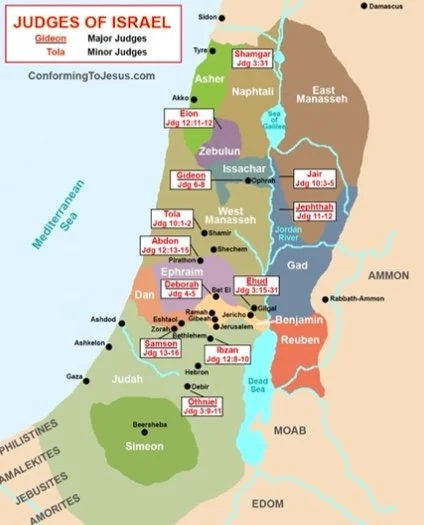

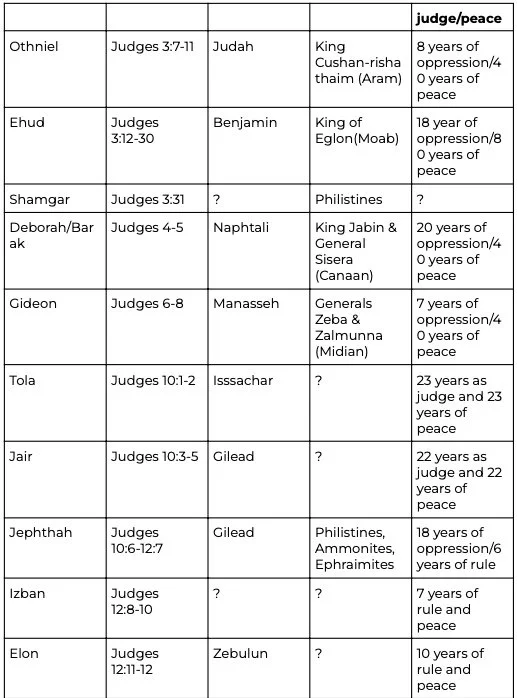
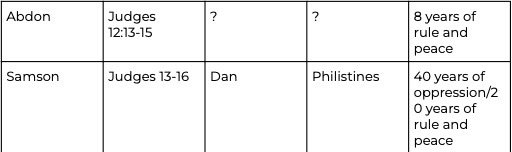
All of the infighting that occurred during Jephthah’s rule reminds me that quarrels between those we are related to can sometimes be the most bitter and in this story, the most violent. It is always sad when families fight.
This week’s story reminds me that I don’t want to be like an Ephraimite. They had a God-given responsibility that they never undertook. Today in many of our churches, we see people who will sit back and complain and not do a thing to help the mission of the church and they are certainly not involved with confronting the enemy.
The great pastor, Dr. D.L. Moody once had a fella come up to him after a service and said, “Mr. Moody, I don’t like the way you preach the Gospel.”
“You know”, Mr. Moody said, “I’m always willing to learn. Tell me about the method you use.”
“I guess I don’t really have one,” the man said.
“I’ll tell you what,” Moody said, “I like the way I do it better than the way you don’t do it.”
BRILLIANT answer! The Church needs believers who are willing to do what God has called them to do and not just sit around and complain and criticize others.
53.The Apostle Paul speaks of 2 things that can cause division in our churches today in Phil. 2:3. What are they?
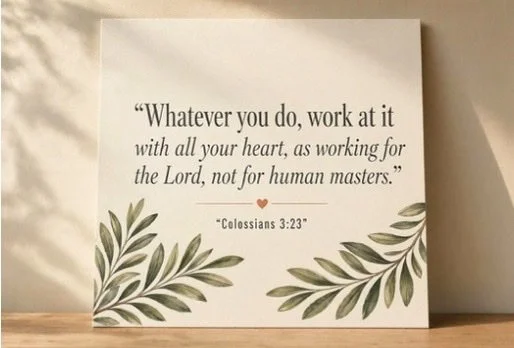
Friends, I don’t care what your lot in life is, whether you’re old or young, rich or poor, sick or well, the Lord has called you to do something. If all you can do is lay in your bed and pray for others, then that is a great calling. JUST DO SOMETHING!!!