Judges Lesson 5 - Chapters 8-9
We will continue our lesson about Gideon for one more week and one more chapter. If you recall from last week, Gideon and his army of 300 engaged in psychological warfare by attacking the Midianites in the middle of the night and confusing them to the point of causing them to kill one another. When we finished last week, 120,000 of the 135,000 Midianite army was dead, so there’s still 15,000 men left who are alive.
There are a lot of players in Judges 8. For the sake of keeping them all straight, let me just list who everyone is upfront so that you can keep them all straight.
Gideon - (also called Jerubbaal) the 5th judge of Israel
Joash - Gideon’s father (mentioned posthumously in this chapter as he was already deceased)
Jether - Gideon’s eldest son
Abimelech - Gideon’s son by a concubine from Shechem
Zeba and Zalmunna - 2 Midianite kings
Oreb and Zeeb - 2 Midianite leaders or princes
Men of Ephraim - the most influential tribe in the north
Gideon’s 300 men - the only group of fighting men in Gideon’s army Officials and Elders of Succoth - 77 leaders from the Israelite town of Succoth, east of the Jordan River
Men of Penuel - residents of a nearby Israelite town east of the Jordan River Young man from Succoth - an unnamed scout captured by Gideon Gideon’s deceased brothers - unnamed sons of Gideon’s mother who were killed by Zeba and Zalmunna at Mt. Tabor (let’s hope that she didn’t actually give birth to all of these brothers!)
Baal (Baal-Berith) - the Canaanite god of fertility
1.Read Judges 8:1-3. Why were the men of Ephriam mad at Gideon? 2.How did Gideon respond to them?
Gideon is using a little psychological flattery of his own with the men of Ephraim. This is called diplomacy and he was killing them with kindness. There were 12 tribes in Israel. Gideon only called 4 of the 12 to join him in battle (Manasseh, Asher, Zubulun, and Naphtali). I guess the tribe of Ephraim wanted in on the action too and they wondered why he waited until the entire battle was wrapped up in a nice little bow before he requested their help.
Gideon’s response to them was kinda like, “Hey, y’all have the best vineyards and wines and we just didn’t want to disturb you because you’re so so good at what you do. And look, God delivered them straight into your hands, not our hands.”.
3.What does Proverbs 15:1 say? (write out all of it)
This verse is absolutely true. Keep this in the back of your mind always when talking to others, especially when trying to make peace with someone else. If someone responds to you with harshness, then an automatic wall goes up and you don’t hear anything else after that. Gideon did the right thing here with the tribe of Ephraim. His gentle answer settled everyone down.
Up until this point, Gideon and his 300 men hadn’t done anything by way of fighting. They didn’t have to. God fought their battle. All they had to do was blow their horns and break their clay pots with the torches inside and scream a little. After this bit of psychological warfare, they sat back and watched the enemy kill each other. From their battlefield to the Jordan River was about 20 miles.
4.Read Judges 8:4-9. What was Gideon’s request of the men of Succoth and Penuel and why did he make this request?
5.What was the response of the men of Succoth and Penuel?
It appears that Gideon and his men were hangry (a combination of hungry and angry). But the men of Succoth and Penuel kinda taunted him. I’m not sure about what happened to “a soft answer turns away wrath”, but there was no softness in Gideon’s answer to them.
6.What does James 3:9 say about our tongues?
The areas of Succoth and Penuel were both located in the tribal allotment of Gad on the east side of the Jordan River. These men were saying they didn’t see any of these enemy people that Gideon spoke of, so why should they share their bread with an army that hadn’t even completely captured the enemy.
7.When they didn’t share their bread with Gideon and his men, what was Gideon’s response?
This lack of unity that Moses feared is showing fracture lines here. With the same mouth, Gideon fulfills both parts of Proverbs 15:1. He used diplomacy and he used anger or wrath. That wrath ended up being his downfall. Now as a very flawed human being, I was clapping in my mind when he said this to the men of Succoth and Penuel. I was thinking that these guys are gonna get what’s coming to them. But I’m a hot head at times, just like Gideon. Gideon allowed his anger to take over his brain and I will tell you that when you get into a situation where you allow anger to explode, then your ability to think logically goes straight out the window. Gideon had every right to be angry at the men of Succoth and Penuel. They were his fellow countrymen. They were Israelites of the tribe of Gad. Israel has always had enemies within. They did then, and they do now.
Before they even entered the Promised Land, the tribes of Reuben, Gad, and the half tribe of Manasseh had a request of Moses.
8.Read Num. 32:1-25. What did the tribes of Reuben, Gad, and Manasseh want?
9.Even though Moses granted this request (reluctantly), do you think it was ever in God’s plan for any of the tribes to settle east of the Jordan River at that time?
10.As Moses was recalling previous escapades with the children of Israel, what did he say was the result of the report from the valley of Eshcol on the sons of Israel?
What happened was so much more than this, this report literally divided the people. And all these years later, those on the east side of the Jordan River are still divided from their brothers across the river. What Moses feared actually continued to play out for years and years to come. That physical boundary of the Jordan river ended up creating a lack of national unity.
11.Read Judges 8:10-12. Who were Zebah and Zalmunna? 12.Where were they at this point?
13.Did Gideon capture them?
Do you remember the famous line from the Kurt Russell movie Tombstone where he played Wyatt Earp and said, “You tell ‘em I’m coming! And hell’s coming with me!”? This is basically what Gideon was saying to his own countrymen when he threatened them because of their refusal to feed his tired, weary men.
14.Read Judges 8:13-20. Why did Gideon capture a young man from Succoth?
15.Did Gideon make good on his threat to the men of Succoth and the men of Penuel? If so, how did he do it?
Gideon is the God-chosen judge in Israel at this point in time and in this geographical location. If this is how he chooses to judge these men, then he has a God-ordained right to do so.
16.Gideon then enters the interrogation room with these 2 Midianite kings. What does he ask them?
He is trying to force them to admit that they had killed his brothers because he already knew that they had.
17.Who does he instruct to kill these 2 kings? 18.Does he kill them? Why or why not?
I guess Gideon was trying to teach his son the tools of the trade, but his son just didn’t have the guts to slaughter those 2 guys. Then those 2 Midianite kings taunted Gideon.
19.What did they say?
20.What did Gideon do when they said this?
Yeah, a fool and his life are soon parted just like a fool and his money! It seems that these 2 foolish kings just couldn’t help themselves and it cost them their lives. They were going to die anyway, but their death was hastened with their hasty, nasty remarks.
Let’s examine what just happened here. Gideon was instructed on how and when to attack the Midianite army and 120,000 men fell by their own sword and the sword of their brothers.
21.Did God instruct Gideon to pursue the additional 15,000 men?
Gideon was God’s man of the hour and he even made it into the Hebrews 11 hall of faith. But something here in Judges 8 leads me to believe that after this great battle accomplishment, things started going south for Gideon as he headed east if you know what I mean. He changed. When Gideon crossed the Jordan River, he crossed in the opposite direction of when Joshua and the people crossed. Instead of going east to west, he goes west to east. When Gideon crossed over the Jordan River, he only had the 300 men who were with him. He didn’t have any of the men from Naphtali, Asher, and Ephraim. In his dealings with the men of Ephraim, he showed great diplomacy. In his dealings with the men of Succoth and Penuel, there was none of that diplomacy to be seen.
22.Why do you think the men of Succoth and Penuel chose not to support Gideon?
I’ve read that it could have been risky for them to do so and that they might have feared retaliatory attacks from surrounding enemies. I think that is a strong possibility because if Gideon had not captured those 2 kings, they could have regathered and mounted another attack from the ones who supported Gideon. The switch in Gideon’s style of leadership began to fracture Israel instead of unite them. In Judges 6-7, there are numerous mentions of God. There are only a couple here in chapter 8. That should tell you something.
23,Who threw the enemy into a panic back in Judges 7:22? 24.Who threw them into a panic in Judges 8:12?
It would not have been uncommon in those days for a warrior to have his son kill the enemy and in this way the father basically anoints the son as his successor.
25.What question did Gideon ask Zebah and Zalmunna? 26.Who did Gideon tell them these men were?
Does this make you think that Gideon already had a beef with these 2 guys and come hell or high water, he was going to capture and kill them? He was acting as the goel for his family or the avenger of blood. We learned about this when we studied the book of Joshua. In those days, each family had a designated goel. A goel is a Hebrew word that means kinsman redeemer. The key duties were:
To buy back family property that might have been sold due to poverty.
To pay a ransom and release enslaved relatives who might have been
trapped in servitude.
To pursue justice and avenge the blood of a relative who had been
unlawfully killed.
Tomarryachildlesswidowinordertosecurethefamilylineage.
He might have been justified in seeking their blood, but we do not see where God asked him to do this or told him not to do this. Gideon did not leave room for God’s vengeance as Romans 12:19 tells us to do. He sought that vengeance himself.
27.How many times does Gideon refer to these 2 kings by name?
Oh, I think he had dreamed of their demise for a long, long time. When Gideon started pursuing his own agenda, that took front and center and so did he. It was not God any longer who was the focus, it was Gideon.
28.But what did Gideon’s son, Jether do in Judges 8:20 and how did he feel about this request from his father?
You see, it was not just Jether’s honor that was on the line, it was Gideon’s! His son hesitated to kill. Gideon did not.
His son was afraid. Gideon was not. His son was weak. Gideon was strong.
His son was basically all the things that Gideon used to be before the Spirit of God clothed Gideon with Himself. God made Gideon into the warrior that he was in the initial encounter when 120,000 men fell. Gideon made himself into the warrior that we see in Judges 8 and his son stood as a silent witness to this change.
29.Read Judges 8:22-36. The men of Israel were so impressed with Gideon, what did they want to do?
This right here is precisely what God did NOT want to happen! Contrast the after-war behavior with Deborah and Barak to Gideon. Very different situation!
It appears here that Gideon had become kind of god-like in their eyes. This is misdirected praise and Gideon did not deserve this type of praise, only God did. In our prayers, we often recite that God is worthy of the praise and glory and honor due Him. And indeed He is. And although Gideon rejects the offer to make him and his son kings, he still acts like one.
30.With his heart now in the wrong place, what does he request of the people?
An ancient Hebrew shekel is about 4 oz. So, 1700 shekels is about 42.3 pounds. As of August 2026, the price of an ounce of gold is $140.21 a gram making this haul of gold worth $2,704,192 in US dollars. That’s a lotta money honey! This, Scripture says, “became a snare to Gideon and his household”.
31.Hmmm, this story sounds familiar! Read Exodus 32:1-6. What happens here?
The high priest wore an ephod. Gideon was not from the tribe of Levi and didn’t have any business making his own ephod. There were 2 little pockets inside the ephod that held the urim and the thummim. The high priest would use these to determine the will of God. The ephod that might have been meant to determine and discern the will of God becomes much like the golden calf that Aaron made and we know how all of that turned out. This ephod leads the people even further away from God instead of drawing them closer to Him. Gideon becomes tangled up in this web of dishonor and false worship. So the fella who led Israel out of idolatrous worship is also the fella who led them straight back into it. I should also note here that some Bible commentators say that the ephod as it is used here is not the kind of ephod worn by the High Priest, but that it is a molded idol. For contextual reasons, I’m not sure that it matters which one it was. It, of course, was not something that God wanted made.
32.What do you learn from Judges 8:28?
33.Why do you suppose God gave Israel 40 years of rest while Gideon was alive?
34.How many sons did Gideon have by his many wives? 35.How many sons did he have by his concubine?
Not unlike many other men in the Bible, Gideon had a woman problem. I’m just glad that 1 poor woman didn’t bear all of those sons! But having multiple wives and concubines often got people into trouble in Bible days.
36.What happened after Gideon died?
The story of Gideon scares me to death. I want to end well. Doesn’t matter how I started, I want the end of my life to be devoted to the God I serve. Gideon did not begin well and he did not end well. We will find in a few lessons that the judge Samson began well and ended well, but the in-between was what got him in trouble. How many times have you seen a pastor or church leader who started out good and ended up bad? No leader ever falls without affecting those in their path, be it their family, their church members, or people at large who follow their ministry. It’s like leaven in a lump of bread. Everything it touches is affected. Leaders don’t generally fall overnight. It’s a slow fade that often happens incrementally with the deterioration of the person’s relationship with God.
37.How does the Apostle Paul warn of this in 1 Cor. 10:12?
When Gideon crossed the Jordan River, he crossed a boundary line. Most lines that people cross are not geographical lines, they are spiritual, emotional, physical, or sexual lines.
I think the biggest takeaway from this story is to not idolize leaders. Our country is full of big-name leaders who are idolized by their followers. This summer when we were in Houston visiting with Colton and his family, we passed by Joel Osteen’s church several times. Notice I said Joel Osteen’s church and not God’s? That church does not belong to God. I griped and complained and nearly screamed every time we drove by it!

Notice anything strange about this picture? His name is plastered across the outside of the church and is actually in larger letters than the name of the church on the adjoining wall. Friends, this is not the way it is supposed to be. This is not glorifying to the Lord! This is glorifying Joel Osteen!
Judges 6-7 (not Judges 8) is what qualified Gideon to make the hall of faith in Hebrews 11.
38.Hebrews 12:1-3 is really the climax of the Hebrews 11 passage. Who should always be our focus?
He is the only leader who has never and will never cross any boundary lines that He shouldn’t. He is therefore the only leader who can be trusted with absolute certainty. Friends, please don’t ever put me on a pedestal for if you do, there is only one way for me to go and that is down. But if indeed the Lord places you in some sort of leadership position, entrust that position and all that it entails to God and pray that whatever you do will lead others to the God you serve and never damage the ones you lead. Always strive to live your life in a way that gives an accurate estimate of who God is for if you do not, those around you will have an inaccurate picture of who God is.
39.What do you learn from Judges 8:34-35?
This bears out the truth that we’ve spoken of so often, and that is this...it only takes 1 generation to forget about God and the things of God.
Gideon/Jerubbaal delivered them from the snare of the enemy and here are the people no longer showing any kindness to his family for all that he had done. This leads us into chapter 9.
40.Read Judges 9:1-6. What exactly was Abimelech trying to convince the leaders of Shechem of?
This 1 son did not live with the others because this 1 son was born of a concubine and thus, he did not enjoy the benefits of being the son of a wife. The 70 sons of Gideon’s wives would have received a larger inheritance and higher social status than the son of a concubine. The eldest son would have received a double portion of the father’s property and wealth. In those days, sons of concubines generally did not receive a full share of the inheritance unless the father had chosen to give them special gifts before he died.
It stands to reason that Abimelech saw himself as the odd man out (because he was), and when you have little man syndrome, that can play out in some pretty interesting ways.
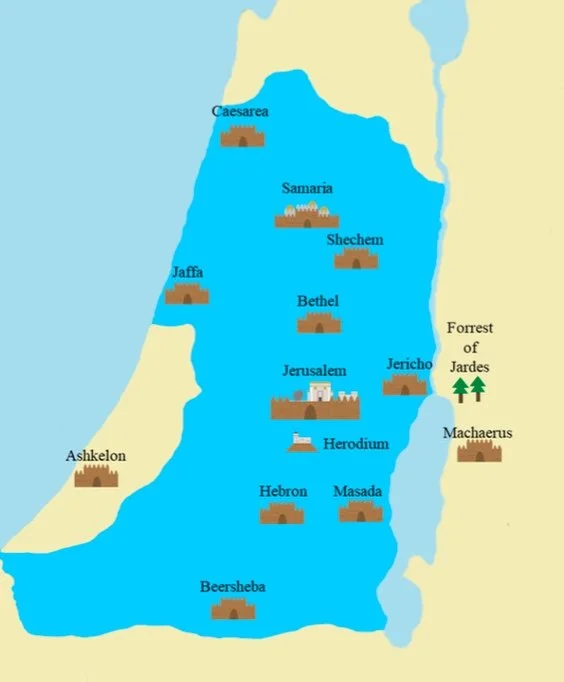
Abimelech and his people were located in Shechem. You can see the geographical location of this on this map. Shechem in Hebrew means shoulder. It was located between Mt. Gerizin and Mt. Ebal. This is the place that God met with Abraham by the oak tree of Moreh and promised the land to his descendants. Joseph is buried there. And if you recall from our study of Joshua, Joshua gathered all the tribes of Israel together and famously said, “As for me and my house, we will serve the Lord.”. Shechem was one of the 6 Levitical cities of refuge. Later on in the Old Testament, after the death of King Solomon, the northern tribes met in Shechem to crown Rehoboam. Jeroboam later made Shechem the first capital of the Northern Kingdom of Israel. Jeroboam was an overseer of the labor force under King Solomon. Rehoboam was the son of King Solomon. It was these 2 men who split the kingdom of Israel and Jeroboam became the king of the northern Kingdom of Israel while Rehoboam became the king of the southern Kingdom of Judah. Shechem is quite important in the biblical account.
41.How did Abimelech’s relatives respond to his request? 42.Who did Abimelech hire?
My rendition of what the Bible says here would be that he hired lowdown, dirty-rotten scoundrels!
43.How much did they give him?
Once again, today in August 2026, that amount would only be worth $1663.00. That’s today’s value! That is not much and divided amongst 70 men would mean that each man got $23.76. Okay that’s not a lot. However, in those days, 70 shekels of silver represented 7 full years of wages.
44.What did Abimelech do to his 70 brothers? Did any of them get away?
He killed 69 of the 70 brothers with one stone. I don’t think that means that he managed to find a stone big enough to drop on all 69 men at the same time. It likely means that Abimelech used some kind of altar or block to carry out an execution-type of death for each man. They weren’t hunted down and killed one by one. They were rounded up and killed publicly. This is one way to make sure that there are no heirs to the “throne”! I read several commentators who believe that the sons of the brothers were also possibly killed to eliminate any attempt for the sons of the brothers to take over. The text leads us to believe that Abimelech did not waste a lot of time between the death of his father and his killing his brothers. I can’t help but wonder if he had a deep hatred for his father due to the fact that he was the low man on the totem pole of the family hierarchy.
45.What did God instruct the people to NOT do when they entered the land?
It is almost certain that this Shechemite woman was a Canaanite. Only Jotham, the youngest brother survived and this is because he hid.
46.Who did the people make king over them?
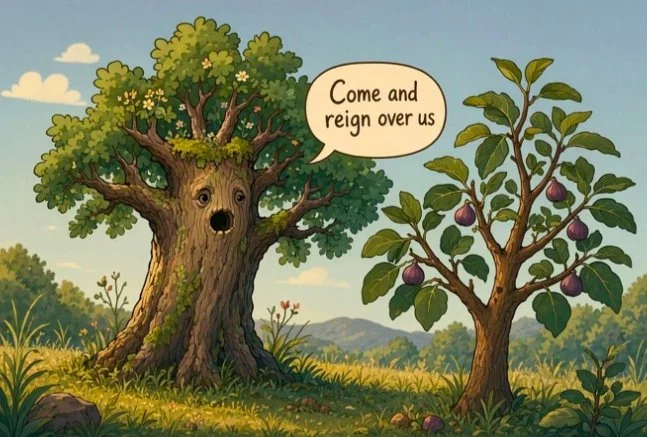
We talk about Saul being the first king of Israel, but really Abimelech was the first king in Israel. He was not the king of all of Israel though as Saul, David, and Solomon were. Read Judges 9:7-15. Baby boy Jotham goes and stands on top of Mt. Gerizim and he gives them a parable. Mt. Gerezim faced Shechem from the southeast. There are very few parables in the Law and the Prophets. This one is unique for sure.
47.What is the parable?
48.Identify the following:
The trees
The olive tree
The fig tree
Thevines
The bramble
I’m going to help you out with the last one. The bramble is Abimelech. I read one commentator say that what Abimelech did made The Godfather look like Strawberry Shortcake. I think I’d agree with that!
The olive tree, the fig tree, and the grape vines are all symbols of Israel in a flourishing state. With this parable, Jotham sends a clear indictment to the people because they have, after all, offended a holy God.
49.So, with the 3 symbols of wealth, when the parable is asking the olive tree, fig tree, and grape vines to rule over them, what is this saying about the materialistic nature of the people?
50.Read Phil. 3:18-19. What do you learn about materialism from these verses?
In Jewish history and tradition, the fig tree is a symbol of prosperity, peace and security. In 1 Kings 4:25, the biblical phrase “sitting under one’s own vine and under one’s own fig tree” is representative of an era of profound abundance and peace. The shade of the fig tree was thought to be the ideal place for a person to sit and study the Torah. Interestingly enough, it was fig leaves that Adam and Eve first covered themselves in after sin entered the world.
In a similar manner, the vine has always symbolized national abundance for the Jewish people because if the vines are loaded with good grapes, then the result will be good wine. A flourishing vine was representative of God’s favor and physical security.
51.What else did wine symbolize in Psalm 104:15?
The quality of the grapes on the vine was often represented by Israel’s faithfulness or lack of it.
52.What do you discover about the quality of grapes in Isaiah 5:1-7?
It is evident from Jotham’s parable that the people expected God’s favor and abundance despite their blatant idolatry. The whole point of this parable is that if the nation had focused on Yahweh, then they could enjoy abundance on the olive tree, fig tree, and grape vines.
You see, the olive tree, fig tree, and grape vine knew what they were created for. And because they knew this, they were not successfully tempted to assume a role that was not theirs in order to gain power and glory.
Bramble is a dry, thorny bush that is considered to be invasive and offensive and needs to be pulled up and burned. But the bramble in our parable threatens destructive fire if the olive tree, fig tree, and grape vine do not comply. This is the great irony in the parable. The 3 symbols of national abundance are not the ones calling the shots, it is the thorny weed that nobody wants or needs in their garden that is calling the shots.
53.Read Judges 9:16-21. The people are delusional and they buy into Abimelech’s trick and it costs them dearly. What kind of pronouncement/warning does Jotham make on the people?
There is a great Gospel application in Jotham’s parable. Within each human being is a God-shaped vacuum that only God can fill. Our hearts long for a king. I was recently telling a parent who is raising a child who is not biologically her own about something that God places within each person. She was distraught because her daughter who she had raised since infancy and has spent the 10+ years loving and protecting is now being drawn to a biological parent who has never taken even the slightest interest in her and who is living a dangerous lifestyle. I told this adoptive parent that God places a natural longing within people to desire closeness with their biological parents. I’ve seen it over and over and over again. Sometimes it doesn’t go so well when that reunification happens. In much the same manner, I believe that within each person is the longing for a king and when that need is not met, our desperate hearts sometimes will make an idol of just about anything and anyone.
Friends, we have to serve God as God. There cannot be any substitutes and we can’t fashion God into the kind of being we want Him to be. Abimelech is a prime example of ambition gone bad....real bad! For him, as long as any of Gideon’s sons were still alive, there was no pathway to leadership for him. That whole “flesh of my flesh” argument that he gave to the men of Shechem was a trickery and yet, as these 69 sons were slaughtered, nobody spoke up and said, “Hey wait! Ain’t these fellas your brethren? They are your flesh! What are you doing?”!
We read this story today and think to ourselves what complete fools the men of Shechem were. And yet, how foolish are those in the world today? Pretty foolish and even delusional I’d say.
54.Read Judges 9:21-25. What happened to Jotham?
After this, we don’t see him again in the pages of Scripture.
55.What did God send in v. 23 and who did He send it to?
This does not mean that God created moral evil because He did not. God is sovereign over the rise and fall of corrupt leaders. He used the greed and pride of Abimelech to sow seeds of hatred, strife, and resentment towards his own people. In the end, it eroded the men’s trust in him and allies turned into enemies.
56.How long did Abimelech rule?
I want to note here that Israel never considered Abimelech to be their first king. They considered Saul to be their first king.
57.What did the men of Shechem do in v. 25?
58.Read Judges 9:26-33. Who is Gaal and what does he begin to question?
Judges 9:27 says that they gathered grapes and trod them and held a festival to their god. In other words, they got soused! And when people get soused, they can do and say some crazy things. The grape harvest in Israel begins in late July and can go all the way to November depending on the geographical area and the types of grapes.
59.Who is Zebul and what do his messengers say to Abimelech?
60.Was this true?
61.Then why did Zebul instruct his messengers to say this? In other words, what’s in it for him?
62.Read Judges 9:34-45. What was Abimelech’s plan against Shechem?
63.When Gaal saw who was comin round the mountain, how did Zebul respond to him?
This likely happened very early in the morning.
64.When Gaal realized that it was Abimelech and his men who were coming to fight the men of Shechem, what did Gaal do?
Talk about a turncoat! What a pathetic excuse for a man and a warrior Gaal was! What we are witnessing here is a civil war in the land.
65.After Gaal joined Abimelech, what did Abimelech do?
66.Zebul ends up driving out Gaal and his relatives, but on their escape from town, what happens?
67.In v. 45, what did Abimelech do to the people and the city?
Razing a city and sowing it with salt means completely and utterly destroying the city. In the ancient Near East, spreading salt on the land would ensure that nothing could grow and that the land would thus be unfit for life forever. It was a symbolic curse that also sent a strong warning to surrounding cities that any kind of rebellion would be met similarly. Here is Abrimelech mimicking the behavior of the Hittites and the Assyrians. Archeology confirms that this actually happened in the 12th century BC and the city wasn’t rebuilt until the reign of King Jeroboam 1. Abimelech destroyed his own city!
68.Read Judges 9:46-49. What did Abimelech do and what did he instruct the men of Shechem to do?
69.What was the result of this?
I can’t help but wonder if the people in this tower in Shechem heard echos of Jotham in their mind as the tower was set on fire, “May fire come out from the bramble and consume the cedars of Lebanon.”
Read Judges 9:50-57. No doubt that the people in Thebez heard about what happened at the tower in Shechem and they didn’t want an automatic replay of what happened there. The people shut themselves into the tower at Thebez when they realized that Abimelech and his men were there. There was a certain woman in this tower and she did something pretty incredible!
70.What was it?
Just like Jael gave Sisera a splitting headache, the woman in the tower at Thebez gave Abimelech a splitting headache! People don’t realize that there is more than 1 female hero in the book of Judges. Most people only think about Deborah, but there are also 2 others.
71.What was so distressing to Abimelech about this woman throwing this millstone on his head?
Too late! We already know that he was basically killed by a woman despite what he had his armor bearer do! People who read this account will forevermore know exactly what happened on that day and will also know that there’s no saving face for Abimelech. He got outsmarted by a woman and met his demise at the hands of a woman. People in those days wanted to die with honor. One of the reasons that Gideon told his young son, Jether, to kill Zebah and Zalmunna was because an inexperienced youth killing a king would have been a disgrace forevermore to that king. In the same way, being killed by a woman was a disgrace.
72.Did the curse of Jotham come true?
The 1st attempt at a monarchy failed miserably. Don’t fight against God or you will fail. Don’t fight against His purposes or you will fail.
73.What do you discover in Gal. 6:7?
There are some crucial principles here that we find in our story this week:
1. We reap in kind what we sow. If we sow orange seeds, expect an orange tree. If we sow kindness, then kindness will be returned. If we sow destruction, then destruction will be returned.
2. We reap later than we sow. In other words, sowing and reaping does not happen all at the same time. Whatever you plant, be it good or bad, you will reap a harvest later on.
3. We reap proportionately to what we sow as 2 Cor. 9:6 tells us, “Whoever sows sparingly will also reap sparingly, and whoever sows generously will also reap generously.”
4. We reap more than we sow. One little orange seed can produce a whole orange tree with multiple oranges that also have multiple seeds and this will go on in perpetuity.
Abimelech sowed seeds of deceit, pride, greed, resentment, hatred, and paranoia. He and those who stood with him not only lost their lives, but so did their families. What he and his men did and the destructive trail they paved and sowed (and salted) lasted until the 10th century BC, that’s 200 years of infertility upon the ground of Shechem.
Friends, evil may seem to prosper everywhere you turn, but make no mistake about it, God will not be mocked and He is the great leveler!
REAPING AND SOWING IS A BIBLICAL PROCESS! DO NOT INTERRUPT THIS PROCESS FOR ANYONE OR THEY WILL NEVER LEARN THE LESSON THAT GOD INTENDS FOR THEM TO LEARN!
Especially don’t interrupt this process for your children or your grandchildren. Why bail out a kid who got put in jail for drunk driving? Why pay for an attorney for a kid who assaulted another individual? Why keep paying for a cell phone for a kid who has repeatedly abused that privilege with lewd pictures and words? If we do not allow those we love to suffer through the natural logical consequences of their behaviors, then we have tossed aside the sowing and reaping process.
God will not be mocked! He will have His way one way or the other!