Judges Lesson 4 - Chapters 6-7
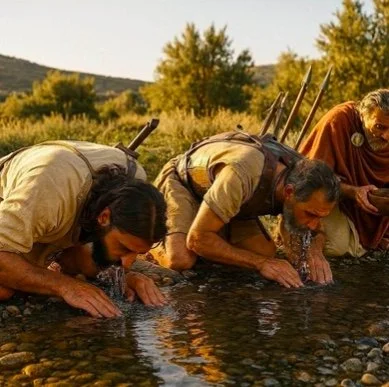
In our last lesson, we learned that Israel had 40 more years of peace in their land following the defeat of Sisera. Now enters the next generation. Then Israel did what they always did, they fell back into apostasy. So the Lord brought up against His own people, the Midianites, the Amalekites, and others from the east to besiege them. God loved them enough to discipline them.
In Malachai 1:2-3, we read, “Jacob have I loved, Esau have I hated”. We must ask ourselves how this love and how this hatred manifested itself. God fulfilled all the promises He made to both men. He blessed Esau with wealth and power and allowed him to be the leader of a great nation. Esau could never say that he wasn’t blessed, because he was very abundantly blessed.
Therefore, when we read that God hated Esau but we also know that God blessed him, this seems to be a contradiction in terms. We cannot think of hatred in human terms because God does not possess that kind of hatred. But God’s hatred of Esau was demonstrated in that He never disciplined Esau. He just gave Esau over to be the kind of fella he wanted to be and God never challenged him in any way to make Esau holy. God gave him over. The 4 scariest words in the whole Bible are “God gave them over”.
Jacob became the leader of a great nation. He was blessed with wealth and power like his brother. Then how exactly did God demonstrate His love towards Jacob? God beat him up constantly. He would not leave Jacob alone. God changed Jacob from a deceiver and a supplanter to a prince. Jacob wrestled with God to the point where he walked with a limp the rest of his natural life. Friends, if you don’t discipline your children, then you hate them. Bottom line.
God loved Israel. And because He loved them, He sent foreign enemies to discipline them. This is the pattern of love throughout the Bible.
1.Read Judges 6:1-10. After 40 years of peace, how long did Israel do evil in the sight of God?
It is important to note here that Israel’s apostasy always led to servitude. If we fall into grave sin, it is also an indication that we are serving the wrong master and thus have become imprisoned by the sin that besets us.
2.Who are the bad guys in this week’s story?
The book of Judges has some of the most amazing stories in the Bible! I love the story of Deborah! I also love the story of Gideon. This week and next week, we’ll be studying all about Gideon. There is more written about Gideon than any other judge in the book of Judges.
Have you ever felt as if you were surrounded by enemies? Oh, I’ve had an enemy here and there. I have some enemies now. There are always those who will hate you if you’re trying to do the right thing. But sometimes, it is those within our own camp who are the cruelest. I think about Jim Elliot and the story of his death.
Jim Elliot was an American missionary to Ecuador. Jim and 4 other families felt the call to minister to the Huaorani people. However, on Jan. 8, 1956, Jim and 4 of his male missionary friends were surrounded by a group of 10 Huaorani warriors and all 5 men were killed. Jim Elliot was the first to be killed and the bodies of all 5 men were found downstream at the camp. This was not the end of that story. When Life Magazine heard about it, they did a 10-page spread about Jim and his friends and their mission. People across the world soon heard about the amazing heroism of these missionaries, but even more amazing was that after their deaths, Elisabeth Elliot, Jim’s wife and other missionaries returned to Ecuador to continue their evangelistic work with the Huaorani. Later on, Susan Martin Miller wrote a book entitled, Jim Elliot: Missionary to Ecuador in which she quoted from Jim’s journal, “He is no fool who gives what he cannot keep to gain what he cannot lose”.
We never know why God chooses to physically protect some who step out in faith and not others. That’s a question only He can answer. Our story this week begins with a scenario much like Jim Elliot in Ecuador. Israel is completely surrounded by the enemy, but unlike Jim Elliot who was faithful, they are surrounded by enemies because of their own disobedience.
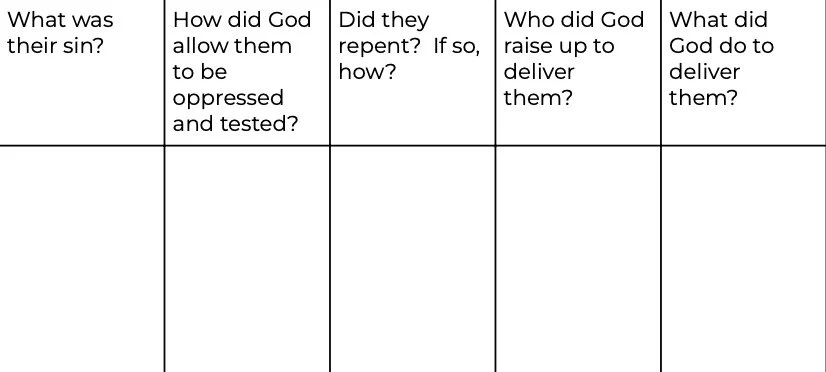
As you go through this week’s lesson and next week’s lesson, fill in Cycle #4. 3.
Cycle #4
Let me just say this, to be surrounded by a physical threat is one thing and to be surrounded by a spiritual threat is quite another. To have the threat of both is a frightening thing and that was indeed the situation with Israel at this time in their history.
4.What does the Apostle Paul explain about this kind of threat in Ephesians 6?
I am convinced that there are spiritual armies of wickedness in high places around this world. As time goes on, I’m even more convinced that there are certain places around the world that have a higher concentration of spiritual wickedness than other places. I believe Gaza to be such a place. I won’t rehash what happened on Oct. 7, 2023, but the wickedness in that area was so great that it boggles the mind just how people who call themselves human beings can act with such evil intentions. And then others who support the atrocities that occurred without questioning the motive are just as bad as the murderers.
If the Children of Israel had just wiped out the enemies of God when they came into the land, much of what we read in the Old Testament would not have happened, nor would what happened 10/7/23 have happened.
5.What did the Children of Israel do because of the Midianites in Judges 6:2?
Friends, they weren’t living as civilized people. They were living as cave dwellers. This was humiliating, but humiliation was needed in order for repentance to take place.
6.How did the Midiantes torment the Children of Israel?
We are getting ready to launch into an amazing story where God used only a few resources to accomplish a mighty victory. This goes back to our discussion about the judge Ehud. He was left-handed and considered handicapped by their standard of judgment. God uses the weak to confound the wise (1 Cor. 1). When the weak are used and resources are drained, the people have to realize that it was only by the hand of God that success could possibly occur. When Israel became a nation on May 14, 1948, there were only about 600,000-650,000 Jews living in Israel. On May 15, 1948, Israel was attacked by Egypt, Jordan, Syria, Lebanon, Iraq, Saudi Arabia, and the Palestinian Arabs. Israel didn’t even have a military tanker when the war began. But what they did have was a strong motivation to fight and to win and they had the greatest weapon of all, God. When all the cards are stacked against you, then the possibility of winning is small. This causes the whole world to look and to wonder how and why this could happen. One answer, God!
7.There was a coalition of bad guys here in Judges 6. Who were the players?
The Amalekites and the people of the east (or Qedemites) were nomadic raiders. They were Bedouin tribes who didn’t necessarily have a city, they traveled around and lived in tents and descended from Ishmael, the son of Abraham. These descendants continue to wreak havoc in the Middle East today. The Amalekites were descendants of Amalek who was a grandson of Esau through Eliphaz. They were a pain in the patootie of Israel all through the Old Testament. They were considered to be fierce desert warriors who specialized in mobile destructive guerrilla warfare. They became famous in Bible days for using massive herds of camels to sweep across the Jordan River and pillage settled farming communities. One Bible commentator said that they used camel warfare.
8.The Midianites were descendants of Abraham. In Gen. 25:1-2, who was Midian’s mother and where did he fall in the birth order?
The Midianites settled in the land of the east. They believed in the one true God just like Abraham. Let’s look at a few references to “children of the east and see what else we can learn.
9.What specifics do you learn about them from the following verses: Judges 6:3
Judges 6:33 Judges 7:12 Judges 8:10
These people groups surrounding Gideon’s tribe and other tribes would go scorched-earth on them. Scorched-earth is a military policy that destroys anything of potential use to an enemy, including food, water, crops, livestock, buildings, and infrastructure. They would take everything from the fields of the Jewish people and then burn the fields, hence the term scorched-earth.
If you recall from the story of Moses in Exodus 2, Moses killed an Egyptian after he saw him smiting a Hebrew. Because Moses began to fear that he might be found out, he fled to the land of Midian.
10.Read Exodus 2:16-21. Who did Moses meet on this trip and how did this change his life?
11.Who does the following verses say Moses’ father in law is? Exodus 3:1
Num. 10:29
Judges 4:11
12.Is Moses’ father in law Reuel or Jethro or Hobab?
And for that matter, how can Hobab be Moses’ father in law and also a descendant of Reuel? My goodness this can get confusing! Let’s look first at the name Reuel. There are those who think that Reuel and Jethro are synonymous and that they are one in the same.
Then, there are those who think that Reuel could be the name of the father of the clan and the daughters of Jethro could be attributed to Reuel. This was a fairly consistent practice in the ancient world. Jacob claimed Joseph’s sons. Rachel and Leah claimed the sons of their handmaidens who bore children from Jacob. But this would force Hobab into the role of being Moses’ brother-in-law. Hobab is recorded as staying with the Children of Israel after the exodus from Egypt while Jethro is recorded as going back home.
There’s a 3rd idea and that is that Reuel is the real name of Moses’ father in law and Jethro is his priestly title. I believe that Reuel and Jethro are the same person. That leaves us with the dangling modifier, Hobab.
You might already know this, but the Hebrew language originally only consisted of consonants. Later on, small markings were put above or below letters to make pronunciation and reading easier. The ancient Hebrew word for father in law sounds like hoten. The ancient Hebrew word for brother in law sounds like hatan. Remember, the vowels would not have been there in the original text, so both father in law and brother in law would have looked exactly the same.
Is it possible that the names Jethro, Reuel, and Hobab are all the same person? Yes, it is possible. I think it’s important that we look at all of these possibilities lest we become extremely confused. There’s a bit of disagreement out there concerning this issue. I definitely believe that Jethro and Reuel are pertaining to the same person and perhaps Hobab too, although I’m not convinced about Hobab.
This brings us back around to an even bigger question for us to consider in the understanding of our story, was Moses’ father in law a Kenite or a Midianite? We’re gonna have to get in the weeds a bit here as well.
Some consider the Kenites to be descendants of Cain. In all my reading about this, I simply don’t think we can prove that with any certainty because all of Cain’s descendants would have been wiped out in the flood of Noah’s day. It is possible that one of Noah’s daughters-in-law was a descendant of Cain, but the Bible nowhere spells this out. Our last story told us about 1 very important Kenite, Jael. She is revered in Scripture for her role in helping the nation of Israel secure a victory.
Moses’ father-in-law was a Midianite because he was a priest in Midian. He was a descendant of Abraham through Abraham’s second wife Keturah after Sarah died. Moses’ father-in-law lived in the land of the Kenite which technically made him a Kenite. It would be like a Chinese individual being an American citizen. They are still ethnically Chinese by lineage, but they still live here. Were the Kenites and the Midianites related in some way? Possibly. Probably. The Kenites were always on friendly terms with the nation of Israel.
13.What did King Saul do regarding the Kenites in 1 Sam. 15:6?
I don’t want to beat a dead horse, but I also don’t want us to have different texts saying different things and not address those things and bring some clarity to them. Okay, now on with the amazing story of Gideon.
14.In Judges 6:8, who is the prophet spoken of?
There are only 2 places in the book of Judges where the word “prophet” is used to describe someone who God sent to foretell God’s plan and we’ve already studied about one of them in the previous 2 chapters, Deborah. We aren’t told who the prophet in v. 8 is, so we won’t even speculate.
15.What message did this prophet deliver to Israel?
Deborah was unique, not only in the book of Judges, but in the entire Bible. She was not only a prophetess, but a judge who delivered Israel. Whoever this prophet was in v. 8 was only a prophet. The deliverer was coming and his name was Gideon.
16.What does God tell the people in Judges 6:10? 17.Now go to Judges 6:11. What is Gideon doing?
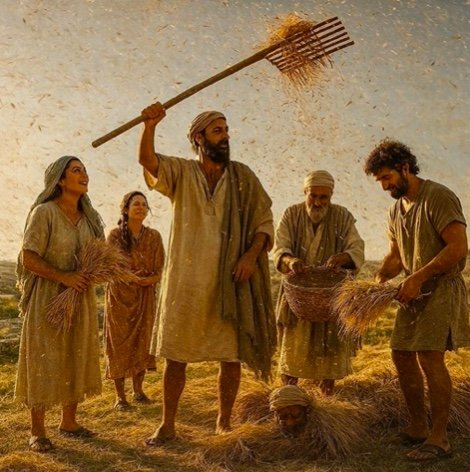
There is one thing you need to thresh wheat, WIND!!! A winepress is a small enclosed space and since there was no electricity and no industrial fans, threshing wheat in a winepress would have been a near impossible task. Winepresses were the sunken down places where grapes were crushed in order to make wine. There’s another issue here and that is the possibility of contamination that would have been in that sticky winepress when the residue from the crushed grapes would have adhered to the wheat. If this is what they were doing in the winepress, then it stands to reason that there were no more grapes on the vine or the Midianites had plundered all the vines. Also, the fact that Gideon felt safe in the winepress is further proof that the Midianites weren’t interested in attacking any winepresses. This lends credence to the fact that there were no vines. The picture below would have been consistent with how wheat would have been threshed in ancient Israel. Separating the wheat from the chaff is called winnowing.
18.We see another tree here in Judges 6:11. Who did this tree belong to?
Gideon is getting ready to ask God 3 questions that I think we’ve all wrestled with:
1. If God is good, why are bad things happening? (Judges 6:13) 2. HowcouldGoduseme?(Judges6:15)
3. HowcanIknowGod’swill?(Judges6:36-40)
19.God is going to graciously answer all of these questions. Read Judges 6:12-27. How did the angel of the Lord refer to Gideon?
This kinda cracks me up because he was hiding out in a winepress threshing wheat and it initially appears that he is anything but valiant. But this word, “valiant”, does not stand alone.
20.Go back to the first part of the angel’s address to Gideon. What does the angel initially say to him?
The true source of Gideon’s valor was the fact that God was with him. Gideon’s identity was tied to God’s identity. And since God was with Him, God knew the potential of this man despite his current weakness of threshing wheat in a winepress. The future transformation of Gideon’s strength was something that was as good as there because in God’s eyes, it was a present reality. Once again, we see God call a man who was not the strong one to be His called one.
21.What else did Gideon feel had disqualified him from the job that God called him to? (v. 15)
In Judges 6:13, Gideon basically accuses God of forsaking the Jewish people, but really it was the other way around. When God reminded Gideon that He was with him, Gideon looked around and basically said, “Well, I don’t see any evidence of that!”.
22.How are Judges 6:14 and Judges 6:16 different?
Did you know that after the birth of Christ, the angel of the Lord is not mentioned again in Scripture? There are numerous mentions of angels though. There are 2 places in the book of Matthew (Matt. 1:24, Matt. 28:2) where some translations refer to “the angel of the Lord”, but in both of those references, there is no article in the Greek language. The article “the” has been inserted by the translators of the text. In both of these verses, we can better translate “the angel of the Lord” as “an angel”.
23.The question we need to pose to ourselves here in Judges 6 is whether this manifestation is indeed an angel or is it a preincarnate Jesus Christ. Judges 6:22 gives us that answer. Who is it?
There are theophanies in Scripture which are manifestations of God (remember Moses and the burning bush) and Christophanies which are manifestations of Christ. I believe that what we have here in Judges 6 is a Christophany.
There are times in Scripture when the angel of the Lord is truly an angel and tells the person not to worship him. Then there are times when the angel of the Lord really is the Lord and allows the person to worship Him.
24.In the following verses, who is the angel of the Lord? Rev. 19:10
Rev. 22:8-9
Gen. 16:9-13
Gen. 22:9-18
25.When Gideon asks how he shall deliver Israel, what is the answer given back to him?
26.What did Gideon ask for? 27.What happened to the offering?
Isn’t it interesting that when God calls the unqualified, they often respond that they know they’re unqualified and therefore, He cannot use them. “Who me, You talking to me God?” He called Moses and Moses replied that he stutters. He called Jeremiah and Jeremiah responded that he was too young and didn’t know how to speak. He called Jonah and Jonah replied that he just didn’t want to go because the people of Nineveh were degenerates and he literally ran in the opposite direction. So it’s not uncommon that Gideon would also make excuses. He’s in some pretty good company with Moses, Jeremiah, and Jonah.
So why does God call the people who don’t want to be called? Because He has a divine purpose and His divine purpose means that He gets to select who He calls and it doesn’t matter if the person wants to do it or not and it doesn’t matter if the person is qualified or not. God completely bypasses reluctance in order to demonstrate that it is His strength that matters and not the strength of the one who is called.
Does God’s plan of redemption depend on our willingness? Absolutely not! But the unwillingness of called individuals reflects character traits of pride or fear or anger and those traits are purged through the refiner’s fire once God steps in and takes over. Who you are is of no consequence, but who you are with God is of great consequence!
Let me ask you a question. Are you comfortable in your service to God? If your answer is yes, then I’m not sure that you’re where you should be. Once we settle into our comfort zone, we are no longer expanding ourselves and growing in our faith and spiritual maturity. I am convinced that God wants us to be uncomfortable Christians. This is the only way that we can say like the Apostle Paul, “When I am weak, then I am strong”.
28.What did the Lord say to Gideon to calm him down in v. 23?
Only the Lord can bring peace and calm to a heart that is beating out of its chest. God didn’t remove the presence of the enemy, but He did share His very presence with Gideon. The peace of God affects how you feel about a given situation and it impacts how you react to it.
29.What do you learn about peace from Phil. 4:7?
I love Phil. 4....the whole chapter, and I use it so frequently in counseling. While it might seem like a contradiction in terms to use the word peace and the word guard or defense in the same sentence, let me explain why this works. The word guard in this verse is a military term which means “to stand guard over”. In other words, the peace of God will stand guard over your heart and your mind when foreign invaders like anxiety or fear creep in.
It may seem to us that since we are vessels of the Holy Spirit, we should always have peace in our hearts. Prayer is the key to unlocking the peace of God in our hearts. When acute anxiety and fear hit us like a ton of bricks, it is easy to forget that God is sovereign. If a situation leads you to anxiety, it should automatically lead you to prayer. Something happened today that caused me to have a meltdown. This something has happened repeatedly and it involves technology and my husband kept telling me to calm down because as he put it, I quickly accelerated to DEFCON 10! (Todd likes to remind me of this about myself.) The peace of God is not dependent upon circumstances, it is dependent upon God.
Gideon is getting ready to move far out of his comfort zone and into the realm of God’s peace. Discomfort and peace do not seem to go hand in hand, and yet, for the child of God, they absolutely can go hand in hand.
30.Once Gideon realized who he was speaking to, what did he do?
31.What did he call this altar?
Here we have a fella who is scared to death and is threshing wheat in a winepress and he has an encounter with God and upon his realization that God was with him, peace came upon him. Oh, if we could all realize the Lord’s presence with us every day!
The Abezerites mentioned in Judges 6:24 were part of the tribe of Manasseh. There were 10 clans that made up the tribe of Manessah.
32.What did God instruct Gideon to do? 33.Why did he do this thing at night?
34.He did it! But he was far too afraid to do it when everyone could see him. What do you learn about Gideon’s father in these verses?
35.Do you think the pagan altars of Gideon’s father were the only altars to Baal and Asheroth in this area?
I think God wanted Gideon to start with his own family. God is basically saying, “You start this process at home”. The name Gideon actually means “hacker”. And here he is hacking down these pagan altars.
36.Read Judges 6:28-35. How did the people respond when they realized what happened to their altars the following morning?
37.How did Gideon’s father, Joash respond?
As a mental health clinician, I find this so interesting. We just read that these altars belonged to Joash and here he is defending his son against these people who proclaim false gods and he’s one of them! Why is this? I believe there are things that are contagious. Fear is contagious. Anxiety is contagious. If you’re around someone who is constantly full of fear and anxiety, then it will eventually rub off on you. Courage is also contagious. Faith is contagious.
Gideon’s courage and faith seemed to have a profound effect on Gideon’s father. When he saw that his son had taken such a bold stand for Yahweh, he too started to look at his own religious belief system and question it. He was Jewish. He knew who he was supposed to worship and it was not a false god. When the culture around you affects you too deeply, this is what you see. Joash was raised to know the God of Israel and he was also raised to know that God would not tolerate false worship. Yet, he gave way to the culture around him. This is exactly what we are witnessing here in the United States of America. Even many of our churches have turned pagan.
38.On that day, what was Gideon’s name changed to and what did it mean? 39.Where did the enemy encamp?
This is a famous place and it’s going to get even more famous in the future. The Jezreel Valley lies just south of the Galilee region in the north. It is a beautiful, fertile area where many biblically significant events occurred. Jezreel means “God sows” in Hebrew. King Saul and his sons died here. Queen Jezebel died here. And in the future, the battle of Armageddon will be here.
40.What role did the Holy Spirit play in this scenario?
The literal meaning in Hebrew is that Gideon was clothed in a Holy Spirit garment. He put on God. We inhabit the Holy Spirit, but prior to Christ’s death on the cross and His resurrection, ascension, and sending of the Holy Spirit, the Spirit of God operated differently. Scripture speaks of the Holy Spirit coming upon some people and then removing Himself from others. When the Spirit of God was removed from King Saul, he literally lost his mind.
41.We see similar language in Judges 14:6 regarding Samson and how the Holy Spirit intervened in his life. What do you discover?
42.List all the clans and/or tribes who were called out to follow Gideon.
43.Read Judges 6:36-40. What did Gideon request of God?
44.What do you think about this? Should we be doing such things?
Have you ever had to tell someone something and you just knew they would not be happy with you, so you start out by saying “Please don’t be mad at me, but........”? This is exactly the dilemma that Gideon found himself in.
45.How did Jesus address seeking for signs in Matthew 12:39 and Matthew 16:1-4?
From our story thus far, it appears that Gideon already had enough information to be convinced of God’s power and faithfulness. He had already seen God in person consume the offering with fire and he had already witnessed Him vanish from his presence. Gideon kinda gets a bad rap here in Judges 6 for what appears to be a lack of faith, and I’m pretty certain that he deserves it. However, I’m not sure that we wouldn’t have done the same if we had been in his shoes. The object of faith (God) is not the problem here. The problem lies with the person and his/her lack of faith. God possesses infinite power. How we perceive that power says something about our own faith. We have 2 things that Gideon didn’t have:
1. The complete Word of God
2. The Holy Spirit living within us
There are lots of Christians today who “put out a fleece”. In other words, they test God in order to determine His will. Now, I will admit that it is not always easy to determine the will of God, but this fleecing stuff is not biblical in the way it is used today.
The bottom line here is that despite Gideon’s lack of faith, God accommodated him. That was God’s mercy and grace upon a man whom He chose for the victory that was to come.
46.Read Judges 7:1-3. Where were Gideon and his men camped out?
Gideon gathered his troops about 4 miles away from the Midianites. This area has a cave near Mt. Gilboa. If you visit Israel today, you can visit Gideon’s Spring or Ein Harod. If you visit this area, here is a pic of what you will see:

47.How many men in total were with Gideon?
48.How many were scaredy cats?
49.Why did God want the number of men trimmed down?
50.Read Judges 7:4-8. What was the final number of men who would go into battle with Gideon?
51.How were these men chosen and why do you think God used this particular method to choose them?
I could be totally off base, but I do believe that men who lap up water like dogs are the most brutal kinds of fellas. But I really don’t know if this even had anything to do with it. There’s lots of speculation out there about this. So now, Gideon has 300 men and the Midianite army has 135,000! I wonder how Gideon felt about those odds.
52.In Deut. 20:1-9, God laid out some laws regarding warfare. These are very interesting to say the least. Read these verses and note what you discover about men who are fearful in war and why they should be rejected as participating warriors.
God confirms that fear is contagious. He created us human beings and He knows how our brains operate. But did you know that it is actually scientifically proven that fear is contagious? When an individual is afraid, that person releases a specific stress chemical in his/her sweat. Others unknowingly smell these chemicals which elicits a stress response in their own brains. And, when we see fear on a person’s face, it signals a part of our brain called the amygdala which is the part of the brain that handles danger and fear.
Obviously, fear can be used for a good purpose. If you’re in a burning building and others don’t realize the building is burning and thus they don’t perceive they need to act, then fear can be a good thing. The reason I don’t walk into an oncoming truck in the middle of the interstate is that I fear I might get run over. But fear in battle can never be a good thing. God wanted only the bravest men who were void of fear to walk into battle. That’s the kind of fella I like!
53.What did the 300 men who stayed keep with them? 54.Read Judges 7:9-18. What did God want Gideon to do?
We see similar language in these verses as to the ones we just read about regarding fear. God only wanted the bravest men to go into battle and here we learn again (we already knew this) that Gideon is scared.
55.What kind of accommodations does God make for Gideon this time?
56.Describe the dream that the Midiante warrior was sharing with his comrade?
57.What did the loaf of barley bread represent?
Barley bread was known in those days as the bread of the poor. Gideon and his family certainly represented this. They were impoverished grain farmers who couldn’t even process their own grain in plain sight. And Gideon expressed himself that he was “the least”(Judges 6:15) in his family.
58.But what does God say about this in 1 Cor. 1:27?
That barley loaf was emblematic of that which the enemy had been stealing year after year. In other words, the very thing that the enemy had stolen was to become the thing that would be used to crush them. We serve the God of turn-arounds. This is abundantly clear in the book of Esther with the hanging of Haman.
Sometimes we look at the enemy and we think that the enemy has it all together like Yosemite Sam on the Bug’s Bunny Show when he would say, “Put up yer dukes! I ain’t afraid a nothin!”. This tells me that whether we realize it or not, the enemy is not only aware of those who have the power of the Holy Spirit, but they are intimidated by them. My goodness what God-given authority we carry! It is interesting that God used the barley loaf as a metaphor for Israel. We might think that a boulder or a mountain would have been a better metaphor to crush something. But God doesn’t think the way we think. His thoughts are higher than ours.
Both the one who dreamt the dream and the one who heard about the dream knew what the dream meant. This is also very interesting.
59.Why do you suppose God wanted Gideon to hear that dream?
If a similar situation were to happen today, I can imagine that people would say, “Ah, it was just a dream. You can’t believe dreams. You probably just had indigestion from what you ate the night before.”. Those in Gideon’s day didn’t look at dreams as just random brain activity that occurred during our sleep. They look at dreams as literal or symbolic possibilities that could come about in the future. Dreams in those days required careful interpretation. We see this throughout the Old Testament. And the dreams in the Old Testament that we read about (Jacob’s dream in Gen. 28, Joseph’s dream in Gen. 37, the cupbearer's dream in Gen. 40, Nebuchadnezzar's dream in Dan. 4, etc) often used common cultural symbols like a ladder, grain and stars, grapes and bread baskets, a tree and a stump. People in those days looked at dreams as indications of fate. Dreams were taken seriously and they were believed.
What Gideon learned in his eavesdropping was that the enormous army he would be fighting against was also already demoralized and they expected defeat. This gave Gideon courage and it increased his faith. It also gave him the psychological edge that he needed to go into this battle fearlessly.
60.What was Gideon’s immediate response to hearing this dream?
61.What leads you to think that the hearing of this dream influenced the way Gideon was thinking about things, especially in how he communicated to his 300 men?
God had already told Gideon that He was going to deliver the Midianites into their hands, yet Gideon had to hear it from the dream of a Midianite before he was emboldened to proceed with courage.
62.What was the gameplan that Gideon laid out?
63.Was there any mention of weapons?
The trumpets in these verses are not trumpets as we might think of. They were ram’s horns or shofars. Can you imagine just how upsetting it would be to be in your tent asleep and to hear the blasting of trumpets and the yelling about the God of Israel?!!! If you are like me, you don’t like to be awakened abruptly. Friends, this is what we might refer to as psychological warfare. During the Vietnam War, American forces blasted sounds from their helicopters at night in an attempt to disrupt the sleep of the enemy and lower their morale. They played distorted, eerie sounds, crying children, and traditional Buddhist funeral music. I’d say this definitely had a psychological advantage to our side.
Read Judges 7:19-25. There were 3 watches of 4 hours each during those days:
Watch #1 - roughly from sunset to 10:00 pm Watch #2 - roughly from 10:00 pm - 2:00 am Watch #3 - roughly from 2:00 am - sunrise
64.When this battle began, it was the middle watch, so this helps to put this in perspective for us. When Gideon blew his horn, what happened?
65.Do you see anywhere in these verses where the Israelite army had to even draw a sword?
66.What happened to the Midianite army when God confused them?
We will later discover that 120,000 of them turned on each other in their panic and killed each other.
67.Of the 15,000 who remained, where did they run to? 68.Why did Gideon instruct his men to capture the waters?
This is a wise plan of action in war. If you control the water supply, then you control the people. The nation of Syria has long contended for control of the Golan Heights area in Israel. Why? Because that is the beginning of the Jordan River which supplies fresh water to Israel.
69.Who did they capture and kill?
70.For those of you who have cats, they will sometimes present you with a trophy, a mouse! What was presented to Gideon as a trophy?
Sometimes God puts us in the least favorable situation to allow us to have the most dependence on Him. When we have few resources and little ability to change the situation to benefit us or those we love and we trust the Lord and miraculously victory comes, we have to know that it came about only by the hand of God.
My parents have told me so many times of their financial struggles when they were first raising their family. Dad told me that Mom would sometimes sell her green stamps to make a few extra bucks to add to the house payment when there wasn’t enough otherwise to do it. But once, he said he was sitting in church and only had a small amount of money (I think it was about $10) which was how much his tithes and offering should have been. He sat there in the pew and prayed and told the Lord that he knew he was supposed to trust Him and that if he placed this money in the offering plate, that left him no money to pay his bills. He placed what he had in the offering plate and trusted God with the rest. In a matter of a day or two, money came in the mail that was an overpayment for something and it was more than the money he had placed in the offering plate. Dad said from that moment on, “You can never out-give God”. He has lived by that because he saw what trust can do.
Do you trust God? Do you know that He loves you and He wants to do great things in you and through you that you could never do by yourself? Gideon discovered this. When he trusted God, God showed up and it had nothing to do with what Gideon had to offer. It had everything to do with what God had to offer!