I’m still kind of reeling from last week’s lesson. The story of Samson has had a profound effect on me. That story is both heartbreaking and hopeful all at the same time. Such is life. This week, we move into the last section of the book of Judges and this book does not end on a high note. Beginning with chapter 17 and going to the end of the book, the book seems to take a different turn. We are through the narrative part of the book that speaks about the judges of Israel. We can look at these last 5 chapters as providing some editorial comment. There are some internal clues as to the fact that the events in chapters 17-18 likely occurred close to the end of Joshua’s life. This book stands as a sad contrast to the book of Joshua which left us with a feeling of victory. Furthermore, these last few chapters would have been edited long after the actual events took place.
Judges ends on a low, sad note. There is a phrase that is repeated 4x in this last section of Judges.
1.Read the following verses and note what that phrase is: Judges 17:6
Judges 18:1
Judges 19:1
Judges 21:25
Because there was no central governing authority at this time, there was a state of political anarchy, chaos, and lawlessness that existed in the land. The true Word of God that existed at that time was the 5 books of Moses. One would wonder if these were even read or taught because as you will see when we get into Judges 17, it almost appears that the people thought they were doing good but didn’t know or understand the Law of God.
2.God spells out the conformity to His Word that He expects of individuals and nations in Romans 2:7-11. What is this?
Our world pushes the idea that everyone should be completely autonomous and do what “makes you happy”. Conformity to a set of rules causes many (most) to balk at the idea that there is 1 absolute, authoritative truth and that it is not oneself. This is the mindset that we will be examining this week in our lesson. Truly, there is nothing new under the sun. That old hamster wheel of sin was turning then and it is turning now.
Chapter 17 leads us into the 7th sin cycle in the book. We will introduce that cycle this week and in next week’s lesson, you can go back and fill in the boxes for all the sin that is introduced.
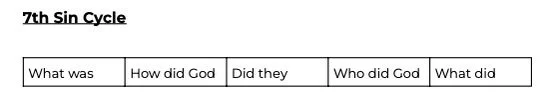
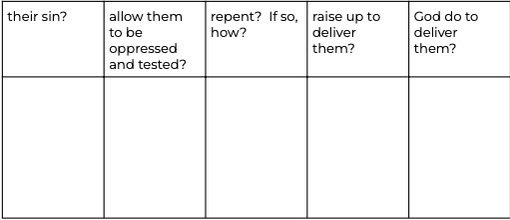
We learn in this book that human beings are terribly flawed, even the good ones! But perhaps the greatest thing that emerges from the pages of this book is regarding the faithfulness of God and His tender mercy towards His people when they cry out to Him.
4.Recall what you learned about His mercy in Judges 2:18:
5.How did God honor His promise to Abraham by raising up the 12 judges of Israel? (Gen. 12:2-3)
There was a fashion-related show that aired a few years ago called, What Not to Wear. I loved that show! If there was a show today regarding the events of the book of Judges it would be called, What Not to Do! I think the same show could be made of our own culture here in America.
6.Read Judges 17:1-5. Who is the son mentioned in these verses and what did he do to his mother?
(FYI, this is not the same Micah as the prophet Micah.) She would have likely given it to him anyway after she died, but this son simply could not wait. I don’t have a fortune by any means, but I do sometimes keep a little stash of cash in a hiding place in the event that we might need it. This mama had a hiding place, or so she thought.
7.She wasn’t just hiding it away for a rainy day, what was her intention for this money?
That silver was her god long before it was fashioned into a false god. When she cursed whoever it was that stole her money, the young man came clean and admitted to taking it.
8.Because the mother was thrilled to have the money back in her possession, what did she do with 200 of those 1100 shekels?
Here we are again with silver shekels! Delilah sold out Samson for silver shekels, 1100 from each one of the lords of the Philistines. She became a very rich woman. I sure hope she enjoyed her money because the time she had on this earth was the only heaven she ever knew. 1100 shekels of silver would have been about 28 pounds.
9.Why do you think the son gave the money back to his mother?
People in ancient times were quite superstitious. Pronouncing a public curse over someone then would have been taken seriously. He was likely scared to death of the supernatural consequences of being on the receiving end of such a curse.
When the mother received the money back into her possession, she said that she had dedicated or consecrated that money to the Lord, but we know that it wasn’t our Lord she dedicated it to. It was some foreign, fake god. She told him that she had dedicated ALL 1100 shekels to the Lord, but when push came to shove, she only gave 1⁄5 to have a graven image made.
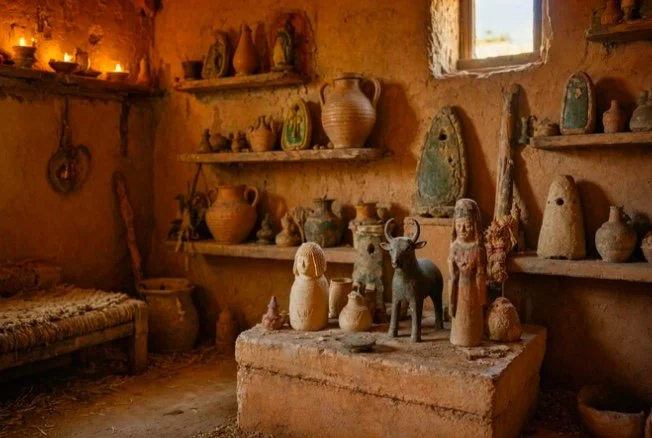
During this time, the tabernacle was located in Shiloh. There was only ever to be one tabernacle or one temple. It was in the tabernacle and later on the temple where the Ark of the Covenant with the Mercy Seat were within the Holy of Holies. The presence and glory of God resided over the Mercy Seat. Here we have a man who decided that he too wants in on the action. He wants to have his own little Holy of Holies in his own little home and he fashions it exactly like he wants. He had his own house of gods.
This scenario may look kinda wonky to us as we do not culturally connect with such things, but here’s the unfortunate truth, too many people want to be their own god. They love autonomy. They love personal control. They love to make their own moral standards regarding what is good and what is evil.
10.What does Isaiah 5:20 say about this kind of cultural phenomena?
Human beings naturally fear being vulnerable and being your own god means that you are the one and only one who is master of your destiny. It elevates the person and his/her pride above any kind of external spiritual law. And if you are the one who makes the moral laws, then you avoid being judged or having to be accountable to anyone, especially God. I’ve worked in the field of mental health for nearly 40 years. Over these many years, I’ve seen this field morph into something that is about as anti-god as any kind of idolatry can be. The field of mental health has convinced many people that they are the sole creators of their own reality and truth. This is evil. What Micah was doing here in chapter 17 was evil.
11.What did Micah either make or have made for his special little house or horrors?
When we think of the word ephod, we think of a garment that the High Priest would have worn. It looks like the picture below:
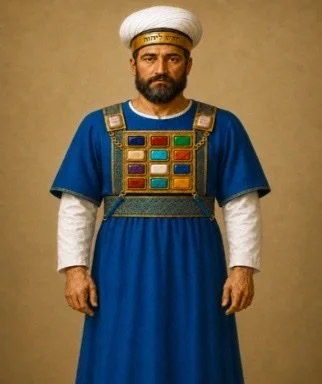
However, that is likely not the meaning of the terminology used here. It could be, but from the majority of commentaries I’ve looked at, it appears that there is another meaning. Because this word is also used in conjunction with the word teraphim (or household idols), scholars mostly agree that this ephod as it is mentioned here in Judges 17 is a portable god/idol. Whether it was a high priestly-type ephod or a portable idol, it is all the same in regards to being something that was worshiped in the place of God. It was not uncommon for people in those days from pagan nations to have household idols because they considered them to be a part of their domestic protection.
One scholar said that “Judaism is a religion of the heart and the ear and that paganism is a religion of the eye”. Too many people want something they can see and touch.
12.The Apostle Paul reminds us in Romans 10:17 what our faith should be based on. What does he say?
Does it help sometimes for us to see how the faithfulness of God plays out in our lives? Absolutely! But this is not a requirement of faith. I remember hearing a prominent TV evangelist commenting on the death of another TV religious personality. He said if she’d just had more faith, then she would still be alive. When I saw that clip, I just thought, “What an idiot! Doesn’t he know that he too will one day die?” Faith is believing in something you cannot see. And although we cannot see God, the manifestation of His greatness and His faithfulness is all around us.
13.What did he do regarding one of his sons?
Seems as if Micah has thought this whole worship thing through. He has his own little house of worship, his own little household of idols, and his own built-in priest. He is the master of his domain, or so he thought! This priest would not have been from the tribe of Levi either.
14.Look back to Judges 17:1, where was Micah and his family from?
Appointing a priest from any other tribe but the tribe of Levi was a violation of the Law of God and having that worship take place in any other location other than where the tabernacle was located was a violation of the law of central worship. The law of central worship is a concept that was laid out in the book of Deuteronomy. It required the Jewish people to only offer sacrifices and worship at one location that was chosen by God rather than at scattered altars across the land. This was first done at the tabernacle and then later at the temple. The reason for this was to prevent any pagan practice that might be associated with local shrines. What Micah did was a violation of this law. The other reason for central worship was to unify the 12 tribes of Israel under one covenant and one central authority. After the destruction of the first temple in 586 BC and then later the second temple in AD 70, this led to decentralized synagogue gatherings.
15.The Apostle John spelled out a new way of spiritual worship in John 4:21-24. How do we worship now that we have the Holy Spirit living within us?
Judges 17:6 tells us that “everyone did what was right in his own eyes”. Oh my goodness! Is this ever a commentary on our own culture!
16.What does Prov. 14:12 say about this?
Hey, if it feels good, do it! That mentality will get any person into trouble and it will send any nation down the tube to moral decay.
17.We looked at Romans 2:7-11 earlier in this lesson (Question #2). We have addressed how God will respond to those who conform to His Word. But what about those who do not?
18.Read Judges 17:7-13. Who came to Micah’s house?
19.What was this man’s profession?
Ah, now we have a real priest. The son that Micah ordained to be a priest was not from the tribe of Levi. Micah thought he had hit the mother lode of spirituality with a Levitical priest! If you recall from our study in the book of Joshua, the Levites were not given a specific territory when the Jewish people entered the land of Canaan. They were given 48 cities that were spread out all over Israel so that they could instruct the people in the ways of God. Six of those cities were cities of refuge. I’m not sure exactly why this fella was sojourning around this area, but he ended up on the doorsteps of Micah’s home.
20.What does Micah promise the man?
This guy was undoubtedly thinking “Hey, what a great deal! I’ve got it made...room and board and then some! Yes, I’ll take the job!”.
21.Did God ever call the Levites to be individual priests to individual families?
It looks as if Micah’s son may soon be out of a job! He got “one-upped” by a real Levitical priest.
22.In Judges 17:10, what 2 offices did Micah indicate that he wanted the Levite to be for him?
For us as Protestants, hearing someone in the ministry referred to as “father” kind of ruffles our feathers a little bit. I have to admit that I cringe whenever I hear that term used in relation to anyone in ministry. However, I will admit that I have had spiritual mothers and fathers along the way in my life. Those who have taught me well and whose wisdom and knowledge of Scripture I learned to rely on, I do consider to be spiritual parents. However, what we are seeing here in Judges 17-18 is a total perversion of this analogy.
23.What does Jesus say in Matt. 23:9?
The warning that Jesus gave in this verse was to never elevate human authority or reverence to the level that only God should have. This is not simply a command to never refer to someone else as “father”. Even the Apostle Paul referred to himself as “father” to the believers he helped to bring into the faith and biblical writers frequently spoke of “Father Abraham”. So the usage of the term “father” as it is used here in Judges 17 elevates this Levitical priest to the level of God and in essence, he becomes an idol as well.
24.Where did the Levitical priesthood begin? (Exodus 28:1)
Levitical comes from the tribe of Levi. Levi was the 3rd son of Jacob and Leah. If Aaron was from the tribe of Levi, then so was Moses since he was Aaron’s brother.
25.Prior to this time, who was consecrated to the Lord? (Exodus 13:2)
All priests were Levites, but not every Levite was a priest.
26.On Jacob’s deathbed when he was blessing each of his 12 sons, he got to the blessing for Simeon and Levi in Gen. 49:7. What was the blessing (or curse)?
This does kind of sound more like a curse than it does a blessing and yet, being scattered amongst 48 cities and not having a land inheritance of their own was really a blessing. They were the ones who did the teaching of the Law. Their real blessing is that instead of land, they got God! God promised that they would be provided for from the abundance of the other tribes. There were Levites who were not priests and they performed other duties.
27.What were some of those duties according to Numbers 3:21-38?
28.What else did some priests do according to Deut. 17:8-13?
Leviticus 21 lays out the behavioral and purity standards for priests. Judges 18 never tells us that this man is a Levitical priest, only that he was from the tribe of Levi. And yet, Micah “consecrated” him as a priest. In other words, Micah took it upon himself as a private individual to appoint this man to perform religious duties for unauthorized, idolatrous worship rather than to follow the worship guidelines that God had prescribed. This Levite, as all Levites of his day, should have been trained to know the Law of God. So either he didn’t know, or he did know but just didn’t care.
29.Do you think that Micah was rebelling against God’s laws or that he simply didn’t know or understand them?
The offerings of the people should have supported the Levites. We know from the historical account of Scripture that this did not always happen. Is that possibly what occurred here? Maybe. I think it is pathetic when congregations do not monetarily take care of their pastors. I’ve been in a couple of churches in my life where certain folks complained about every penny that was afforded to the minister who cared for their spiritual needs. Some dear friends in the ministry were asked a year or so ago to travel several hundred miles to speak at a large church. This couple paid for their gas, their hotel, and their food and they were not given one dime for coming and giving their time and energy. In fact, it cost them a good chunk of change. One little man came up to them and handed them a $5.00 bill when they finished speaking because he knew they had not received anything and he told them that he wanted to give more, but just didn’t have more to give. He gave the widow’s mite. I have a feeling that in some form or fashion, God will rebuke those congregations who do not take care of their ministers.
As far as the priest in Judges 18 is concerned, it sounds more to me from reading these verses that this young man wanted to wander and see where he could settle and find his fortune. This young Levite was hired and I guess Micah’s own son was then fired. Micah didn’t ask for references or for a resume, he simply trusted that this fella was a priest of Yahweh. And the ignorance of Micah is profound! He assumed that because he hired a Levitical priest that he would somehow be blessed by God.
30.What does Micah promise this man about his clothing?
I would be ashamed to say how many changes of clothes I have in my closet and drawer....far too many for sure! However, it wasn’t so back then. Clothing was a precious commodity and the average person didn’t have many options. We learned that in our last lesson about Samson. When the bet with the Philistines happened, Samson was hoping for 30 new outfits, instead, he had to go kill 30 men and literally rob them naked and give their clothes to the men who told him the answer to his riddle. What Micah promises this young priest is an outfit for everyday wear and one for holy days. Remember when you were little and you had your “Sunday-going-to-church-shoes”? Steve and I always knew that we could not wear those shoes (our Buster Browns) to school or out to play. They were set aside for church and special occasions. Such were the outfits for this priest.
Micah was delusional to think that Yahweh would ever bless him for what he had done and the very fact that he thought this tells me that Micah was not spiritually or religiously educated. We can never expect God’s divine favor if we are coloring outside His lines. We have no excuses for our ignorance as we have the completed Word of God in our hands.
31.Read Judges 18:1-6. I think the writer of this book wants to emphasize that there was no king and that everyone was his/her own god. What were the Danites seeking?
The real question is why were they seeking new territory. When Joshua entered the land of Canaan with the 12 tribes of Israel, they drew lots to see who got to have land assigned to them next. It was the tribe of Dan who went 12th and last in the lineup.
32.What do you learn from Judges 1:34?
Last week and the week before, we learned just what a pain the Philistines were to the tribe of Dan and to the nation of Israel as a whole. The Amorites refused to allow the tribe of Dan to come into the territory given to them and take ownership of it. They were forced into the hill country. The Danites believed they could not dwell in the area that God had allotted for them because it wasn’t safe to do so. But God had already told them that He would give them the land. They had to take ownership of it. They couldn’t just go in and cower in a corner somewhere which is exactly what they did. There were other tribes who didn’t get rid of the original inhabitants of their land allotment either, but none quite as pronounced as the tribe of Dan. Instead of asking themselves why they were not able to occupy their land, they decided to go on the hunt for another piece of land. Their original land was pristine ocean-front property and it was beautiful! God is never going to give you something and then not enable you to conquer it.
The tribe of Dan, believe it or not, was the 2nd largest tribe in Israel at the time. They had 64,400 men of fighting age during their years of wandering in the wilderness (Num. 26:43). The largest tribe was the tribe of Judah. These men were trained in how to fight. But all the training in the world doesn’t matter if God isn’t in it. You see, the tribe of Dan had turned to other gods. God wasn’t about to fight on their behalf because they had forsaken Him. Has God ever given you something and you said, “I don’t want this, I want something else!”? This is exactly what happened. Their disobedience to God is what forced them into the hills and now, they’re getting ready to seek out a new territory. Let’s look at the birth order of the 12 sons of Israel/Jacob:
Reuben - son of Leah
Simeon - son of Leah
Levi - son of Leah
Judah-sonofLeah
Dan - son of Bilhah (Rachel’s handmaid)
Naphtali-sonofBilhah(Rachel’shandmaid)
Gad - son of Zilpah (Leah’s handmaid)
Asher-sonofZilpah(Leah’shandmaid)
Issachar-sonofLeah
Zebulun - son of Leah
Joseph - son of Rachel (Manasseh and Ephraim)
Benjamin - son of Rachel
When we look at the order in which these sons received their blessing at the time of Jacob’s death, the order is a little different:
1. Reuben 2. Simeon 3. Levi
4. Judah
5. Zebulun 6. Issachar 7. Dan
8. Gad
9. Asher
10. Naphtali 11. Joseph 12. Benjamin
I find it interesting that Dan is listed after the last 2 sons of Leah although he was born before them. In Gen. 49:16, we read, “Dan shall judge his people as one of the tribes of Israel.” The word “Dan” means judging or a judge. And at first glance, we suspect that this means the tribe of Dan will produce judges for Israel. But Samson was the only judge from the tribe of Dan.
What this verse could actually mean is that this tribe would be self-governing without the help of others. By the time we get to Gen. 46:23, we read that Dan had 1 son. Other than this, we don’t know a whole lot about Dan’s life.
Back in Joshua’s day when the tribal allotments were made, 17 cities were given to the tribe of Dan. This would have made for some close quarters with so many people and a relatively small plot of land. The Philistines were in control of most of their seacoast. Why didn’t Dan attempt to control all of the territory that had been allotted to them instead of seeking out new territory? That really is the question that needs to be answered. I think the bottom line here is not necessarily that they were afraid of the Amorites in their land, but that they simply did not trust God or have faith in His ability to help them rid the land of those who were dwelling there when they came in to take ownership of it.
Frequently in Scripture, we will read “from Dan to Beersheba”. That means from the northernmost part of the land of Israel to the southernmost part. There are 4 primary streams that form and feed into the Jordan River:
Dan River - begins and flows directly inside northern Israel, providing the largest volume of water to the upper river.
Hasbani River - originates in the mountains of Lebanon.
Banais River (Hermon) - flows from the slopes of Syria.
WadiBarayghit(Nahallyyon)-asmallerstreamthatalsofeedsthe
upper section in the Hula Valley.
The Jordan River derives its name (Yardun or Yarden) from an ancient Semitic root meaning “to descend” or “to go down”, and indeed, it is descending down from the area renamed as Dan. However, it is not named Jordan as a play on words from where the tribe of Dan settled in that area. It was already named Jordan prior to that when the conquest of Canaan occurred.
Here’s another interesting thing: the tribe of Dan is not listed amongst the genealogies of the 12 tribes of Israel in 1 Chron. 1-8. But then later in 1 Chron. 12:35, 28,600 Danites came to David in Hebron to make him king over all of Israel. We’ve previously discussed the fact that Dan is also not listed in the sealing of 12,000 men from each tribe in Rev. 7.
33.However, in Ezekiel 48:1-2, the prophet Ezekiel prophecies something that will take place during the millennial reign of Christ regarding the tribe of Dan. What is it?
Now that you probably know way more than you might want to know about the tribe of Dan, let’s get back to our story in Judges 18.
34.How exactly did they figure out where to relocate their tribe? 35.Where did these 5 men end up staying in Judges 18:2?
36.Well, what a coincidence!!! Whose voice did these men recognize? 37.Again, what a coincidence!!! What did they inquire of him?
This is not the way in which God’s will was revealed at that time in history. There were multiple ways that God’s will was revealed in the Old Testament:
God spoke directly to certain individuals or through physical manifestations (i.e. - the burning bush).
The written Law or the Torah - the 1st 5 books of the Bible.
The priesthood who would use the urim and the thummim to make
decisions on critical national decisions.
Dreamsandvisions.
Prophets which will come about after the book of Judges.
Nowhere in any of these ways is simply asking a random Levite if something is God’s will to be a trusted source. Here again, this points to the fact that the people were clueless regarding the laws of God and how He wanted them to operate. Apparently, even some, if not most, of the Levites were clueless.
38.How do you think this Levitical priest decided that it was okay for the tribe of Dan to proceed in their quest for new land?
Oh, what carelessness this priest utilized! But why?!!! Why be so casual? I could ask many people today that same question. Why do folks around us seem so clueless, careless, and indifferent toward God’s Word? In the case of this priest, I think we could say that there was indeed a spiritual disconnect. He didn’t know God and he didn’t know God’s Word. There was undoubtedly some spiritual blindness that was present as well as biblical illiteracy. And let me just tell you that whenever there is a lack of biblical literacy, there will always be shallow and incongruent interpretations. In all of those regards, I’m not sure that this priest was a whole lot different than many people in our churches today.
39.Read Judges 18:7-13. When the scouts made it to Laish, how did they find the people were living?
There was no king in the land of Israel and there was no ruler or laws in the land of Laish. Civil law was established by God for the restraint of evil. And as these verses state, evildoers should be put to shame. But apparently, the area known then as Laish left the front door open and they were therefore open to others taking advantage of them.
The area of Laish was not part of the original property of Israel. 40.Were the people of Laish enemies to the people of God?
There were rules that governed war that God gave the people in Deuteronomy 20. We looked at that chapter a little bit when we studied about Gideon. It was in this chapter that God told them if any man was fearful, he was to return home because he could cause his brethren to also be fearful. But there’s so much more about the rules of warfare in this chapter.
41.Read Deut. 20:10-12. What did the tribe of Dan NOT do when they neared the city of Laish?
These people were not the enemies of Israel. They were abiding peacefully in the land. There should never have been any war or any battle with them. Were they enemies of God? Yes they were because they were pagan but this allotment of land did not originally belong to Israel and this situation should never have even been a situation.
A group of people named the Zidonians are mentioned in these verses. Zidon (also called Sidon) was the capital of Phoenicia which was was located on the eastern coast of the Mediterranean Sea very close to another city called Tyre. Tyre and Sidon are often mentioned together in Scripture. The term Zidonians was used at times to refer to all the Phoenicians. Today, this area is a port city within the landmass of Lebanon.
42.Who founded this city or who was the city named after in Gen. 10:15?
Zidon would have been within the land allotment for the tribe of Asher. The Zidonians were known for living a wealthy life within a well-fortified maritime city and they felt as if they were completely safe because they were surrounded by the sea.
43.How many military men were there who went up to this new territory? (Judges 18:11)
44.When they entered Canaan originally, how many fighting men did they have? (Numbers 26:42-43)
There’s a big difference in these 2 numbers! This number is not even a hundredth part of the original tribe. It appears that not the entire tribe of Dan migrated up north, very possibly only those 600 armed men with their families. So although this migration occurred and the area was renamed Dan, much of the tribe did remain in the original territory.
45.Read Judges 18:14-26. What 3 things were the 5 men looking for?
1. 2. 3.
Here’s the thing, it appears that they wanted God’s presence with them and at the same time, they desired to take these detestable idols. They were mixing the holy with the profane.
There are many theologians who believe that the Antichrist will come from the tribe of Dan. They base this on the following verses.
46.Read these and note what you learn: Gen. 49:17
Deut. 33:22
Jer. 8:16
I, however, am not convinced of this, but I think it’s important to note it. This tribe who was once the 2nd-most populous tribe declined significantly in numbers and in influence by the time the prophet Ezra was on the scene. And there are many who believe that the decrease in numbers is the reason that Dan is not listed among the tribes in 1 Chron. 4-7 and Rev. 7. Again, I’m not sure on the reasoning behind this.
47.What happened with the Levite (priest) who was in the house of Micah?
These 5 men were completely enamoured by Micah’s little house of gods. They just had to have them and yet, handmade idols could have been reproduced easily by them. Why put so much stock in Micah’s gods?
48.How did they end up taking these idols?
Micah was left talking to the 600 men at the gate to the city while his little house of horror was being disassembled by the 5 men who were spies. These were certainly great gods! They couldn’t even keep themselves from being stolen!
49.What did the men say to the Levite and how did they convince him to go with them?
50.What does Isaiah 46:1-2 say about idols?
I think these verses apply to what we are reading in Judges 18 in that the idols are themselves taken into captivity. Not only were these Danites involved in idolatry, they were also thieves. They stole their neighbor’s gods to make these gods for themselves. They did not fear the God of their fathers nor did they fear the people of Laish, but they did fear the people living in their original land. Their sense of right and wrong, good and evil, and safe and dangerous was all out of whack.
Friends, I want to tell you something, nothing will ever go okay with you as long as you refuse to trust the promises of God. The Danites had long since refused to believe God’s goodness and promises. They took those idols because they simply did not believe that God was enough for them. Have you ever been there where you just could not believe and trust that God was there for you? Have you ever thought there must be more because what you could see with your own 2 eyes was not enough? Before we judge the tribe of Dan too harshly, we need to get the speck out of our own eyes.
This young Levite provided them with a sense of false spiritual leadership. There are things that we can find comfort in (money, job, people) and if we substitute any of those things for our relationship with God, those things can leave us feeling empty and they can all be taken away from us in an instant. We must guard our hearts from following any kind of spiritual leadership who is self-absorbed. This Levite was completely out for himself. His goal was not to educate the flock or to feed the flock. His goal was to get the biggest bang for his buck and he did just that.
51.It wasn’t just Micah who chased after the people who took his little gods. Who else went with him?
52.What did Micah say to the tribe of Dan when he caught up with them?
Can you imagine this scene? I want to paint it for you. Here we have this man, Micah, and his community who were likely part of the people who worshiped in his homemade shrine with his homemade gods. They were all upset over the fact that not only did this group take their gods, but they took their priest as well! And then when they caught up with them, Micah responded, “Oh woe is me! What do I have to live for now? There’s nothing else for me in this world and you have the audacity to ask me what is the matter with me!”. (This is Cindy’s paraphrase.)
53.How did the Danites respond to him?
I don’t know who is the more pathetic here, the Danites or Micah and his gang. What Micah and his group obviously did not realize was that their loss was definitely their gain. And the Danites gain (the idols and the Levite) were their loss. This is what happens when we call good evil and evil good.
54.Read Judges 18:27-31. What did the Danites do when they got to Laish?
The people of Laish appear to be nature’s perfect victims. They were unsuspecting. They were unarmed. They were without proper protection in their city. They were happy and secure in their own homes. This is the most dangerous place to ever find yourself in both physically and spiritually. For those Christians who:
Never suspect that Satan could harm them because they are believers...
Never read and study God’s Word so as to know how to respond to
spiritual attacks....
Never keep themselves away from things that could harm them (i.e.,
social media, profane tv shows and movies, profane music, etc.)...
Aresatisfiedwiththeirhappinessandfeelingofsecurityintheirown
homes and lazy in their awareness of spiritual danger...
WATCH OUT!!!
55.What do you learn from 1 Cor. 16:13-14?
God expects us to be mature Christians and to continue to grow as long as we’re breathing air. Spiritual braveness means that we don’t shrink away from contending for our faith and from calling out inconsistencies with God’s Word.
What did they do when they conquered the land? They immediately set up idol worship! Not a great way to start off in a new land. We finally discover the name of this priest/Levite.
56.What is it and who was his father?
As you know, there are no vowels in biblical Hebrew and small notations over certain letters can completely change the word or the meaning of the word. The word Manasseh is one such word. In the Latin Vulgate (4th Century translation of the Bible that has been used as a standard text for the Western Roman Catholic Church for over 1500 years), there is an “n” that some Jewish rabbis say should not be there. What does this mean then? If the letter “n” is taken out of the Latin translation, the word Manasseh becomes Moses! Okay, that is a game-changer if this is accurate.
57.What do you discover from the following verses: Exodus 2:22
Exodus 18:3-4
So, was this Levitical priest descended from Moses’s son? Possibly. There are those who would say this is true, but then we have some chronological details that are in conflict as this would make the Levite referred to as Jonathan in Judges 18:30 well over 100 years old and the Levite in our story is referred to as a young man. The question here is whether or not the young Levite in Judges 17-18 and the Levite named Jonathan are one in the same. In reading the text, it appears as such. However, there are many who would disagree with this assertion. And much of this disagreement has to do with where we date the events of these last 5 chapters in the book of Judges. I do admit it is strange that we find out the name of this Levite close to the end of Judges 18 when he is mentioned nearly all the way through Judges 17 and 18.
Whether this Levite named Jonathan is or is not a descendant of Moses is not a problem that we need to grapple with. The fact that any Levite would set up an idolatrous means of worship for the Danites is the problem. We often say when a child goes astray from the path of his/her godly parent that the parent would “roll over in his grave” if he/she knew how the child conducted his/her life. I just said this to a friend yesterday about Andy Stanley. I said, “His sweet daddy (Dr. Charles Stanley) would roll over in his grave if he could hear the blasphemous things Andy is currently saying.” What great dishonor this Levite, Jonathan, did to his lineage.
58.How long are we told in Judges 18:30 that this corruption with idol worship continued?
This would have occurred in 722 BC when the Northern Kingdom of Israel was taken into captivity by the Assyrians. Both the original plot of land named after the tribe of Dan and the one at Laish fell into the northern kingdom.
After the death of King Solomon many years after the book of Judges, the kingdom of Israel split into the Northern Kingdom of Israel and the Southern Kingdom of Judah. Jeroboam was crowned king of the Northern Kingdom. He had 2 golden calves made and he put one of them in Bethel (in the southern area of the Northern Kingdom) and he put the other one in the area where the tribe of Dan relocated to (1 Kings 12:25-33).
What we know is that the part of the tribe of Dan who relocated up north in the area previously known as Laish, did so between mid-12th Century BC and 1100 BC. It was around 931-930 BC when King Jeroboam set up a worship center in the area of the tribe of Dan in the north. That is over 200 years later and there is still idolatry going on in this area.
Even today if you visit the area in northern Israel called Tel Dan, you can see the high place where this golden calf was located. In 1979, archaeologists uncovered an entrance gate that was almost entirely intact. Abraham visited this area and it is entirely possible that he went under this entrance gate. Below is an approximate timeline of when the land was settled until the time when the Northern Kingdom was taken into exile. Of course, you realize why these dates are approximate. It would be nearly impossible to know the exact dates of earlier events. We do, however, know that 930 BC and 722 BC dates are accurate.
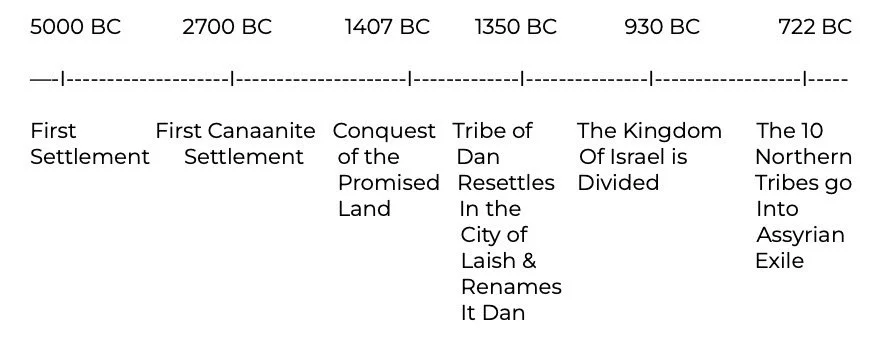
The area of Laish/Dan is about 20 miles north of the Sea of Galilee and at the base of Mt. Hermon. Extra-biblical texts (Jasher and Enoch) tell us that it was upon Mt. Hermon that 200 angels descended and that those are the angels who mated with the daughters of men in Gen. 6. I believe that there are places around the globe where evil is more abundant than in other places. The area at the foot of Mt. Hermon, where the golden calf of Jeroboam’s day, the worship center of the tribe of Dan, and the dissension of those 200 angels are all located near the source of the Jordan River, just south of present-day Lebanon.
Friends, as we look at the lack of faithfulness of the tribe of Dan, we must also examine our own faithfulness or lack thereof. Whenever any group of people
© Cindy D. Ketron. All Rights Reserved 21
abandons the God of the Bible, the result is destruction. While we might not physically bow down to a molded image, many believers place other things above God and in doing so, some make idols out of their job/prestige, children, money, scrolling on social media, approval, comfort, security, celebrities, etc., etc., etc.. Humanity can make an idol out of just about anything.
The tribe of Dan lost their way, not just for an hour or a day or a week or a year, but for hundreds of years.
59.What do the following verses tell you about what to do and what not to do?
Prov. 16:25
John 14:6
It is a wise person who learns from the mistakes of others. Let us learn from the tribe of Dan that we are to worship God and only Him and that we are to follow His precepts and live for Jesus every moment that we draw breath.
Blessings.