1 Corinthians Lesson 8
First Corinthians
Lesson 8 - Chapter 15-16
By Cindy Ketron
On The Edge of Eternity
Scroll below to read the lesson on this device and Download Questions Here
OR
If you prefer to download and print the a PDF of the lesson click here

We are finally coming to the end of 1 Corinthians. We still have 2 Corinthians to go! Oh what a ride this has been! The past 2 weeks, we’ve been looking at some of the spiritual gifts and how God wants us to use the gifts He has given to us. This week, we’re going to be looking at the resurrection of Jesus Christ and what that means to us as believers. Chapter 15 is a mammoth chapter in regards to its length. All Scripture is inspired and all is holy, but there are some chapters that stick out to me as being crucial to our understanding of the Christian faith. This is just my opinion, but some of those chapters are Genesis 1 (the creation account), Genesis 2-3 (the fall of man and the promise of redemption), Genesis 6 (the flood and the Nephilim), Genesis 11 (the tower of Babel and the creation of 70 people groups), Genesis 15 (the Abrahamic covenant), Exodus 20 (the giving of the Law), Isaiah 53 (the atonement of Jesus), Daniel 2 and 7 (the chronology of future world powers in the Gentile world), Ezekiel 36 (the process of regeneration), Matthew 24 and Luke 21 (the signs of the end of time), Matthew 27-28 (the crucifixion and resurrection of Jesus Christ, and the commissioning of the disciples), John 1 (who is Jesus and why did He come to earth), John 3 (rebirth and salvation), Romans 3 (judgment, justice, and faith), Romans 8 (how to live the Christian life, both now and in eternity…this is possibly the greatest chapter in all the Bible), 1 Thessalonians 4 (the rapture of the Church), Revelation 19 (the 2nd coming of Christ), and yes…..1 Corinthians 15. I know there are more chapters than this that are vital, but when I go through the books of the Bible, these are the ones that have meant the most to me in my understanding of Scripture and doctrine.
In this book we have looked at some of the issues going on at the church in Corinth. Here’s what we’ve studied so far:
Chapters 1-11 the carnalities of this church
Chapters 12 and 14 spiritual gifts
Chapter 13 the manner in which we must administer those gifts Chapter 15 the bodily resurrection of Christ and what that means to us as believers Chapter 16 will be Paul’s closing remarks
The death of Jesus for our sins is only 1 part of what was done for us on the cross. If He had not risen from the grave, there would have been no proof that God had accepted His sacrifice and therefore, our sins would not have been forgiven. The fact of the resurrection is what gives us hope that we will live in heaven eternally with God. It gives us the promise that at the moment we breathe our last breath on earth, we breathe our first breath in heaven and never ever will we be separated from God. This chapter is filled with hope for every believer.
There is a great equation put forth in 1 Corinthians 15….
The blood of Christ + My sin = No sin
No sin + Christ’s resurrection = Eternal life with Him
Friends, this is the gospel news! This is the best news we can ever share with anyone! Because of His resurrection, our bodies will also rise from the dead one day.
Before we start reading, let’s define what this resurrection is according to Greek words used in Scripture:
Anastasis - “to stand up”
The “ana” part of this word - standing up of one’s physical body Nekron - corpse
Therefore, Anastasis Nekron means the standing up of a corpse. This could not mean a spiritual corpse. It means a physical corpse. This is important to grasp because if everything about a person dies, that means the soul of the person dies and we know that is not the case. Corinth was littered with Greek philosophies. People there had all kinds of misconceptions about life after death.
Read 1 Cor. 15:1-4. Paul lays out in a nutshell the gospel. What are the 3 facts he gives?
In business classes in college, they teach students to do a 2-minute “elevator” introduction of themselves. This short, concise introduction teaches them that if they only have a tiny amount of time to make an impression on someone, then they need to figure out how to include the critical highlights of what they want the other person to know about them. In other words, how can they sell themselves in 2 minutes. 1 Cor. 15:1-4 is the elevator introduction of the gospel.
I don’t know if you’ve ever read Lee Strobel’s book, The Case for Christ, but if you haven’t, you should. He was an atheist who started out to prove that the whole Jesus thing regarding Him being God and resurrecting from the grave was a complete hoax. What he discovered instead is that there is plenty of evidence to prove that He absolutely lived, that He was who He said He was, that He died by crucifixion, that He rose from the grave, and that He ascended to heaven in front of a multitude of witnesses. This discovery not only led to Strobel’s salvation, but it led to a landmark book that will stand the test of time.
When was the Church born? Was it when Christ was born? Was it when He died? Was it when He arose from the dead?
2. In 1 Cor. 15:5-8, Paul tells who Jesus appeared to after His resurrection. Who were these people?
In the book I referenced above, William Lane Craig (a contributor to the book) talks about the empty tomb. He mentions that the book of Mark and the book of 1 Corinthians (in particular, chapter 15 that we are currently examining) were both written so close to the date of Jesus’ resurrection that they couldn’t possibly be the products of legend. He says, “In fact, nobody, not even the Roman authorities or Jewish leaders ever claimed that the tomb still contained Jesus’ body. Instead, they were forced to invent the absurd story that the disciples, despite having no motive or opportunity, had stolen the body - a theory that not even the most skeptical critic believes today.” (p. 387)
Evidence #1 of Jesus’ resurrection - Multiple eyewitnesses to Him post-resurrection.
2. Who did Jesus appear to first?
3. Why do you think this is?
We actually looked at the story of Peter a couple of weeks ago when Jesus asked him 3x if he loved him. This appearance to Peter was a restoration of Peter’s faith and it was done out of the Lord’s love for him.
4 . At the time of His resurrection, how many disciples were there?
This begs the question, then why does the Bible say “12”? The 12 is a term that is used collectively to refer to the disciples. Why do you think He appeared to James separately? (Note - There were 2 men named James who were apostles. It was not either of these men. This is James, the half brother of Jesus. This James was not a disciple) James was one of Jesus’ brothers.
5. What did he think about Jesus prior to the resurrection? Read John 7:1-5 and Mark 3:20-21.
In my job, I have opportunity to see trends or patterns of behavior in certain families. There are children in families who sometimes are allowed to play particular roles that create further dysfunction in the family. In some families, there might be a child who is the family hero, while in others, there might be a child who plays the family zero. Jesus was the zero in His family. He embarrassed His siblings. They thought he was nuts. Did you know that after His resurrection, he only appeared to 1 unbeliever, His brother, James? All the other post-resurrection appearances were to believers. There’s no way to know what His post-resurrection encounter with His brother, James was like. We have no record of what was said in that meeting. Suffice to say, James woke up on that day an unbeliever, and he went to bed a believer. It was James who became the leader of the church in Jerusalem. It was James who penned the book of James. He went by certain nicknames in church history; James the Just, James the Righteous, and James the brother of Jesus.
First century historians Josephus and Hegesippus recorded that the Christians in Jerusalem during the 30 years following Jesus” ascension into heaven turned the city upside down with their proclamations of the resurrection of Jesus. A group of Jewish religious leaders reportedly came to James because they knew he had a lot of influence with the people. They told him to tell the people that Jesus was not the Son of God and did not rise from the grave. It was during Passover that these leaders put James up high on one of the temple walls to address the people and convince them that Jesus was not who He said He was. Of course, when he got upon that wall, he did the opposite of what they wanted him to do and they were so enraged that they threw him off the wall. Amazingly, this did not kill him and when he was able to rouse himself back up from the fall, he got down on his knees and began to pray for those who had persecuted him. Realizing that he wasn’t dead and that he was praying for them, the Jewish leaders began to stone him and a man stepped up with a pole and struck him in the head so hard that it crushed his skull and he died.
When his family arrived on the scene to retrieve his body for burial, they discovered that his knees were so calloused they looked like the legs of a camel. This was because he prayed so much. Why did Jesus meet with James alone? I think we know why.
6. Who was the last person that Jesus appeared to?
7. When did this happen?
Evidence #2 of Jesus’ resurrection - Paul, the former persecutor of Jews became a believer and he became a martyr for his beliefs.
Evidence #3 of Jesus’ resurrection - His unbelieving brother became such a staunch believer in the divinity of Christ that he was willing to be martyred for his beliefs.
Evidence #4 of Jesus’ resurrection - There were believers in Corinth.
Christianity in the 1st century Grecco/Roman world was a hard sell. The Christians were harassed, lost their employment, tortured, murdered, and frequently had to meet in secret in certain places. In the 3 centuries after the 1st century, there were many periods of Christian persecution. Why would someone subject themselves to such cruelty if there was no resurrection? Answer - they would not.
The fact of Jesus’ resurrection was what breathed life into the Church and the Church today is the greatest proof of the resurrection of our Lord! The Jewish people, for the most part, didn’t get it. They didn’t understand that Jesus was the Messiah. Those leaders in the temple knew Old Testament Scripture, and yet, they didn’t see what was plainly there.
8. What was there that they missed in the verses below?
Gen. 3:15
Psalm 22:27-31
Isaiah 53:1-5
Psalm 16
So, these Jewish believers knew that the Messiah would be a suffering Messiah. They even knew that He would be in the grave for 3 days.
9. How did they know this?
Jonah 1:17
Matthew 12:40
Gen. 22:4-8
Hebrews 11:19
The fact that Matthew, one of the 12 apostles of Jesus, a Jewish man, knew this should tell us that many other Jewish people also knew it, especially the leaders.
The same place that Abraham was going to sacrifice his only son (the son of promise) is the same location that God sacrificed His only Son on an old rugged cross.
Abraham waited til the 3rd day to make this sacrifice. Jesus Christ was in the grave 3 days and nights before He arose from the grave. Jonah was in the belly of the fish 3 days and 3 nights before he was coughed out onto the shore.
3 days and 3 nights is a pattern representing the grave that was outlined in the Old Testament and Jewish teachers would have known this. They would also have known the words of Abraham in Gen. 22:8 “God will provide Himself a lamb for a burnt offering.”
Evidence #5 of Jesus’ resurrection - Old Testament Scriptures prophesied that Jesus would be in the tomb 3 days and 3 nights before He arose from the dead and that is exactly how the scene played out.
Evidence #6 of Jesus’ resurrection - The Church.
The Old Testament also prophesied the manner in which Jesus would die.
10. What does Psalm 22:16-18 say about the crucifixion?
These words were written before death by crucifixion was ever created. The Persians were the first to crucify in the 6th century BC. Then 700 years later, the Romans had this type of execution perfected. The fact that Psalm 22 was written before crucifixion was even a known means of execution lends even more internal validity to the accuracy of Scripture.
I have a philosophy about people and it is this, people believe what they want to believe. In a 1992 film named, “A Few Good Men”, Jack Nickleson had one of the most famous lines of any character in any movie. He screamed from the witness box in a military court at the opposing attorney, “You can’t handle the truth!”. Oh how true that so often is. Too many people cannot handle the truth because they have on blinders and don’t want to see the truth. For the Jewish leaders who had Christ crucified, they had all the information they needed, but at the end of the day, they could not handle the truth even though the Truth was right in front of them.
11. In 2 Thess. 2:10-11, Paul explains what happens to people who refuse to love the truth. What is that?
12. Would you say that there are a great many people today who are delusional? Do you think it could be because they chose to not love the truth?
The Jewish leaders of Paul’s day had much to lose if Paul’s message was accurate. They could lose their political standing which means a loss of power. They could lose their money because religion was big business, just like it is today. They could lose their religious standing and respect of other leaders who also didn’t know the truth. In a nutshell, they needed to save face and they weren’t willing to even consider the truth.
13. Read 1 Cor. 15:9-10. Why does Paul refer to himself as the least of the apostles?
When Christians screw up, they can often accept the forgiveness of Christ easier than they can forgive themselves. From time to time as I’m counseling people, I become aware that an individual is carrying a tremendous amount of guilt and shame. Guilt is feeling bad about what you’ve done. Shame is feeling bad about who you are. Guilt and shame were nailed to the cross. Yes, Paul had persecuted Christians, but he knew that he was forgiven. He was able to leave his guilt and shame at the cross.
14. How do we know this? (Rom. 8:1)
Have you ever purposely killed someone? I don’t know anyone personally who can answer “yes” to this question. If God can forgive Paul and move his sins as far as the east is from the west, what makes you think that He can’t forgive you? As believers in Christ, we need to live in the light of that reality. Carrying around guilt and shame does nothing to help those around you see Jesus and it does very little in helping you see Jesus in an accurate way.
While Paul refers to himself as “the least of the apostles” because of his persecution of the Church and also because he wasn’t a charter member of the 12, in my opinion, he was the greatest apostle of all. He wrote 13 of the 27 books of the New Testament, roughly 48% of it.
The Greek culture in Corinth abhorred the idea of the resurrection of the dead. In fact, they thought it was absolutely bizarre. They believed that the body of a person was a tomb for the spirit and that when a person died, their spirit was liberated. So the idea of their spirit being held hostage in a physical body after death was a nightmare of a thought to them! I remember an occasion when I was working as a chaplain. There was a patient who was Asian and who had a very different religious belief system from me (he was not my patient, but another chaplain’s patient). This patient wanted a window to be opened in his room when he died so that his spirit could fly free. Doing something like this in a government facility required going through layers of red tape, and on the day of his death, the window in his room was open. I’m sure by now he knows his spirit was not liberated. The fact that people have these odd beliefs about death is not unusual and it is not anything new. It’s been going on for a long, long time.
Corinth was a Roman province and the Romans also did not believe in the resurrection of the body. But the worst of all, there was a whole group of Jews who didn’t believe in the resurrection of the dead. The Pharisees did believe in a bodily resurrection, but the Sadducees did not. They also didn’t believe in angels or spirits. That’s why they were sad, you see.
It was the Apostle Paul who ushered in the concept of the resurrection of the body to immortality to the Corinthians. They had a hard time wrapping their minds around such a concept. When you grow up believing something that everyone else around you believes and everyone was taught the same thing, and those beliefs had been passed down through hundreds and hundreds of years, to suddenly have someone share the information that Paul was about to lay down was revolutionary.
15. Read 1 Cor. 15:11-18. List all of the “if” statements in these verses and the “then” statements attached to them.
In v. 1 of this chapter, we read that the Corinthians received this information and in v. 11, they believed this information. Friends, if Jesus is not risen from the dead, then we’re all wasting our time. Our entire belief system hangs on this one event. People don’t have to believe this fact if they don’t want to, but you can’t be a Christian if you don’t believe this fact. If the resurrection did not happen, then you and I are still dead in our sin and we have no hope in this life or the one after.
A few years after Paul wrote 1 Corinthians, he found himself under arrest in Caesarea, Philippi at the insistence of the Jewish leaders. These people appealed to the Roman governor Festus to send Paul to Jerusalem so that they could make their case against Paul there. They had planned on ambushing him and killing him on his way there. But Festus refused to send Paul to Jerusalem. Instead, he went to Caesarea and a bunch of Jewish leaders went there as well. Festus gave Paul the option of going to Jerusalem, but Paul refused to do so claiming that he had a right to go before Caesar since he was a citizen of Rome. In the meantime, King Agrippa showed up in Caesarea and Festus told him about what was going on with Paul. Festus said he had no idea what information to send with Paul when he went to Rome to go before Caesar because he couldn’t find anything unlawful that Paul had done and he certainly couldn’t find anything worthy of killing him. King Agrippa wanted to see him the following day. So when Paul went before King Agrippa, he shared his side of the story. Festus was there as well.
16. Read Acts 26:19-25. How did Festus respond to the information that Paul shared with King Agrippa?
This ties back in with what we just learned about the feelings of the Greeks and Romans regarding resurrection. A bodily resurrection was an absurd notion to them. What Paul shared with them was something they had never heard before. There’s a lot of people down through the ages who went to their deaths trusting Christ as their personal Savior and believing in a bodily resurrection from the dead. Hebrews 11 is considered the Hall of Fame of Faith. In Hebrews 11:13-16, the writer describes what these people hoped for and in their lifetime never obtained. But in the life after this one, their faith was realized.
17. What was their hope?
18. What is your hope?
Read 1 Cor. 15:19. What if all we have is hope of this life and not the one after? Human beings can manage a lot of horrible things in life if they have the hope of a better tomorrow. For those of you who have experienced any tragedy in life, you know this to be true. The hope of heaven is always out there for us regardless of what happens on this side of heaven.
Evidence #7 of the resurrection - Countless numbers of people were willing to endure unimaginable trauma and even death for the sake of their Christian beliefs.
19. Read Romans 5:5-10. What is the hope that Paul laid out in these verses for those who knew they might be persecuted for their faith in Christ?
In my time as a chaplain doing funerals and also doing them for numerous family members and friends, I can tell you with certainty that it is different when I do a funeral for a believer and when I do one for an unbeliever. The sorrow at the funerals of unbelievers is horrific. There is no hope for the family of these individuals that they will ever see their loved one again. I’m not sure what “Rest in Peace” even means. To some unbelievers, I’m sure they think that death is the end of the individual…..period, end of story! But when a believer dies, he is more alive than ever before because he’s with Jesus in heaven. And even though all funerals have some sadness attached to them, the funeral of a believer, especially when most of the family are also believers, is vastly different. Hope makes all the difference!
20. Read 1 Cor. 15:20-25. Paul is moving from the resurrection of Jesus and connecting the dots to our resurrection as believers in Christ. Why is Jesus referred to as “the first fruits from the dead?”
1 Cor. 15:20 is a reference to the Feast of First Fruits. At the spring harvest, they would bring the first cuttings of their wheat and/or barley and they would wave those in the air in a show of gratitude to God for the harvest. This feast was one of joy.
(This is an excerpt from our study last year on the feasts of the Lord) Think about this, whenever there is a mention of something being the 1st, the implication is that there is more to follow. Therefore, the 1st fruits offered were not just representative of the 1st cuttings, they were representative of the whole harvest. If the 1st fruits of the harvest were acceptable to God, then the whole harvest was acceptable to God.
21. How does Romans 8:11 and Romans 11:16 explain this?
Jesus fulfilled the Feast of First Fruits when He arose from the grave. We are the rest of the harvest. There had to be a first for there to be “the rest”. Adam was created to live in perfect, sinless, harmony with his wife in the Garden of Eden. But Adam sinned and because of his sin, we all are born into a life of sin. Sin is the most widespread contagion in the world and every single person who is born is infected with this deadly virus. Adam brought about death, but the 2nd Adam (Jesus) brought about life eternal.
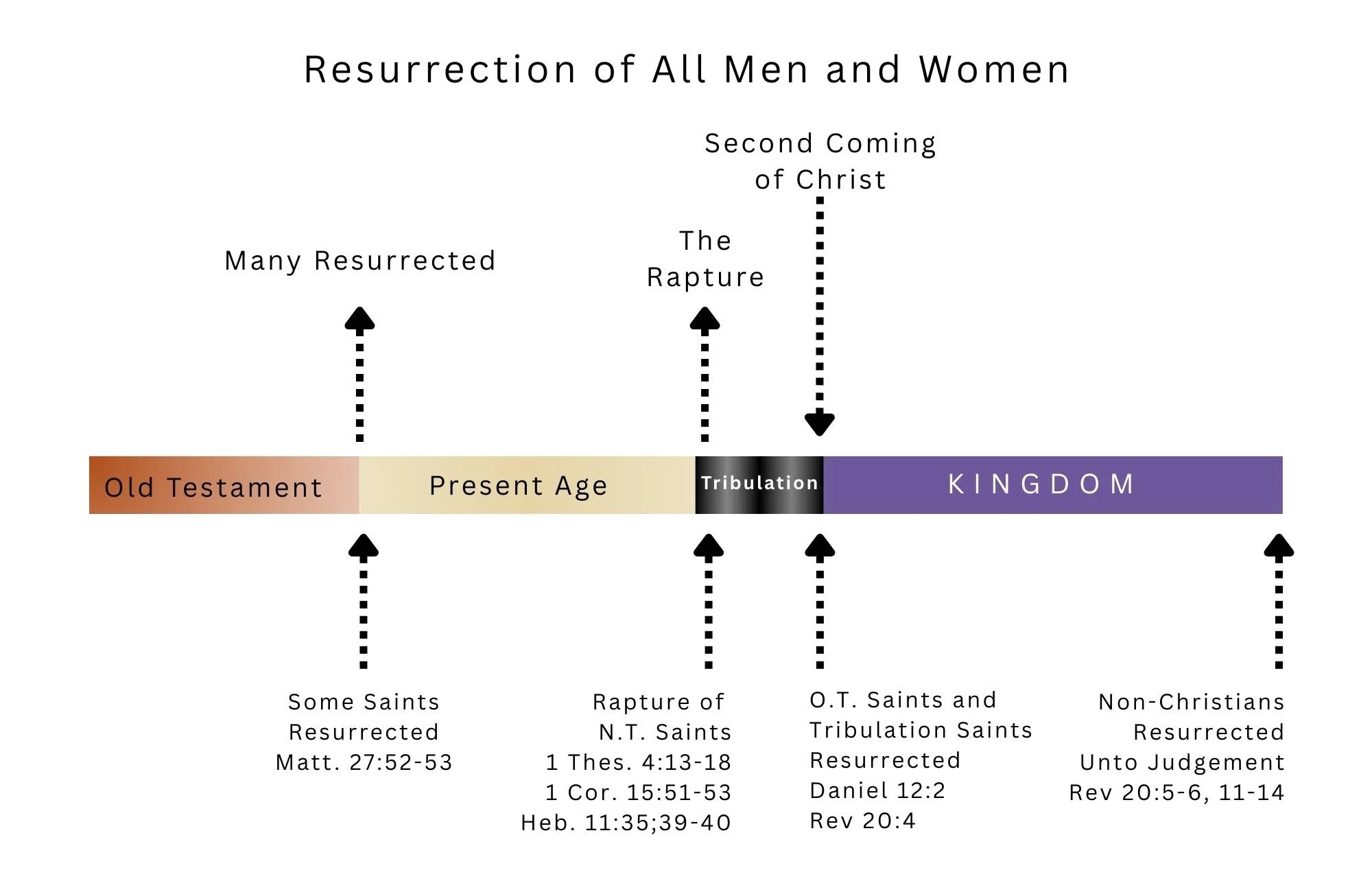
1 Cor. 15:23 speaks of “every man in his own order”. This is a bit confusing. Let’s see if we can grasp the meaning of this statement.
There are different bodily resurrections mentioned in Scripture. This is what Paul is referring to when he speaks of the order of resurrection. The chart below is an excellent resource from a site called, Never Thirsty, and it is for understanding the different resurrections mentioned in the Bible. We won’t go into all of these in this lesson, but this is good information to have because this issue of who gets resurrected when can be very confusing.
22. Read 1 Cor. 15:28-29, Rev. 20:6, and 20:14. What is the last enemy?
There should be a song entitled, The Day Death Died! I think there’s a book by that title, but not a song. There will be that day out there in the future. This is yet another thing to give us abiding hope as a believer.
23. Ephesians 1:22-23 allude to the fact that 1 Cor. 15:29 has already occurred. Is Paul saying 2 different things in these verses?
We have discussed in our studies that there is a verb tense in the Greek language (proleptic aorist) that means something is as good as done even though it hasn’t actually occurred yet. This is what is going on here in Ephesians 1. We are not yet to the end of the millennial reign of Christ, but it is such a certain thing that all enemies will be under His feet, we can go ahead and speak of it as if it were a done deal…..because it is.
Read 1 Cor. 15:29-34. Verse 29 is not an easy verse to understand and there’s a whole bunch of thoughts on it out there. The Mormon church interprets this verse to support the practice of baptizing people on behalf of their dead relatives. This is something called proxy baptism. They believe that this is a valid way to extend salvation to those who died without accepting the gospel (their definition of gospel and our definition is very different). In fact, the Mormon God and the Mormon Jesus are vastly different from Christianity. And for Mormon’s, the act of baptism is akin to salvation. During Paul’s day, this practice was common in pagan religions. I want to remind you of what the word “baptize” means. We studied this a few weeks ago. To baptize is to identify with. So what v. 29 could mean is this:
24. What does it mean if those who identified with Christ died and did not rise at all?
They are not identified with Christ because of death. They are identified with Christ because of life!
25. We for sure know that it doesn’t mean what the Mormon church thinks it means. What does it mean to be put in jeopardy?
If we put our lives in jeopardy every single hour, then we’d better have a good reason for doing so.
26. What does Paul say in Romans 6:3-4 that coordinates with vs. 30-31 above?
I look at what is going on right now in the Middle East and the loss of life over these religious wars seems nuts to me. But we have to remember something, the Muslims who are absolutely convinced that they are right in carrying out jihad against other groups do so because their religious convictions have dictated such. People will willingly die for causes that they are convinced are true and that is especially true when it comes to religion. But all these groups can’t be right. Only one can. And we know which one it is. To die for a worthless cause is to die in vain. None of the believers in Christ who were martyred died in vain. They died to life eternal, but they lived in constant danger.
27. 1 Cor. 15:32, Proverbs 23:35, Luke 12:19, and Isaiah 22:13 all say the same thing. What is that?
This saying comes from Epicurean philosophy. Epicurus was a Greek philosopher. His teaching focused on the pursuit of pleasure with happiness being the ultimate goal. This worldview was very materialistic and it totally denies the existence of a deity who offers eternal life after death. If you were a person who was convinced that the life you’re living right now was all that there was, then you too would want to live every day as if it was your last.
28. What was it that Paul did not want the church at Corinth to be deceived about? If you are taught the wrong thing, will you do the wrong thing?
I cannot help but think of all the little children we have seen in Gaza who are holding guns, or calling out profanities to the Jewish people, or holding signs of hate. They grew up being indoctrinated into this kind of a flawed system of thought and that thought process will eventually lead to their eternal death unless they find Christ. Paul is telling the believers in Corinth that he knows they were indoctrinated into sin, but now, they are being taught the ways of God and if they don’t act out their faith, then it is to their shame.
29. What 2 questions is Paul raising in v. 35?
The immortality of the soul is not the same as a resurrected body. The immorality of the soul means that when the body dies, the soul (the part of us that makes us who we are) continues to live either in heaven or hell without a physical body. The resurrection of the body means that at some point, the soul will join a resurrected body for eternity. Right now, we live in a body that is fashioned for earth. When our earthly bodies are resurrected to join our souls, that body will be fashioned for heaven. I don’t know what that means yet, but I will one day.
30. In 1 Cor. 15:36-38, Paul lays out the principle of death and resurrection in regards to the natural world. What does he compare physical human death to? What happens if you plant an apple seed?
31. Is the tree that results from that seed the same seed as the one you placed in the ground?
It may be similar, but it is not the same seed. Our human bodies are like that. We are buried with one kind of physical body. That body, over time, decomposes. But at the resurrection, all the molecules, the ashes, the particles of our human bodies that were placed in the ground will arise in an incorruptible form to live with Jesus.
32. What do you think Paul means when he says that all flesh is not the same flesh in 1 Cor. 15:39-41?
Why should we value the life of a human more than the life of an animal? (Gen. 1:27) The fact that abortion is so applauded and widespread in our country is something that no doubt grieves the Lord. Every single person is an image bearer. Just last week, I read that the Minnesota House of Representatives had a bill to vote on that would require doctors to administer life-saving treatment to any baby who was born alive after a botched abortion. Do you know that this piece of legislation was defeated? If you ever want to share the love of God with someone, you had better make sure that you are a person who values life.
All flesh is not the same and for those who value the life of an animal, but do not value the life of a human baby, there is a disconnect somewhere.
33. According to 1 Cor. 15:42-43, what is the difference for the Christian in their body on earth and their body in heaven?
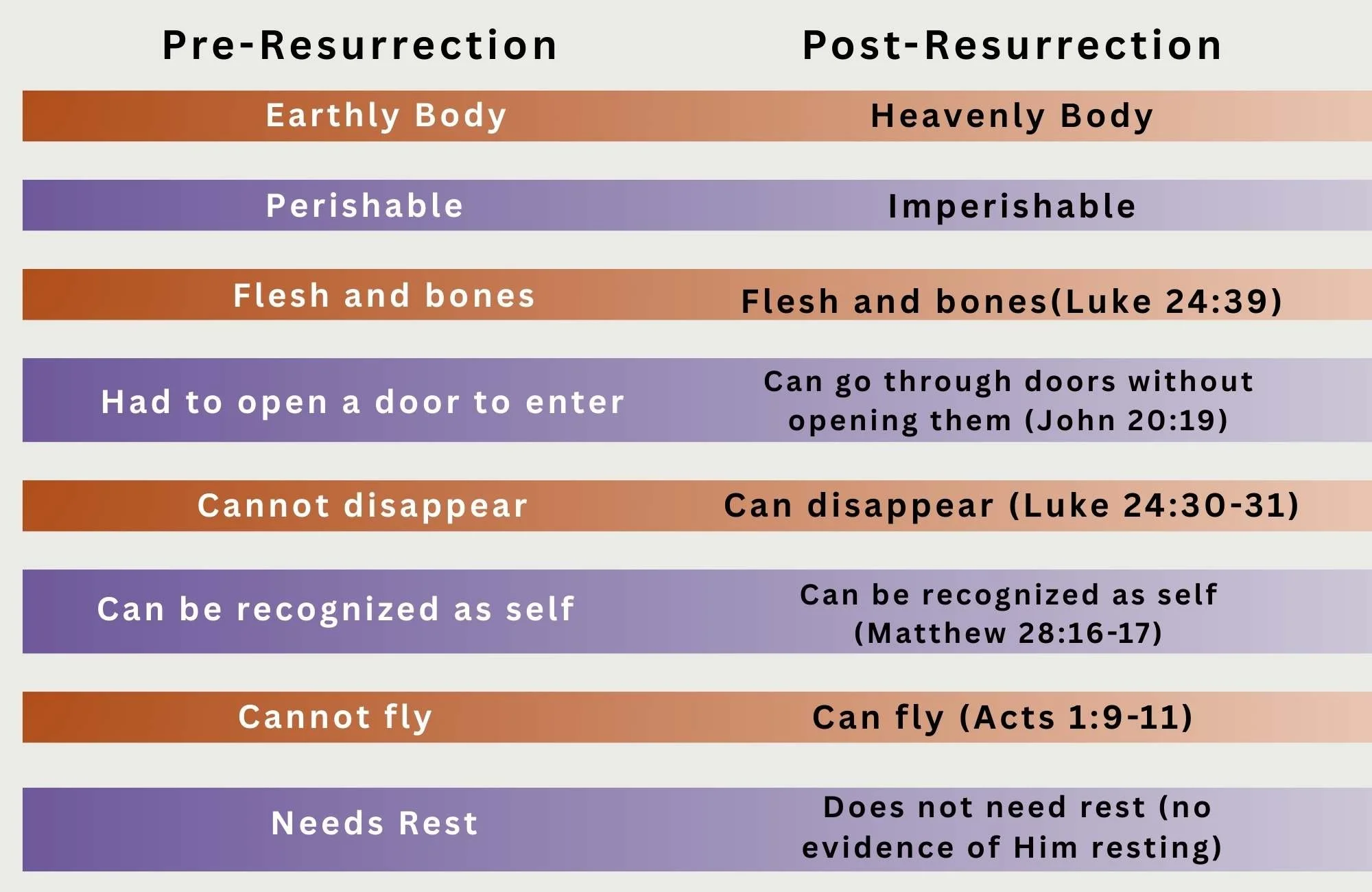
There are those who would say that the bodies we will receive will be spiritual only, basically ghost-like features. But this cannot be if Jesus was the first fruits from the grave and we are the rest. Jesus did not raise from the dead with a ghost-like body. There were similarities and differences in His pre-resurrection body and His post-resurrection body.
In 1 Cor. 15:46-47, the words “earth” and “earthy” literally mean clay. In Daniel 2, we see an outline of the rest of human history with the illustration of a massive statue. The head of gold is the earliest time period that is mentioned as the time of the Gentiles and it began with the Babylonian Empire. By the time we get down to the feet of this statue and the 10 toes, they are a mixed composite of materials.
34. According to Dan. 2:31-33, what were these feet made of?
These 2 materials do not mix, which is part of the message of these verses regarding the end of days on earth. The other thing that is important in these verses is that this 10-nation confederacy will be comprised of both strong and weak nations. In Scripture, clay is often a metaphor for human frailty.
35. Read 1 Cor. 15:48-50. According to these verses, why will no earthly (clay) bodies be in heaven?
After the Church was formed in the 1st century, the very first heresy to enter the Church was the denial of the bodily resurrection. In 1 Cor. 15:51-58, Paul lays out the order of the resurrection of the Church. A mystery as it is used here is something that was hidden in the Old Testament and is now revealed in the New Testament. The word “sleep” is used to denote the death of the body.
36. If we’re not all going to sleep, but we’re all going to be changed, what does this mean?
1 Cor. 15:52-58 are some of the most exciting and hopeful verses in the entire Bible. There will be those who will still be alive not only at the rapture of the Church, but at Jesus' 2nd coming. Those people will not see physical death, but their bodies will be changed. The twinkling of an eye is a term that means when Jesus returns, things will happen so quickly that we won’t even be able to warn those who need to be warned who perhaps do not know Jesus. In fact, we won’t even have the opportunity to say to those who might be near us at that time, “Hey, here He comes! Get ready!” We talked in an earlier lesson about the importance of trumpets in the Old Testament, as a means of rallying people together for some kind of action.
37. But are we talking about actual trumpets in these verses? What do you think it could mean according to Rev. 1:10-13?
There’s gonna be a holy holler from the sky one day! For those who are still left on earth when this happens, they will hear the voice of Jesus like the sound of a trumpet. Oh what a day that will be! In the 1960s and 1970s, bodysuits became popular. It was great to not have to tuck in your shirt or worry about it riding up. For those of us who are alive when Jesus calls us out of this world in the rapture, we’re going to be wearing a different kind of bodysuit, a full, head to toe body suit that will never wear out (incorruptible) and one that is eternal (immortal) and suited for life in heaven, or as v. 49 says, “we shall also bear the image of the heavenly.”
Years ago, I was speaking somewhere and the person who was introducing me accidentally introduced me as Cindy Crawford (the supermodel). When I came to the podium, I was smiling and said that I’m not Cindy Crawford, but when I get to heaven, I wouldn’t mind having a body and face just like hers! People often wonder what their body will look like in heaven and if they died old, would they be old in heaven. And if they were blind, would they be blind in heaven. And if they had their ashes scattered atop a high mountain, would God be able to collect all the molecules and put them back together again.
God can do anything! All I know is that when we get to heaven, others who knew us on earth will recognize us in heaven and our bodies will be totally different from the ones we have right now. It will all be good! Nothing to worry about.
Many times when I’ve done funerals, I have read 1 Cor.15:55-57. There are perhaps no more glorious and hopeful verses in all the Bible! If I was a cheerleader, these verses would be my battle cry!
Because of all the hope of the resurrection that Paul laid out in this chapter, he can say in v. 58, “be steadfast” and hold on!
If I know that relief is going to come, I can hold onto that hope when the misery of life heaps upon me.
Look up! Your redemption draws nigh!
Blessings.
© Cindy D. Ketron. All Rights Reserved