1 Corinthians Lesson 1
First Corinthians
Lesson 1 - Introduction
By Cindy Ketron
On The Edge of Eternity
Scroll below to read the lesson on this device and Download Questions Here
OR
If you prefer to download and print the a PDF of the lesson click here

Welcome to the adventure of 1 and 2 Corinthians! Before we get into our study, we need to look at the culture of the 1st Century Church in Corinth. This church was undoubtedly Paul’s problem child. Corinth was the LasVegas of Asia Minor! It was a licentious environment filled with much debauchery. In fact, there was a word that came to be used for those who fell into the worst type of sexual sin. That word was “corinthianize”. If someone was “corinthianized”, then they had sunk to the deepest pits of evil. Even in the pagan world, Corinth was known for its moral corruption. This is the backdrop from which the Apostle Paul writes about in his letter to the Corinthian Church. He first visited this city during his 2nd missionary journey. Paul probably wrote 3 letters and possibly 4 to this church, but the first one, we do not have. We know this because of 1 Cor. 5:9 where Paul mentions a letter that he had previously written to them regarding sexual immorality. The 2nd letter is what we now know as 1 Corinthians.
Let’s look at some other facts about the ancient city of Corinth:
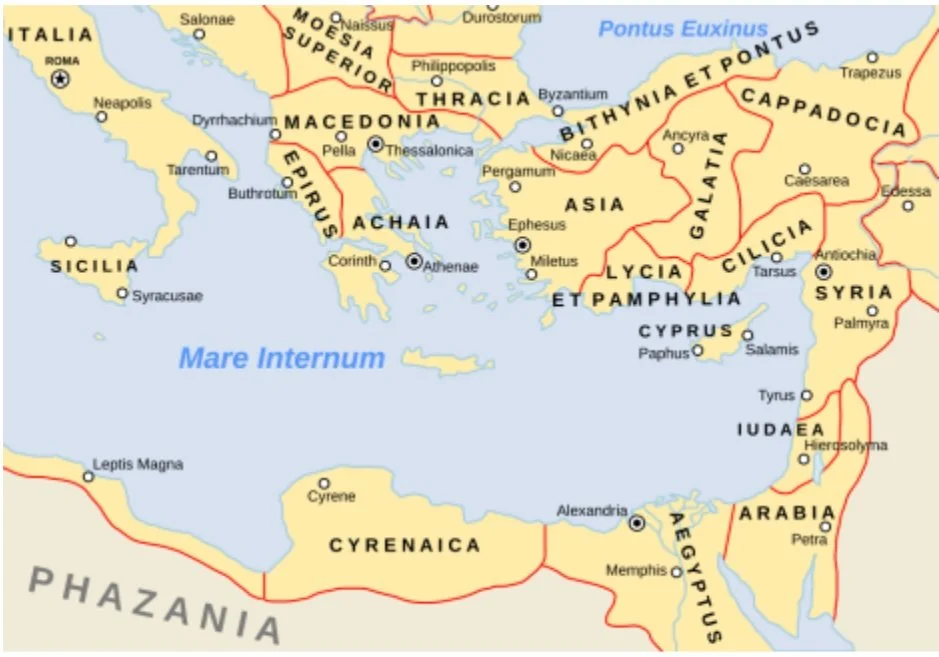
1. Corinth had a strategic location. It was located between mainland Greece and the Peloponnese Peninsula in southern Greece. It was near a land bridge, or isthmus that connects the Aegean Sea with the Ionian Sea and was a seaport that was visited by sailors all over the known world. As a result of its location, Corinth was a commercially prosperous city. This isthmus was only 3 ½ miles wide.
2. Corinth was a hodgepodge of nationalities, Greeks, Romans, Italians, Jews, etc.
3. All kinds of mythical gods were worshipped in Corinth; Posidon, Apollo, Hermes, Athena, and the Egyptian gods, Isis and Serapis.
4. Corinth was founded in the 10th Century BC.
5. By the 7th Century BC, it was known for its vast wealth, its architecture and the Isthmian games. These games were kind of like the Olympics and were a series of athletic and music competitions that were held every other year in honor of the god, Poseidon, the god of the sea. The Isthmian games brought in thousands of people and this alone made the trade of tent-making a profitable trade for Paul. Also interesting to note, Paul never took any money from anyone he ministered to. He paid his own way. He did periodically take up money for other churches though.
6. The location of Corinth made it an easy target as it was accessible from the sea in different directions.
7. Corinth was destroyed by the Romans in 146 BC. It was rebuilt by Julius Caesar in 44 BC, and was then established as a Roman colony and was made the capital of the Roman province of Achaia.
8. The Apostle Paul walked 50 miles from Athens, Greece to Corinth in 51 AD. At the time, Corinth was under Roman rule and had roughly 200,000 inhabitants.
9. It was in Corinth that Paul met Aquila and Pricilla and rounded up a rather rough crew to begin the church at Corinth.Paul stayed in Corinth for 1 ½ years.
10.Corinth had a large temple to the god of healing. People who were sick would travel for miles to come and stay in this temple in hopes of being healed. It also had a large temple to the goddess, Aphrodite or Venus. In it were a thousand priestesses who ministered “sexual” healing to those who came inside.
11. Because of Corinth’s strategic location and because thousands of people visited the city each year, the trade of prostitution became popular.
12.Paul wrote 1 Corinthians from the city of Ephesus between 53-54 AD. He wrote the epistle to the Romans while he was in Corinth.
13.He wrote 2 Corinthians from Macedonia about 1 year after he wrote 1 Corinthians.
This little 3 ½ mile isthmus, because it was so small, offered merchants from one sea to have their cargo transported across the land to the other sea without having to go around the southern part of Greece. If they sailed around southern Greece (Peloponnesian Peninsula) they would have to travel over 200 miles. Big difference! Another problem with going around the southern part of Greece is that the trip was often treacherous and many sailors were too frightened to attempt it. In 1893, a canal was cut through the isthmus to allow for travel from one sea to the other without having to go around the bottom part of the country.
Acts 16-17 is the starting point for our lesson. It is in Acts 16 that Paul’s 2nd missionary journey began. Paul first met young Timothy on this journey and took him under his wing to mentor and disciple. Why didn’t they go to Asia? (Acts 16:6-7)
Instead of going to Asia, they went to Troas. While in Troas, Paul had a vision of a man from Macedonia begging him to come and help them. You might want to mark Macedonia on the map on p. 2. They ended up going to Philippi which is in Macedonia and while there, the very first convert on European soil was saved.
2. According to Acts 16:14-15, who was this convert?
Their next stop was Thessalonica. Locate that on the map. When trouble was stirred up by some wicked men in Thessalonica, the believers there snuck Paul and Silas out and sent them to Berea along with Timothy. Trouble seemed to follow Paul. Trouble will follow you too if you are preaching the truth of God’s Word. 1 Cor. 1:23 spells out why. Write the reason below.
From Berea, the believers there escorted Paul to Athens, Greece. Silas and Timothy later joined him. And from there, he went to Corinth. This is where our story really begins.
The background for 1 Corinthians is found in Acts 18:1-22. Paul stayed in Corinth for a year and a half teaching and training the people there. Go ahead and read these verses.
3. When Paul left Athens and got to Corinth, who did he meet?
4. Why were they in Corinth?
5. Why did he stay with Aquila and Pricilla?
Aquila and Pricilla had been previously kicked out of Rome. Claudius Caesar had kicked all the Jews out of Rome.
6. What did Paul do every Sabbath?
7. In Acts 18:6, why did Paul decide to spread the gospel to the Gentiles instead of the Jews?
Paul went to a house beside the synagogue and a man named Titius Justice lived there. He was a believer. Paul decided to have church in this house. It should also be noted that Crispus, the leader of the synagogue, became a believer along with his whole household while Paul was in Corinth. Keep this name in mind because when we get into 1 Cor. 1 momentarily, this name will resurface again and you will need to have a point of reference for him.
8. What message did God give to Paul while in Corinth?
9. Why did the Jews in Corinth rise up against Paul and what did they try to do to him?
10. Why did the proconsul (governor), Gallio, want nothing to do with prosecuting Paul?
Gallio seems like a pretty smart guy. Remember that Crispus was the leader of the synagogue to begin with, but he got saved. After Crispus was gone, a fella by the name of Sosthenes became the leader of the synagogue.
11. In Acts 18:18, why did Paul get a haircut?
There are lots of seemingly insignificant tidbits in Scripture, but we must know that anything that is there is significant or else it wouldn’t be there. Have you ever watched a show or a movie and a totally unrelated piece of the story is introduced? For really good writers, they manage to work these bits of information into the overall plot of the story. But for writers who are not quite so skilled, the information that might seem to be insignificant really is insignificant because it is not connected to the story at all. It’s just “filler” material. There is no filler material in Scripture. If it's there, it is supposed to be there and we, as the reader, need to discover why it is there.
In Scripture, there is only 1 reason to take a vow to not get a haircut and that is if someone took the voluntary Nazarite vow.
The Nazarite vow involved 3 things:
1. No consumption of alcohol.
2. No cutting of the hair.
3. No contact with the dead.
The reason for any Jew to take the Nazarite vow was to live a life consecrated to God. A person could take this vow for a period of time or for life. Paul apparently took it for only a short time while he was in Corinth. There were only 3 people in the Bible who we know of who took the Nazarite vow for life:
1. Samson
2. Samuel
3. John the Baptist
It makes sense that Paul would take this vow because he was living in such a paganized area of the world. This was his way of staying close to God and being an example to those around him. Have you ever been in a place or worked in a place that was so anti-God that you feared for yourself in regards to being influenced by such behavior? I have worked in such situations and because I was in these situations for a period of time, my natural inclination as a believer was to draw even closer to God so as to protect my own spiritual well being. I have a feeling that Paul felt the same way.
12. Look back a few pages. From Corinth, where did Paul go?
Paul was in Ephesus when he wrote 1 Corinthians. He was there for 3 years. After he left Ephesus, he went to Caesarea, Philippi and then to Antioch in Syria. This ended his 2nd missionary journey and began his 3rd.
Now, we’re going to jump right into the 1 Cor. 1. Go ahead and read the entire chapter.
13. In v. 1, who did we read about in Acts 18 who is now apparently a Christian?
Paul opens this first chapter with his traditional manner of greeting. When we send a letter to someone, we generally write, “Dear ………………”. In English class, this is called the salutation of the letter. When we get to the end of the letter (or the complimentary close), we close with our name. It was different in Paul’s letters. His letters generally contained the following in this order:
● His identity as the author of the letter at the beginning of the letter
● Who the letter is addressed to
● His credentials as an apostle with apostolic authority
● Anyone else who is with him in his current ministry
● A greeting to the recipient or church
● Grace and peace from God our Father and the Lord Jesus Christ
● Paul’s affection for them
● Paul’s concern for them or reason for the letter
● Paul’s hope for them
14.Look back over the first 9 verses and identify how he communicated the above information:
In Acts 18, we see 1 leader of the synagogue, Crispus, who became a Christian. Therefore, he could no longer be the leader of the synagogue.
15. Who was Sosthenes and what was his job after Crispus was no longer allowed to be the leader of the synagogue?
16. In 1 Cor. 1:1, what can we infer about Sosthenes?
Therefore, Sosthenes is no longer in Corinth. He is in Ephesus with Paul and is being trained by Paul.
After Paul gets through his greeting, he always jumps right into the issue at hand or the reason he is writing the letter.
17.According to v. 10, what is the reason for this letter?
18. How did he know about these problems? (v. 11)
19. Was Chloe gossiping? Was she stirring up strife within the Corinthian church by getting this information to Paul?
If Chloe had been gossiping, then Paul would have rebuked her. He didn’t seem to have an issue with rebuking others. Gossip in Scripture is referred to as tale-bearing. If a person spreads negative or private information about someone else behind his/her back, with the intent of harming that person’s reputation, then that is considered harmful and sinful. In Jewish tradition, there is a word for this, lashon hara which literally means “evil tongue”. Because Chloe was a leader in this church, she cared about the people and their relationship with God. She encountered a problem and she sought help and wisdom from someone who had more experience in ministry than she did. Paul then used this information as the primary focus of this book as he addressed the issues he learned about.
I will just tell you as a woman, I don’t know any female, including myself, who hasn’t gossiped at some point or other. Women are much more prone to this than men are. It is a part of our sinful nature. When we read about Chloe getting this information to Paul, it might look as if she is bearing tales. However, upon closer examination, she is simply taking care of the flock she’s in.
20. What seemed to be the initial problem in the Corinthian church in regard to the divisions?
21. So Chloe had communicated to him that there were some major issues within the church. Read 1 Cor. 5:9-13. What does Paul say he wrote to them about at an earlier time?
22. Read 1 Cor. 7:1. What did the Corinthian church write to Paul about?
This can all get very confusing! Therefore, let’s make a timeline of events:
1. Paul goes to Corinth and stays 1 ½ years.
2. When he leaves Corinth, he then goes to Ephesus for 3 years. While in Ephesus, Paul sends a letter to the Corinthian church (1 Cor. 5:9) and the Corinthian church sends a letter back to Paul to ask him some questions. We do not have Paul’s first letter to them, nor do we have the letter that they wrote back to him.
3. Chloe sends a letter to Paul describing the divisions in the church. 4. Chloe’s letter plus the letter the church wrote earlier to Paul asking for guidance in certain areas is the content of 1 Corinthians.
We need to keep this timeline tucked in the back of our mind so that the things we read in this book can be kept in their proper context. The Corinthian church was not unlike our modern churches. They had all kinds of problems. Because we are all flawed humans, there will always be some issues in our churches, even the best of them.
The problems were:
1. Disunity
2. Marriage and Divorce
3. Immorality
4. Abuse of Spiritual Gifts
5. Doctrine
The theme of 1 Corinthians is Addressing Problems within the Church. Paul refers to himself in v. 1 as an apostle. Apostle means literally, a sent out one on a mission. The 12 apostles in the Bible were all commissioned by Jesus Christ when He was on earth. One of those apostles, Judas, betrayed Christ. He was replaced with Matthias. I’m not sure that this was the express will of God, but God did allow this. There is nowhere that we read that the will of God was sought when Matthias was selected. The apostles cast lots to choose him. Paul was not commissioned by Christ when He was on earth. Paul was commissioned post-ascension when he met Christ on the road to Damascus.
23. In v. 2, how does Paul refer to the members of the church at Corinth?
The Roman Catholic Church has literally destroyed the concept of saint for many people.
A saint in the Catholic Church:
1. Has to be dead for at least 5 years.
2. There has to be proof that the person showed some kind of heroic virtue or was martyred.
3. The person must be responsible for at least 1 miracle after death. That miracle could be: resurrecting someone who is dead, curing someone of an incurable illness, or curing an illness that takes place instantly. Not sure how they attribute any of these things to a dead individual.
4. The pope must issue a formal decree to canonize the person and grant them the title of Saint.
If this all seems a little bit insane, it is. How could a miraculous healing be attributed to a dead man or woman? The Catholic Church also believes that saints whose bodies have not decayed after death have been preserved through divine intervention. They call these saints, incorruptible saints. The only way they can determine this is to exhume the person’s body and inspect it. When this happens, the incorruptible saint is generally placed in a glass case for others to see.
The individual on the following page is Therese of Lisieux, a French nun who died in 1897. Looks like she died yesterday! Yes, there is a creepy effect to this, but those incorruptible saints are all over Europe and are preserved in glass coffins and on display for all to see. No thank you!
This is not the kind of saint that the Apostle Paul was speaking of. This is not what the New Testament teaches.
24.The New Testament tells us that if we know Jesus Christ as our personal Savior, then we are already saints. In vs. 7-8, what are these saints waiting for?
Isn’t this what we’re waiting for as well? Sometimes life gets so hectic and overwhelming that we forget that we’re waiting for Jesus to come back and get us. The knowledge of that wait gives us hope. The 1st Century church had that hope. They were looking for Jesus to return during their lifetime, but He didn’t. My grandparents were waiting for Jesus to return during their lifetime, but He didn’t. We are waiting for Him to return during our lifetime. He may or may not return during our lifetime, but that does not mean that we abandon the anticipation. Always anticipate! Always hope! He will return!
25. In v. 8, how will we as saints be confirmed to Jesus?
There are certain things that as believers we are declared to be even though we’re still living in these frail and sinful human bodies. Blameless is just one of those things.
The great thing about the Reformation was that the doctrine of justification by faith was fleshed out for all. There weren’t a lot of people who owned their own copy of Holy Scripture in those days. For the most part, it was only the theologians who had access to Scripture. Therefore the average Christian not only didn’t have a personal copy of the Bible, they were reliant on the reading and interpretation of it by their priests and learned theologians.
Justification in a nutshell means that a person who is unjust is declared just. Therefore, an unrighteous human being can receive the righteousness of Christ through imputation. To impute something means that there is a process by which 1 individual is declared innocent because of the virtue of another person. We are declared just before God because of the righteousness of Christ.
Paul will later thoroughly flesh this concept out in the book of Romans.
Therefore, at our conversion, God declares us as just and as righteous and one day in heaven, Christ will present us as such. Oh what a day that will be!
26. What does Romans 5:1 say that we get from this justification on this side of heaven?
We can’t put a price tag on peace. So many people suffer mental/emotional difficulties because they lack peace in their lives. And many believers lack peace, not because God doesn’t offer it to them, but because they won’t take it. Remember when we studied the book of Joshua? One of the things we talked about was that the land of Canaan had already been given to the children of Israel. They just needed to take the land. In the same way, peace has already been given to me and you. We just need to lay hold of it.
The church in Corinth had become splintered. Some believed in certain ideology/theology from 1 teacher and another from another teacher and still another from another teacher. Paul wanted them to know that believers are to have unity in the Spirit of God. That does not mean that everyone was commanded to believe the same thing, although that would be nice. That means that in the things that are essential, they must be unified. In the things that are non-essential, they can agree to disagree.
There are numerous Christian denominations and they can’t all be right. After all, truth is an exclusive term. There can only be 1 truth. So, why is there so much disagreement about what Scripture teaches? There’s a lot of possible answers to this and it is important to note that the very first groups of believers after Christ ascended to heaven had disagreements. Therefore, over 2000 years later, we’re going to have a multitude more.
Here are some of my thoughts about why these differences exist.
1. The Bible is a very complex book.
2. People often do not take the entirety of Scripture into account when coming up with a doctrinal stance.
3. The Bible might appear to contradict itself in certain places. It does not, but this is an explanation as to why some disagree on what different passages mean. 4. Many people do not know what they believe and they do not know enough about the Bible to make a case for anything.
5. Too many people have embedded theology. That is a theology that you picked up perhaps because you were in a certain denomination and you never actually studied whether it was true or not, you simply accepted that it was.
The following quote is attributed to St. Augustine, but it is not for certain that he is the one who said it: “In essentials, unity; in non-essentials, liberty; and in all things, charity.”
One thing is for sure, when we all get to heaven, we will ALL believe in perfect unity. The understanding of our minds will be exactly what the Father wants us to know. There will be no disagreements, no agreeing to disagree on non-essentials, and we will not be divided between denominations.
27.Read 1 Cor. 1:18-31. What do you learn about the wisdom of God and the foolishness of man in these verses?
God sovereignly established that He would not be known by human wisdom. The cross of Jesus Christ is the boundary line between the saved and the unsaved. Read Luke 12:51-53.
28.What does Jesus say about division in these verses?
At first glance, this may seem to be contradictory to what we just read in 1 Corinthians. However, we must also keep in mind that Jesus also said, “Whoever is not for Me is against Me.” Sometimes in family squabbles, I hear people say, “I don’t want to choose sides.” In regards to the Gospel, we have to choose sides because the 2 sides are polar opposites. What we can’t do is to sit on the fence. There is no in-between state. You are either a slave to Christ or a slave to Satan. You can’t be a slave to both.
So, while the cross of Christ divides believers from the unbelieving world, it does not divide Christian from Christian. In 1 Cor. 1:22-23, there are 3 groups and the requirement/s for each group.
29. What are they?
1.
2.
3.
30. What does Jesus have to say about signs in Matthew 12:38-40?
The Jews and the Greeks both had their issues. The Jews were absorbed in the search for signs. The Greeks (or Gentiles) were absorbed in their own brilliant thoughts. The entire Greek world was so impressed with itself. There were all of these Greek philosophers; Socrates, Plato, and Aristotle, just to name a few, who were thought to be godlike in their knowledge and wisdom. One of the many lines from one of my favorite movies, The Princess Bride, comes to mind here. The scene opens with a game of Russian Roulette, but instead of a gun, there are 2 glasses of wine and one is tainted with poison.
Vizzini: “I can’t compete with you physically, and you’re no match for my brain.” Wesley: “You’re that smart?”
Vizzini: “Let me put it this way. Have you ever heard of Plato, Aristotle, Socrates?” Wesley: “Yes.”
Vizzini: “Morons.”
Vizzini then falls over dead having drank the tainted wine. He obviously wasn’t as smart as he thought he was. I don’t think I’ve ever noticed more people who are impressed with their own intelligence as I see in today’s culture. And yet, the most intelligent of them are fools when placed beside the wisdom of God.
31. Do you think the Jews would have accepted a Messiah who rode in conquering the world on a white horse?
That was actually what they were looking for, hoping for, praying for. So when He came onto the world scene, born to poor parents in a stable, and ended up dying on a Roman cross, this was the opposite of the picture they had in their minds. Their embedded theology that they’d heard all of their lives and that was passed down from generation to generation was that the Messiah would come to earth as a great conqueror. The Savior that we know and love seemed like a foolish notion to the Jews who had been looking for a military conqueror and the Greeks who made themselves out to be their own gods. We know that one day, Jesus will return as a great conqueror and judge, but His first coming was not for that reason. His first coming was to die for our sins so that we could obtain salvation.
32.How do the following verses explain this?
Romans 9:33
1 Peter 2:7-8
33. What does 1 Cor. 1:30 say Christ Jesus becomes for us?
Wisdom - the ability to discern or judge what is true, right, or lasting. Knowledge, on the other hand, is the acquisition of information.
34. Can a person be wise and not knowledgeable? Can a person be knowledgeable and not wise?
I love what one theologian said, “Knowledge is knowing how to use a gun; wisdom is knowing when to use it and when to keep it holstered.”
Righteousness - the Bible’s standard of what is human righteousness is measured against the perfection of God.
35. How does 2 Cor. 5:21 explain the process of righteousness for us as believers?
Sanctification - this word is related to the word “saint” and has everything to do with holiness. Something that is sanctified is set apart for holiness.
36. What does Jesus say about sanctification in John 17:16-19?
Redemption - means to buy out. Because we are all born guilty, we need to be redeemed. Related to this word is the word ransom. Jesus paid the price for our ransom so that we could be set free. I love what Rev. 5:9 says about what Jesus did for us.
37. How do you explain this?
Friends, the people who consider themselves wise apart from God are foolish indeed. It does not matter how many degrees we have. It does not matter how much money we have. It does not matter if tons of people admire us. The only thing that matters is that we are rich with what the Lord has given to us; true wisdom, the righteousness of Christ, the holiness of Christ, and that He paid the ransom for our weary souls. If we want to glory in anything, let us brag about Him and what He has given to us and what He offers to everyone else.
When I glorify God, I give an accurate estimate of who God is in me as a believer. May each of us live our lives with this in mind. For to live our lives and cause others to have a poor view of God is to miss our calling.
Do others see Jesus in you? They should…..
We will end this week to the lyrics of the old hymn, Let Others See Jesus in You by B. B. McKinney:
While passing through this world of sin,
And others your life shall view,
Be clean and pure without, within,
Let others see Jesus in you.
(Chorus)
Let others see Jesus in you,
Let others see Jesus in you;
Keep telling the story, be faithful and true,
Let others see Jesus in you.
Your life’s a book before their eyes,
They’re reading it through and through;
Say, does it point them to the skies,
Do others see Jesus in you?
(Chorus)
What joy ‘twill be at set of sun,
In mansions beyond the blue,
To find some souls that you have won;
Let others see Jesus in you.
(Chorus)
Then live for Christ both day and night,
Be faithful, be brave, and true,
And lead the lost to life and light;
Let others see Jesus in you.
(Chorus)
The Apostle Paul lived his life for this very reason, so that others would see Jesus in him. And 2000+ years later, we still see Jesus in his life as we read the words of holy Scripture.
Blessings…..
© Cindy D. Ketron. All Rights Reserved